All posts by daf

Makos 23a-b Shiur 9/17/15

Makos 23a-b

1- We spoke about the case of the fellow that ran away after being tied to the whipping post , then recaptured. The Beis Din must set him free because we consider his embarrassment of escaping enough of a punishment. (Nowadays escapees receive hero status…..)

Quoted the Hagahos Mai’munis  about the fellow who was sentenced to receive lashes (not D’oiraisa) and the Beis Din-appointed lasher never showed up! So the Beis Din commuted his sentence.

2- Interesting Vort about Moshe Rabeinu running away from the snake. Rashi says that since he spoke ‘lashon hara’ he was liable to receive Malkus. In order to be relieved of this potential punishment he ‘ran away’.

3- We spoke about the Sereidei Aish and his remarks that the Soloveitchik family’s hero worship and adulation of their family greats is similar to that of the adulation of Chabadniks and Breslov…….

4- Our Gemara mentions the expression “Chasei’re Mado”. Meaning people with ‘weak intelligence’ – chosen to administer the Malkus.

We mentioned that the Alter Rebbe uses this expression in Tanya.

See here for a humorous misprint.

5- The Mishna explaining for a  sin that also carries ‘Kareis’ and Malkus once the Malkus are given they are absolved of the Kareis.

Fundamental machlokes of the Rambam versus many others if the Malkus receiver needs to be repentant in order to receive a ‘kapara’ for the Koreis.

We spoke about how this fits with the Gemara in Yuma and Igeres Ha’Teshuva. 

If one commits a sin [punishable by] excision or execution, repentance and Yom Kippur are tentative, so that the individual is not punished, and sufferings scour [i.e., they complete the atonement.]

6- The ‘Shana Tova card” sent by Dovid Hamelech to Naval. “Va’amartem Ko Lechai”.

A Gemar Chasima Tova.


Makos 22b- 23a Shiur 09/01/2015

Makos 22b- 23a

1- Our Mishna states that if the Shliach Beis Din administering the malkus errs and gives one extra (more than the evaluation) and causes the death of the defendant he is ‘patur’ but needs to go to ‘galus’.

Rivan-designstyle-love-heart-m
The Rivan (Rashi’s son-in-law) introduces the classic question of ’10 people who strike a man and the victim dies, all are exempt including the last one that hit (the 10th)’.

So why in our case is the Shliach obligated to go to Golus?

2- The Gemara talks about ‘Loshon Hora’. We discussed the various opinions if it applies to gossiping something that is actually true.
The Gemara adds that one who talks Loshon Hora ‘deserves to be thrown to the dogs’.


We mentioned that the Ariza”l says that the reason the Gemara chooses the term ‘dogs’ is because one that talks Loshon Hora is reincarnated into a dog.


dog reincarnated as a tree

3- We discussed the difference between the good deeds of the dogs that didn’t bark by Yetzias Mitzraim as opposed the the frogs that went on Mesiras Nefesh by jumping into the ovens (by ‘makas Tze’fardeah).

ok, everybody in!

Why were the dogs rewarded for posterity (all treifa meat is given to them) and not the frogs?

A-It’s harder to keep your mouth closed than jumping into a fire……


B- frogs have no relationship with the original brave frogs two millenniums ago. One the other hand mother in law miss‘alle hint fun alle doros zeinen kroivim un mechutonim’.
All barking dogs have a commonality and thus are related……

4- We spoke about the two Misnagdishe camps that don’t exactly get along. Chazon Ish versus the Brisker.
One is very stringent on the topic of Shiurim (ke’zayis) the other is even more machmir.

ocd1
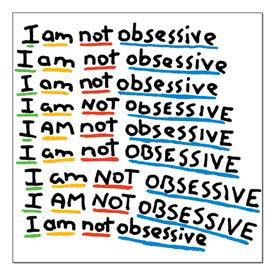
The first group claims that the second suffers from OCD……

Makos 22b. Shiur 08/25/15

Makos 22b.

  1. 1- We are in the middle of discussing the concept of the ‘evaluation’ process needed to ascertain how many Malkus one can physically absorb.

    We discussed the Halacha that if he cannot take all 39 Malkus we give him less, as long as the number can be divided by 3.

    Say one is evaluated that he can only receive 18 lashes. An interesting argument is whether:

    a) – in reality he should have received the full 39. It is just that the balance is not administered because of Pikuach Nefesh.

    b) – or, the 18 he receives is his punishment. He never received a verdict of more than 18.

    2- The concept of shlichus is well know. When appointing a proxy in Halacha, all actions performed by this proxy (shliach/POA) is considered as if the one who appointed him had performed this action(s).

    So if Yoily sends Mechel to purchase something for him the transaction is 100% valid as if Yoily was present and performed the act himself.

    The exception to this ‘Shlichus rule’ is if the action was illegal. In such cases the shliach is the only one liable for the consequences. So if Yoily sends Mechel to ignite a fire on Shabbos  (C”V) it is Mechel who is liable.

  1. In our Gemara we have the case of a shliach Beis Din that gives one extra lash and that single blow causes the poor defendant to die….. So our Mishna states that the shliach Beis Din is required to run to Golus.

    How could such a thing happen? The Gemara (B”K 32b) says that the Dayan erred in his counting!

  1. But isn’t the administrator of the lashes just a shliach? So the Dayan should go to Golus.

    We discussed this perplexing question at length. Does the rule of  ‘Ein Shliach Lidvar Aveira’ also apply to when it is (like our case) a ‘Shogeg’. We mentioned the opinion of the Ketzos and the Nesivos.

    3- We concluded with a long story.

  1. Here are some points:

    a- The dialogue between Reb Eizal Chorif – R, Yehoshua Yitzchok Scahpiro and Reb Chaim Soloveitchik about taking a noted Posek to a Din Torah…..

    b- The Noda Biyehuda’s  ruling on the following:

    Someone appointed a shalich to divorce his wife.The shliach did indeed hand over  the get to the wife ….the only issue was that she didn’t want to receive the get! 

  2. Now we know that Rebeinu Gershom prohibited the giving of a get against the wishes of the wife.

    So R’ Yechezkel Landau (the Noda B’yehuda) ruled that since forcibly giving a get is prohibited,  ‘Ein Shliach Lidvar Aveira’ – the shliach by his prohibited act severed his relationship with the husband and is no longer a shliach and therefore invalidating the get!

    This ruling caused a storm in the Rabbinic world.

    c- The Rav of Constantinople, Reb Yizchok Dovid Bechar,  weighs in on this dispute. He writes to the NB agreeing with him. The NB is floored by Reb Yitzchok’s greatness.

    d- Reb Yitchok’s book arrives in Europe. Here is the part mentioned in our story.

Makos, 22a-b Shiur 08/10/15

Makos, 22a-b

1- Our Mishna discusses the verses:  “If the guilty one has incurred [the penalty of] lashes, then the judge shall…. flog him in front of him, commensurate with his crime, in number.

With forty [lashes] he shall flog him; he shall not exceed, lest he give him a much more severe flogging than these [forty lashes], and your brother will be degraded before your eyes.”

The Mishna says that the order of the words “In Number – Forty mean to imply that only 39 Malkus are given.

2- We spoke about the opinion of most of the Rishonim that the number 39 is Min HaTorah as opposed to the Rambam who says that it is a “Seyag’ enacted by the Chachomim in to ensure that one does not go over the 40.

Here is the Rambam – Sanhedrin 17, 1.

How are lashes administered to a person liable to receive them? According to his strength, as indicated by [Deuteronomy 25:2] “According to his wickedness by number.” The number 40 stated in the following verse is mentioned to teach that more than 40 lashes are never administered even if the person is as healthy and as strong as Samson. When, by contrast, a person is weak, the amount of lashes is reduced. For if a weak person is given many lashes, he will certainly die. Therefore our Sages said: that even a very healthy person is given only 39 lashes. For if accidentally an extra blow is administered, he will still not have been given more than the 40 which he was required to receive.

We mentioned the Chinuch who is unable to explain the Rambam’s opinion.

We read the text of the Kesef Mishna who explains the Rambam’s words based upon the concept that the Rambam designates all Halachos that are derived from the 13 principles (Shlosh Esrei Midos) and Halacha L’Moshe Misinai as “divrei Sofrim”.

The classic example is Kidushin- engagement to a woman using money or a ring. In our printed edition of the Rambam he states that Kidushei Kesef is “divrei Sofrim!”.

But that is semi problematic since some manuscripts of the actual Rambam seem to imply that the Rambam changed his mind and subsequently amended  it to say that all the above are considered Divrei Torah.

Here is quote from a fine article on the topic. Page 165.

It must be noted here that there are manuscripts of Mishna Torah containing variations in the text of the two Halakhot mentioned above.  In these texts, Rambam says the exact opposite, namely that all three of the methods of kidushin are “din torah” – Biblical. According to R’ Avraham ben HaRambam and R’ Moshe HaKohen of Lunil, although initially Rambam held that kiddushei kessef is Rabbinic, he subsequently changed his position and amended the text of Mishna Torah to say that they are all Biblical. The earlier manuscripts of Mishna Torah which had already been in circulation at that point were never changed, and these were later used as the source for the printed editions. 

3- We discussed the concept if the Torah rounds off numbers.

See here.

For example:When the Torah lists the number of people in each of the 12 tribes  we find mostly a multiple of either 50 or 100. There are differing views regarding whether or not these numbers are exact.

4- We quoted the Rosh in Pesachim that makes note of three instances that one must say that the number mentioned in the Torah means “up to that number“.

1- Sefira- It says “Count 50 days”. When in in reality we only count 49 since it also says “count seven weeks” which equals 49! So it implies that “Count 50 days” means “up to that number“.

2- When enumerating the count of Ya’akov’s family that descended to Mitzraim the Torah itemizes 69 and then summarizes them as “a total of 70”! So here again it implies that the 70 means “up to that number“.

[commentaries make note of the Gemora and Midrash that Yocheved was born “at the gate” thus reconciling both numbers]

3- Malkus- We know from Halocha L’Moshe Misinai that the number is 39.

Thus the number 40 mention in the Torah means “up to that number“.


Makos 22a. Shiur 08/11/2015

Makos. 22a.

1- In continuation to the case of the Mishna, of one doing one act and simultaneously transgressing eight ‘Lavin’,

  1. A Kohen
  2. who is a Nazir
  3. plowing over Tum’as Meis,
  4. with a Hekdesh ox
  5. and donkey where
  6. Kil’ayim was planted in a vineyard, in
  7. Shemitah,
  8. on Yom Tov

Our Gemara suggests that perhaps we can add some more ‘Lavin’:

What if this fellow was plowing on the spot that an ‘Eglah Arufa’ was beheaded? The Torah prohibits one to plow or plant there.


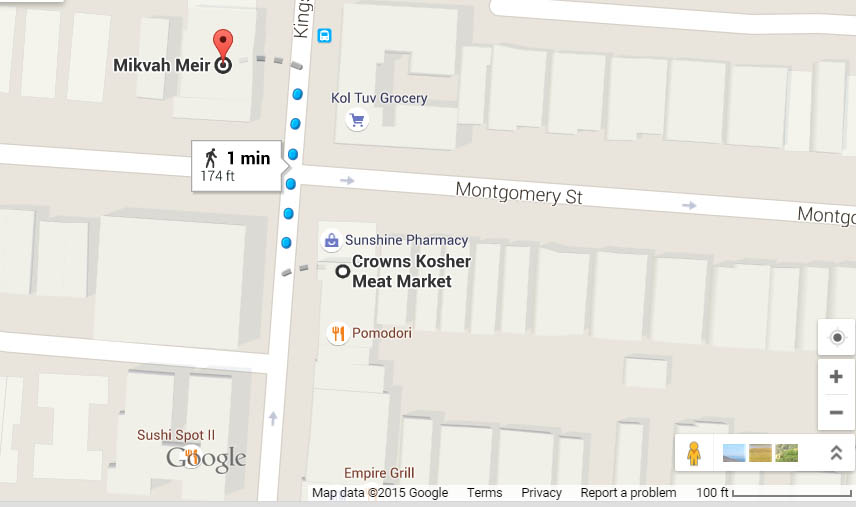
We discussed the question of Reb Shimon of Kinon (here) (directions) in his rare to find book ‘Sefer Hakrisus’, as to why one is allowed to plow anywhere in Eretz Isroel if perhaps that is a spot that the Mitzvah of Eglah Arufa was performed?

ספר כריתות - שמשון בן יצחק, מקינון

We cannot answer that we follow the ‘rov’ – meaning that the majority of fields did not have an Eglah Arufa….because the rule of ‘Kovua‘ (Halacha 11) should apply! (Zevachim 73a, top)

[He also ask there why we don’t all read the Megillah on the 14th and the 15th day of Adar since there is a remote chance that the city we’re in once had a wall around it!]

We mentioned the opinion of the Rambam that “Nachal Ei’son” where the Eglah Arufa was beheaded was in or at the banks of a strong flowing river.

וְהוֹרִדוּ זִקְנֵי הָעִיר הַהִוא אֶת הָעֶגְלָה אֶל נַחַל אֵיתָן אֲשֶׁר לֹא יֵעָבֵד בּוֹ וְלֹא יִזָּרֵעַ וְעָרְפוּ שָׁם

אֶת הָעֶגְלָה בַּנָּחַל:

Parenthetically- this Reb Shimshon, despite being a great scholar and Kabbalist is the one who famously said:  “when I pray, I pray just like a child“.

Meaning that even if one is well versed in the order of the Sefiros etc. when praying one should think of G-D himself.

See here as he is quoted by the Tzemach Tzedek in ‘Shoresh Mitzvas Ha’Tefila’ Chater 8.

2- The Gemara suggest another scenario: a fellow who swears not to plow and goes ahead and plows, thereby transgressing another Lav.

The Gemara says that since such vows can be nullified, much as all donations etc. can be nullified, and thus it does not fit with the eight Lavin mentioned in the Mishna.

We discussed the humorous story of the Ropshitzer Rebbe who gave advice to one of his Chassidim that didn’t want his wife around….Here is the story with slight variations. (Page 3)

3- How about the Nazir? Can that indeed be nullified?

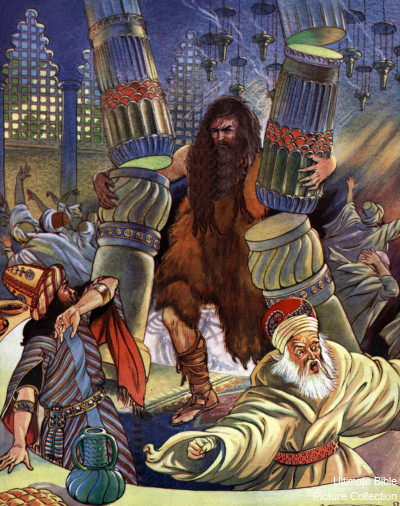
The Gemara states that the case of the Mishna where this fellow was plowing in a cemetery was a Kohen and Nazir. This Nazir, the Gemara adds, was a “Shimshon-type Nazir”.

Meaning that he was a ‘lifetime Nazir’; thus no nullification would be permitted.

In 1965, the Rebbe, upon concluding the 11 months of saying Kaddish for his mother, Rebbetzin Chana (who passed away on Vov Tishrei 5725) made a Siyum on Meseches Nazir. [The Rebbe spoke on the 5th of Menachem Av as that year was a leap year].

The Messechta ends with a discussion on the status of Shmuel Hanavi, whose mother ‘Rebbetzen’ Chanah vowed that if she were to have a son she would “never cut his hair”, so was he, Shmuel, a Nazir like Shimshon? Etc.

We mentioned the idea of the Rebbe on this topic:

Briefly – how can a mother commit her unborn son to be a Nazir? Ditto with Shimshon whose entire Nazir status came from what his parents heard from an angle that appeared to them advising them that their soon to be born son shall be a Nazir?  [Albeit not a 100% Nazir].

The Rebbe suggest that both Shimshon and Shmuel’s Nazir status came about in two stages. Prior to becoming Bar Mitzvah they “acted’ like a Nazir. Both their parents’ commitment (only) obligated them to act like a Nazir.

But it did not take effect until after their Bar Mitzvah when they accepted their Nazir status on their own.

Now here is the clincher – once they accepted it at the age of 13 it retroactively gave them the status of being a Nazir from birth due to their parent’s commitment- which is considered a valid beginning!

As an example the Rebbe bring a case of a child convert who must go thru two acts: circumcision and mikvah.

Now a child Ger when turning Bar or Bas Mitzvah then needs to recommit. He can also renounce it and is considered not Jewish!

Once he commits he is considered a Yid from the time of his Bris and the Tevilah preformed as a child suffices and he does not need to go to the Mikvah again.

The problem is that how is that pre-Bar Mitzvah Mikvah act valid? The fact that one has the option to renounce his Geirus and reverts back to being a Goy  means that all his acts prior to his commitment at his Bar mitzvah are worthless and therefore should not be valid at all?

Rebbe uses this as proof says that a commitment prior to the real event taking place is sufficient to be considered a valid beginning.

Similarly, every adult Ger needs to go thru Milah and Tevila.  What is his status between these two acts?

-The Rebbe quotes the Ramban that says that the Torah intentionally allows for a time period between the two so that he, the potential convert, can change his mind!

[One can assume that after the trauma of one’s adult Bris there is ‘a lot’ to think about….]


directions

So this Ger is in limbo until he goes to the Mikvah. But once he does, he is retroactively a Ger from the circumcision.

So this brings us back to the process of the Nazir status of Shimshon and Shmuel:

Their parents’ commitment on their behalf, their acting as a Nazir until their Bar Mitzvah (a valid beginning) and finally their self-made commitment at that point which solidified their Nazir status retroactively back to their birth.


Makos 21b (2) Shiur 07/28/15

Makos 21b (2)

1- Continuing on the case of our Mishna concerning a person who plows a field  and thereby transgressing eight Lavin and is liable for Malkus. A Kohen who is also a Nazir plowing with two different species (see last week’s shiur) that were property of Hek’desh while causing  the planting of Kil’ayim on Shmita on Yom Tov inside a cemetery .

The Gemara attempts to add a ninth transgression:  Planting on Yom Tov.

2- The Gemara brings another scenario where one cooks some items and transgressing 5 Lavin and is liable for Malkus. How?

Image result for sciatic nerve, gid hanasheh

He use the following 2 ingredients to create a dish on Yom Tov and then eats it: The sciatic nerve of an animal – Gid Hanasheh, together with milk.

So here are the five Lavin:

1-  Eating the Gid Hanasheh.

2- Cooking on Yom Tov for no purpose.

3-Cooking meat and milk.

4- Eating meat and milk.

5- Igniting a fire for no purpose.

Much has been written, analyzed and discussed about the above cases.

We mentioned one interesting idea, perhaps one can call this a “progressive thought”.

The Minchas Chinuch writes the he once heard a question in the name of   Reb Yonason Eibishyts of Prague on the above case # 1.

Starting at the bottom of the page. http://beta.hebrewbooks.org/pdfpager.aspx?req=14092&st=&pgnum=128

When one plants Kilayim on Yom Tov he is spoiling (mikalkel) because the produce will be prohibited. Now a basic rule of  the 39 Melachos prohibited on Shabbos and Yom Tov is that the act needs to create something useful and not to spoil or destroy. So this chap’s planting is useless and destroying good seed.

The same can  asked on case #2 as well.

When someone cooks a dish on Yom Tov that will become treif and inedible (meat and milk) then he is basically spoiling good raw food!  So why would he chayav for Mevashel?

Pesach Kitchen

The Minchas Chinuch answer that building, cooking etc  is defined not by what Halacha says! Rather by what is accepted universally, in the world at large.

So the fact that one planted on Shmita causing the products to be inedible by Jews or if he cooks milk and meat together although a Jew is prohibited from eating it is is still considered ‘useful cooking’.

Similarly when one cooks milk and meat, although a Jew cannot eat it it is still categorized as an act of cooking which is prohibited on Shabbos and Yom Tov.

Indeed an interesting and novel idea.

4- We spoke about a letter from the Rebbe written in 1972 to Reb Sholmo Goren then the  Chief Rabbi of Israel pertaining to the Heter Mechira on Shmita. See here for a brief synopsis.

Rabbi Shlomo Goren


Inspector Closeau

The Rebbe’s letter discusses the issue of  the Jewish farmers selling their land to Arabs in 1972 to avoid the Shmita issue. The point made there is the seemingly blatant contradiction of such a sale bearing in mind the dangerous and volatile situation in Israel at the time.

In other words- what Jew would even think of selling his land  to an Arab when having an Arab owner in our midst is dangerous and unthinkable? For a sale to be valid it needs to be irreversible; The Arab must become the real owner forever. When Shmita is over he can or cannot sell the land back to the Jewish seller.

Just as the Goy who purchases the Chometz on Pesach. He has no obligation to sell it back after Pesach. If such an obligation exists then the sale is a sham.

So that being the situation in 1972 the  Rebbe suggests that the Jewish farmer should sell it and then be ‘maf’kir’. We tried to explain how this is something that constitutes a real sale and/or a disassociation (mechira and then hefker) of the farmer from owning his field.

What we didn’t understand is the last sentence in this paragraph where the Rebbe writes “The IDF (Tzaha”l) in specific places are like the “Shomrei Sefichin for the Omer”.

Background: Being that on Shmita all fields become Hefker, in order to insure that some wheat is put aside for the Omer sacrifice, Bais Din would employ guards to keep an eye out on particular fields. These watchmen are the Shomrei Sefichin.

So what did the Rebbe mean with the IDF being present out there?

That since the IDF is out there keeping an eye on the fields there is no fear of the Arab not selling back the field? Or perhaps that the IDF’s presence does not negate the Hefker? Or that the Shomrim by looking at the fields becoming owners? etc etc.

Mendel Nemanov writes:

I checked in the משניות and תויײט and it seems like that is exactly what he is saying.

He mentions the question of תוספות that you can’t use something which is שמור (it has to be from הפקר) and תוספות answers that it is not really שמור

because they are only keeping animals away and telling people to stay away.

Makos 21b Shiur 07/21/2015

Makos 21b

Thanks to Eli Chitrik

  1. An interesting thought from the Sochotchover – in his book Iglei Tal.

Capturing an animal – Tzei’da- is one of the 39 Melachos of Shabbos. Now the Rambam writes that if if one goes on a hunt with a pack of dogs and the dogs close in on their prey the hunter transgresses the Melacha of Tzei’da.

Where does the Rambam take this from? Isn’t the hunter assisted in the capture by the hounding dogs, thereby not essential capturing the animal on his own?

The Sochotchover writes that our Gemara is the source of the “dog rule”.

How?

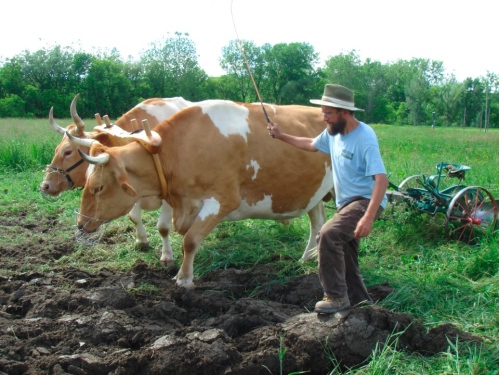
Our Mishna mentions the ‘Melacha’ of ‘Choresh‘ – plowing. Now plowing can be done by hand or with an animal.

or, by hand, by animal…?

Now let’s think about it. When a person plows by hand, unaided by anyone else, then he is performing the Melacha all on his own. Conversely, when he is aided by an animal he is a sense only doing half the work! So why is one chayav?

Perhaps the Melacha of Choresh in only when a person plows on his own?

Our Gemara is the only place that actually mentions plowing with a human and an ox together and being chayav! Therefore, concludes the Sochotchover, we see that a Melacha that is performed by a combination of human and animal, if the human is the one that directs and leads the animal the Gemara considers that ‘this is the way it is done’. It is considered that the human performed the Melacha unaided.

2. We mentioned in our Mishnah regarding one who plows with an ox and a donkey yoked together. This prohibition applies not only to an ox and a donkey, but to any two species.

Interestingly, the Rambam is of the opinion that this Lav is limited to pairing  a Tamei and Tahor animal together. If one plows with two animals that were either both Tamei or both Tahor it is only prohibited Miderabanan.

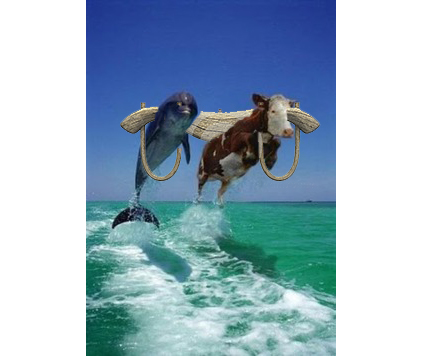
It is also forbidden to lead an animal from dry land together with a sea-animal.


cow dolphin plowing

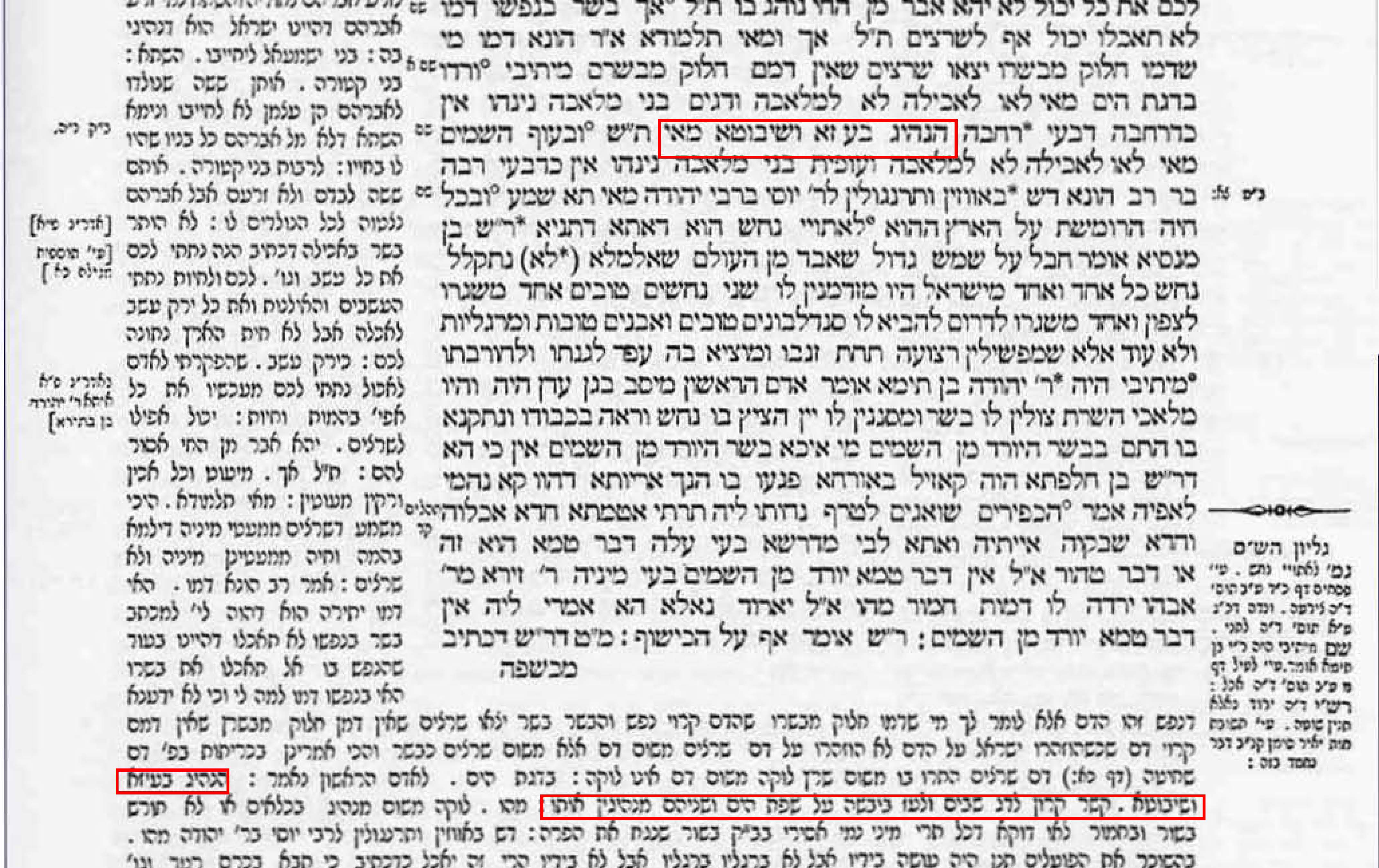
As Berel mentioned we had this case previously in Sanhedrin 59b (Thanks to Moshe Rosenfeld for finding it)

Sanhedrin 59B cropped

However if one did so he is not liable for Malkos.

The reason for that is because the Gemara raises the question whether one is liable for Malkos for such an action or not, for the two cannot function as a team in the ordinary sense, since the fish cannot leave the water and the goat will not enter it. Since the question is left unresolved, the Rambam maintains that the person is not liable.

3

If one drops seeds on Shabbos on the ground and not does not cover it is that enough to consider it Zo’rea – planting?

The famous Rav of Moravia, Reb Mordechai Benet in his book Magen Avos on the 39 melachos writes that it is not considered planting until covered with soil.

We discussed the proof he brings from our Gemara he brings and the opposing opinions.

4- We mentioned the famous opinion of the Ra’avad that today the prohibition on Kohanim to become ‘tomei’ may not be Min Hatorah since bizman hazeh when we are all t’mei’im anyway.


Makos 20b -21a – Shiur 7/14/15 – Continuation

Makos 20b -21a

1. In continuation to the Munkatcher’s words about shaving and the Tzemach Tzedek we spoke about clapping on Shabbos.

Tosfos Beitza 30b  writes that despite the Mishna explicitly prohibiting the clapping and dancing on Shabbos we can be lenient today because the reason given  for the prohibition is that it can lead to repairing  a broken musical instrument.


Nowadays when very few people are experts in repairing musical instruments clapping etc. can be permitted.

[always wondered about that whenever I see guitarist repairing and tying broken strings..]

And in Shulchan Oruch 339  it says that one should not clap or dance on Shabbos. The Ra”mo quotes the leniency of Tosfos. See here the Alter Rebbe’s words and accompanying footnotes.

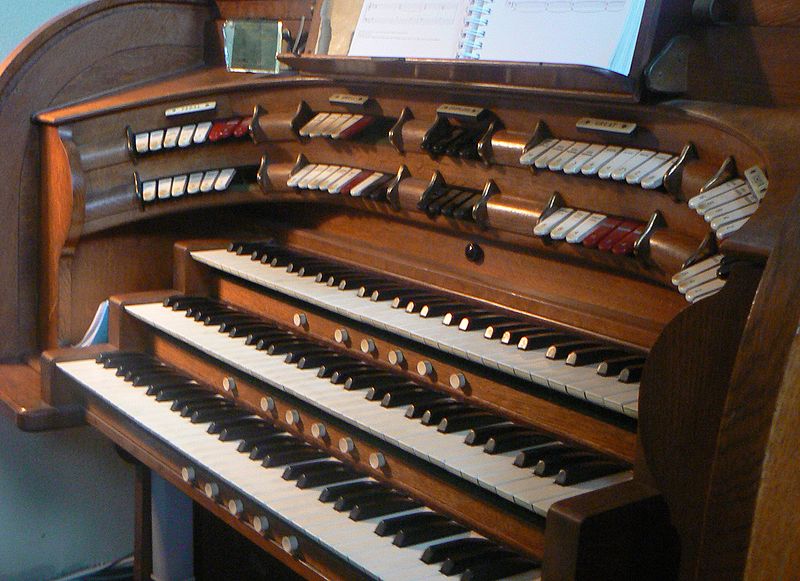
The Rebbe when he wrote (246 לקו”ש ח”א) and spoke about this mentioned the Minchas Elazor in the footnote (או”ח כ”ט – Orach Chayim, vol. 1, Responsa 29)​ who takes issue with this leniency. He mentions the reform movement that allowed the playing on Shabbos of their church-like organs in their temples because of this Tosfos!

(as if they needed a solid ‘heter’….)

Also in 1992 the Rebbe spoke about the minhag of the big “oivdim‘ who would snap their  fingers in middle of davening even on Shabbos.

2. Also spoke about the book Tikun Olam by Munkatcher’s chosid before WWII  where he explains the battle against the Zionists- religious or not- and the letters of the Rebbe Rashab and Rayatz that are prominently featured there.

We learned the Mishna about the prohibition to tatoos.

body.Opinions whether or not the order of the tattooing process- first applying the ink and then puncturing of the skin or vice versa –   is relevant to the prohibition.


Is this Lav limited to tattooing letters or any mark or picture is also prohibited?

We mentioned the Gemara in Gittin that discusses the weird case of a man that tattooed an entire ‘Get’ on the hand of his slave and then gifted the slave to his wife…….

Tosfos there mentions our Gemara that explicitly prohibits one to do this. We discussed how the Get is Kosher if the Sofer (scribe) did something that is forbidden m’De’oraisa. Similarly, the witnesses by tattooing their signature on the slave’s hand are transgressing this Lav and simultaneously disqualifying themselves. See Beis Shmuel #15. 

The Minchas Chinuch writes that any writing on the skin is prohibited.

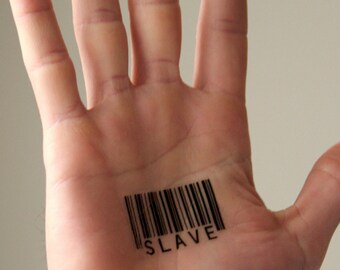
Interestingly, in Shulchan Aruch  we find that if one tattoos his slave “in order that he should not escape” he is ‘potur’. The Rama adds that one should do this le’chatchila. Commentaries note that this Halacha is referring to a non-Jewish slave who has not converted yet.

I wonder if any of the Jewish slave owners of the South were aware of this…..

(Did they use White Out?- that’s racist)

Makos 20a (2). Shiur 07 07 15

Makos 20a (2)

1- We spoke about the two separate (but often mistakenly combined) Halachos pertaining to ‘payos‘ and a beard.

Beard– Concerning the beard the Torah uses the term “shaving”  and ” destroying”. Thus our Gemara states that only when uses a razor (thereby shaving and destroying the hair roots) one is Chayev Malkus.

Cutting or shaving with other instruments has been a point of contention for generations. Many say that there is no Malkus but still prohibited M’Deoraisa. Others say only M’Derabanan while others permit it.


All agree that according to the Zohar no method is permitted.

See below on the opinion of the Rebbe the Tzemach Tzedek.

Payos– sideburns- (unlike the beard) there is no mention of shaving at all. The word used in the Torah is “circling”. Meaning to make a complete circle around the skull with no hair which would entail the removal of the Payos.


We discussed the Rambam who writes that one needs to leave a minimum of 40 hair strands.

We mentioned the question asked by Rabbi Akiva Eiger as to why one is even allowed to comb (! ) the Payos. A Nazir who is instructed to grow his hair is prohibited from combing it!

The Chasam Sofer (who eventually would become his son-in-law) has a lengthy answer on this.

Of course we all know the opinion of the Tzemach Tzedek who strongly and firmly writes that one should not remove facial hair by any means and method.

Image result for chainsaw

he famously posits that in addition to all the above one who shaves transgresses the prohibition of ‘lo sil’bosh gever’ – one should not dress like a woman (cross dressing).

We went on to discuss the Munkatcher dynasty starting with the illustrious Minchas Elazar, to his controversial son-in-law

Baruch Yehoshua Yerachmiel Rabinowicz father of the current  Munkatcher Rebbe.

In a first class irony, the Minchas Elazar, who was prior to WWII, the leading opponent against Zionism had a single daughter who married Reb Baruch Yehoshua Yerachmiel Rabinowicz who to everyone’s surprise became an ardent religious Zionist!
(Thus the humorous saying that there are three Munkatcher Rebbes…)

Moshe Rosenfeld has suggested these valuable links:

https://www.youtube.com/watch?v=CbfC949G17U

https://sites.google.com/site/binatnevonim/home/shana

 and a fascinating article from 1934:

 http://www.jta.org/1934/09/28/archive/the-bulletins-day-book-174#ixzz3Mo0QYh9F

Our discussion of the above pertains to a particular letter written by the Minchas Elazar in regard to a beard.  In short- a Torah periodical published multiple articles on this topic. The Minchas Elazar wrote to the journal stating his opinion of a strict prohibition to shaving with any any type of shave; adding the opinion of the Tzemach Tzedek.

וילקט יוסף - ט - יוסף בן נפתלי הכהן שווארץ

Some smart-aleck submitted a response in which he writes with total disrespect about the Tzemach Tzedek.

The Minchas Elazar strongly rebukes the writer (as the Rebbe once wrote that the method of the Minchas Elazar was “storm and hurricane”) and urges him to ask forgiveness from the Tzemach Tzedek. Open the link– bottom of the first column- it’s a good read with story of the Tzemach Tzedek about his mesiras nefesh for the mitzvah of wearing a beard.

He continues that the writer is apparently angry at Rabonim in general as we see this opposition to the Rabbis opinion in regard to the Status Quo Ante story.

Thanks to Mendel Nemenov for the link. Hebrew.

Makos 19a (2) Shiur by Alex Heppenheimer

Makkos 19a (2)

Special Thanks to Alex Heppenheimer.

The Gemara mentions that a ger, when he brings bikkurim, can’t make the accompanying declaration (מקרא ביכורים), because he can’t say אשר נשבע ה’ לאבותינו. This in turn is based on a Mishnah in Bikkurim which says so (with the proviso that if his mother is Jewish, he can say it).

This turns out to be not so simple. There are actually two possible issues with a ger’s מקרא ביכורים: the lack of a portion in Eretz Yisrael, and that he’s not descended from אבותינו.

Now, there was indeed one group of gerim who did get a portion in Eretz Yisrael. בני קיני, the descendants of Yisro, were given a fertile area of 500 x 500 amos near Yericho to live in until the Beis Hamikdash would be built (at which time it would be given to whatever shevet provided the equivalent area for the Har Habayis).

(Incidentally, they didn’t stay there for long; they needed a rebbe, and so they wound up leaving this area and traveling to Arad, in a desolate part of the Negev, to study under Osniel ben Kenaz. Their reward was that some of their descendants served in the Sanhedrin.)

So the Yerushalmi mentions בני קיני, and then goes on to quote a baraisa that R. Yehudah holds that a ger can recite מקרא ביכורים because Avraham is the father of all nations, and a psak by R. Abbahu that the halachah is like R. Yehudah.
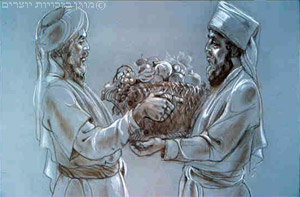
Tosafos (in Bava Basra) discusses what this means. According to Rabbeinu Tam, the Mishnah (R. Meir) is saying that any kind of ger (בני קיני or anyone else) can say מקרא ביכורים as long as his mother is a born Jew, while R. Yehudah holds that you need to be בני קיני as well as אמו מישראל. (Although he asks: how does a ger say ארמי אובד אבי וגו’, which seemingly refers to Yaakov?) Ri understands that there’s no real machlokes between R. Meir and R. Yehudah – both agree that only בני קיני who are also אמו מישראל can bring bikkurim and say the pesukim.

On the other hand, Rambam states that any ger (no distinction whether אמו מישראל) can say מקרא ביכורים, because he understands R. Yehudah to be saying that אב המון גוים makes it possible even for a ger to say לאבותינו. He also adds a detail: “the promise was first given to Avraham that his children would inherit the land.” Now, what does that mean? Also, why then does the Rambam differentiate between מקרא ביכורים and וידוי מעשר – the latter, he says, a ger can’t say? (The question is actually on the Mishnah and the Yerushalmi – no variant opinion is given about וידוי מעשר.)

Ramban explains that in theory gerim could have been בני ירושה because of Avraham, but practically speaking they didn’t get a portion simply because Eretz Yisrael was divided only among those who left Egypt. But just as those who were children at יציאת מצרים didn’t get a portion of their own but yet, when they do eventually inherit, can say מקרא ביכורים, so it is with gerim – they are essentially בני נחלה. (As for Rabbeinu Tam’s question about ארמי אובד אבי, Ramban answers that once the ger is considered a descendant of Avraham, then by extension he has the same relationship to the other Avos.)

Kesef Mishneh takes a different tack. When Hashem promised the land to Avraham he wasn’t yet אב לגרים – that came only afterwards, and by that time his biological children were entitled to it. But it’s not that intrinsically gerim can’t inherit Eretz Yisrael.

Shaagas Aryeh, in the course of a long teshuvah about milah for בני קטורה (they are obligated – Rambam, Hil. Melachim 10:8), discusses the idea that the Rambam’s point about the promise to Avraham is that even though Yitzchak and Yaakov aren’t called “fathers” of gerim, since Avraham is, that’s good enough. (Which means, he says, that Rambam would necessarily disagree with Ramban’s answer about ארמי אובד אבי. One of the other mefarshim on Rambam suggests that maybe he would understand that posuk as Rashbam does, “My father (Avraham) was a wandering Aramean.”)

Incidentally, he points out that בני קיני are in fact biologically descended from Avraham (since Midian was one of the sons of Keturah); but because of כי ביצחק יקרא לך זרע,
they’re excluded (which is why R. Meir says that there needs to be אמו מישראל to be able to recite מקרא ביכורים). Also incidentally, he points out why in Nedarim (recent Daf Yomi) we are told that even circumcised בני קטורה are considered uncircumcised – because while they are obligated in milah, they don’t have the mitzvah of periah, and מל ולא פרע כאילו לא מל.

As for the difference between מקרא ביכורים and וידוי מעשר, there are several explanations, most of which focus on the difference in wording between the two.

Radvaz notes that by מקרא ביכורים the expression is אשר נשבעת לאבותינו לתת לנו, which can be understood as נשבעת לאבותינו – to Avraham – and therefore לתת לנו, it pertains to the whole Jewish people, gerim included. Whereas by וידוי מעשר the expression is אשר נתת לנו, and it wasn’t given to the gerim; כאשר נשבעת לאבותינו there refers to זבת חלב ודבש.
Mishneh Lamelech quotes R. Moshe ibn Chaviv, who points out that Yechezkel states that gerim will get a portion in Eretz Yisrael in Moshiach’s times; therefore they can well say לתת לנו in future tense. (A logical reason for this is that gerim who joined the Jewish people after Yetzias Mitzrayim, when we were at the highest heights, may not have been totally sincere; not so with those who became gerim during the years of galus.) Whereas אשר נתת לנו is in past tense.

A couple of mefarshim on Rambam bring an idea from R. Shmuel Primo, אמרי שפר - פרימו, יהודה שמואלthat the expression ארץ זבת חלב ודבש is never found in Chumash Bereishis (addressed to the Avos), only in Shemos (addressed to the Jews in Egypt) and afterwards. So if in וידוי מעשר the expression כאשר נשבעת לאבותינו refers to ארץ זבת חלב ודבש, then אבותינו there necessarily means the Jews who were in Egypt – and the ger isn’t descended from them.

(This R. Shmuel Primo – probably no relation of the hatter – was an interesting character. He was a youngish talmid chacham when Shabsai Tzvi appeared on the scene, and he became his secretary – and even after Shabsai Tzvi’s shmad he continued to believe in him. He later became rav of one of the important communities in Turkey, wrote a couple of sefarim, and is quoted respectfully by the Chida and others.)

Yet another answer, from Mirkeves Hamishneh, is that מקרא ביכורים must be said in lashon hakodesh, and there אבותינו can mean “masters” (as in וישימני לאב לפרעה); whereas וידוי מעשר can be said in any language, and in other languages “av” means only “father.”

*

All of this, in turn, brings up the question about what a ger says in davening. Can he say אלקי אבותינו, and can he say in bentching שהנחלת לאבותינו?

The Mishnah there in Bikkurim says that a ger should say אלקי אבות ישראל, and in shul he should say אלקי אבותיכם (unless אמו מישראל, in which case he can say אבותינו because of her). On the other hand, we have the opinion of R. Yehudah mentioned earlier, and the Yerushalmi stating that R. Abbahu paskened like R. Yehudah (which necessarily would have to refer to davening, since in R. Abbahu’s times there were no bikkurim).

In the Tosafos mentioned above, Rabbeinu Tam decides according to the Mishnah, and therefore says that a ger can’t lead a mezuman, because he can’t say על שהנחלת לאבותינו. Whereas Ri argues that the halachah is like R. Yehudah, and therefore that he can.

Similarly, Mordechai tells how in Wurzburg they prevented a ger from being chazzan because of the problem with him saying אלקי אבותינו, but that Rabbeinu Yoel allowed it based on R. Yehudah.
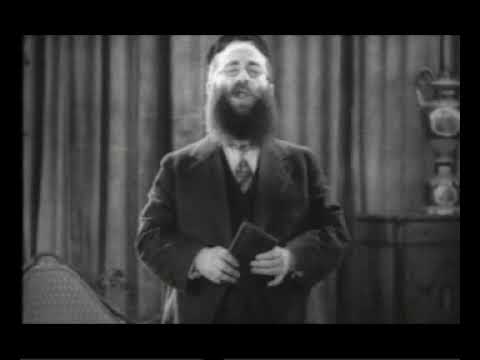
Yossele Rosenblatt (not a ger)

Rambam, too, writes in a teshuvah to R. Ovadiah the ger that he should daven like everyone else, because all gerim are children of Avraham.

So this is accepted as halachah. The Alter Rebbe summarizes it as follows: with women there is a safek whether they are chayav in ברכת המזון מדאורייתא, since they don’t get a portion in Eretz Yisrael (and they are עם בפני עצמן, so not necessarily included with the men). With Kohanim and Levi’im, the only reason they are chayav is because they have ערי מקלט, but otherwise they are important enough to have a status of their own. Whereas gerim can be considered an appendage (נטפל) to the Jewish people.
One last detail we talked about: isn’t being a chazzan a type of שררה, and gerim are not allowed that? The answer is that a chazzan is not telling anyone what to do, just saying kaddish and Borchu and so forth, to which everyone answers.