All posts by daf

Makos 15a Shiur 03/24/15

Makos 15a

A- The Gemara were are learning is admittedly a bit complicated.

Here is a simple outline:

1- A Lo Sa’ase transgressed brings Malkus.

Example: Wearing Shat’nez.

2- A Lo Sa’ase with correction: A Lo Sa’se transgressed that the Torah allows  for a correction (in the form of an E’se – a positive commandment), “teshuvah”, there is no Malkus if the remedy allowed is actually performed.

Example: Stealing is a Lo Sa’ase. Returning the loot is a Mitzvas E’se. Meaning that one can return the stolen object performing the E’se and rectifying the Lo Sa’ase of stealing.

Thus there is no Malkus if he returns it.
How much time does one have to remedy the LoSa’ase ?  [See below in different words and its connection to Pesach] –

In our example – how much time is one given to return the stolen property?

That is argument between Reb Yochanan and Reish Lakish:

Reb Yochanan says that he has as long as one wants-  provided that he is indeed able to remedy it.

Once the possibility is gone, he gets Malkus.

Example: Finishing eating the Korbon Pesach until the morning. The Lo’Sa’ase is not to allow any potion of the Korban uneaten.

If one does leave some pieces he is given the next day to burn it. That is an E’se.

But once the next day passes and he does not burn it, is too late and he gets Malkus.
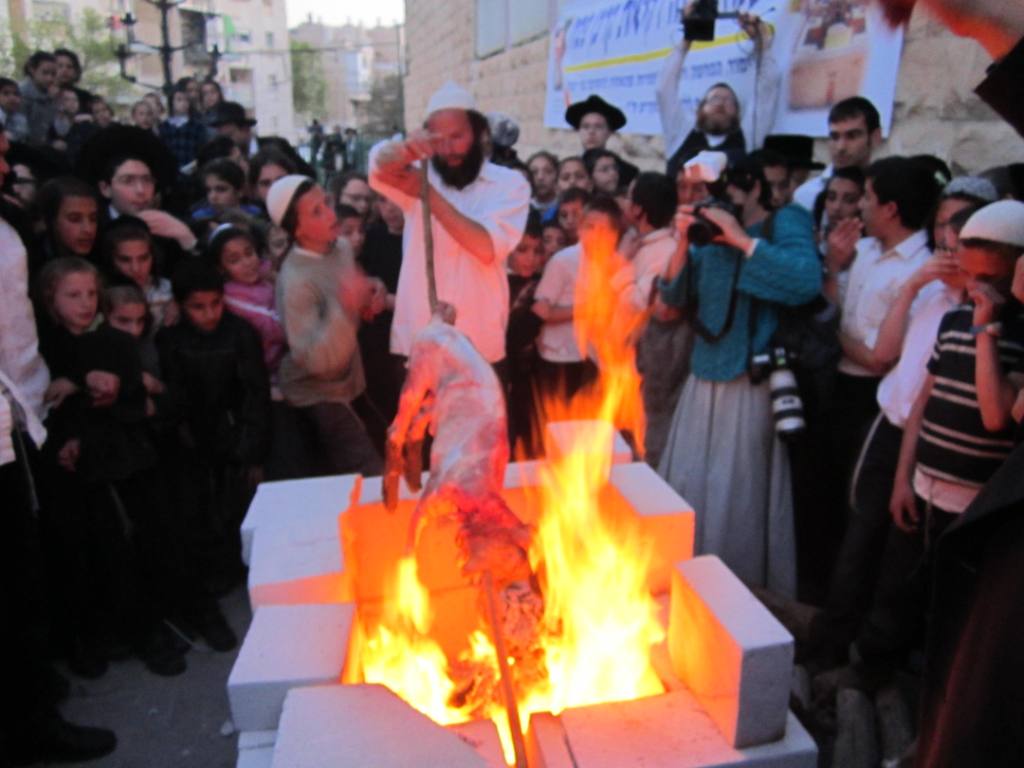
Reish Lokish argues and says that one is not given much time at all. Rather, after one transgresses a Lo Sa’ase, Beis Din calls him for a hearing and tells him: Either you remedy it immediately (i.e. return the stolen property) or we will give you Malkus.

In this category one cannot perform the “correction” before the transgression. One can obviously not return stolen property before stealing it.

3- This is the tricky one. A Lo Sa’ase and an E’se. But the E’se can and/or must be performed with out transgressing the Lo Sa’ase.

Example: A fire must always be lit on the Mizbeach. That is an E’se.

Extinguishing it is a Lo Sa’ase.

This E’se can and must be preformed prior and without any connection with the prohibition of extinguishing it.

On the other hand it can also be performed after one extinguishes it.

So here is the dilemma – does this E’se rectify the Lo’Sa’ase?

Someone that extinguishes the Mizbeach fire -transgressing a Lo Sa’ase – but then reignites it performing an E’se. Does his second action rectify the first?

That is what original saying of Reb Yochanon was all about.

——–

More examples of ruining the ability to correct the Lo Sa’ase:

1. A Kohen rapist who divorces his wife cannot remarry her.

2. A non-Kohen rapist who divorces his wife then makes a vow  not to have anything to do with her

3.  Removing the bird’s eggs while the mother is hovering above them. He can avoid getting Malkus by sending away the mother now. But if the mother dies then he in unable to correct the Lo Sa’ase

​B-  In this week’s Gemara we learned about in interesting Machlokes which also has to do with Hilchos Pesach.

Everyone agrees that if a person rectifies the Lo’Sa’se with an E’se he does not receive Malkus.

For example, if someone steals and later returns according to all opinions he is exempt from malkus.

The question is how long does a person have to rectify his actions?

In other words when does Beis din determine that this person is never going to do Teshuvah and we can give him Malkus right away?

There are two opinions:

  1. Bitlo ve’Lo Bitlo, A person always has the capability of fixing the Lo’Sa’se as long as he lives, and as long as it is possible for him rectify it. (For example if he steals from a Ger and he dies then according to everyone he cannot fix it)
  1. Kiymo ve’lo Kiymo, a person must fix his Lo’Sa’se right away. As soon as Beis Din finds out that he transgressed this Lo’Sa’se he must fix it immediately or be subject to lashes (this is Rashi’s version)

The Halacha is is Kiymo ve’lo Kiymo.

Based on this the Alter Rebbe brings a very novel idea in the name of the Magen Avraham in Hilchos Peisach:

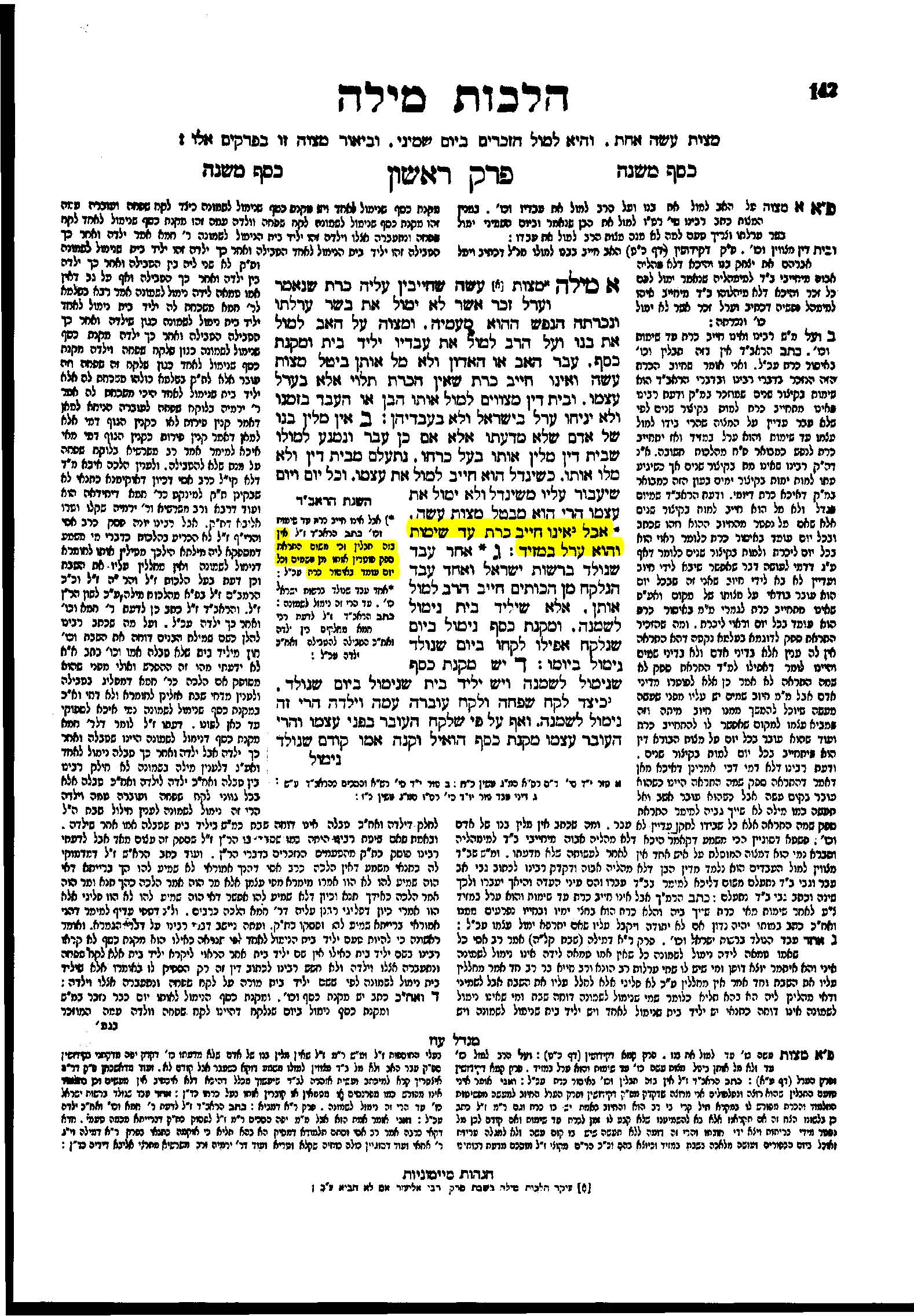
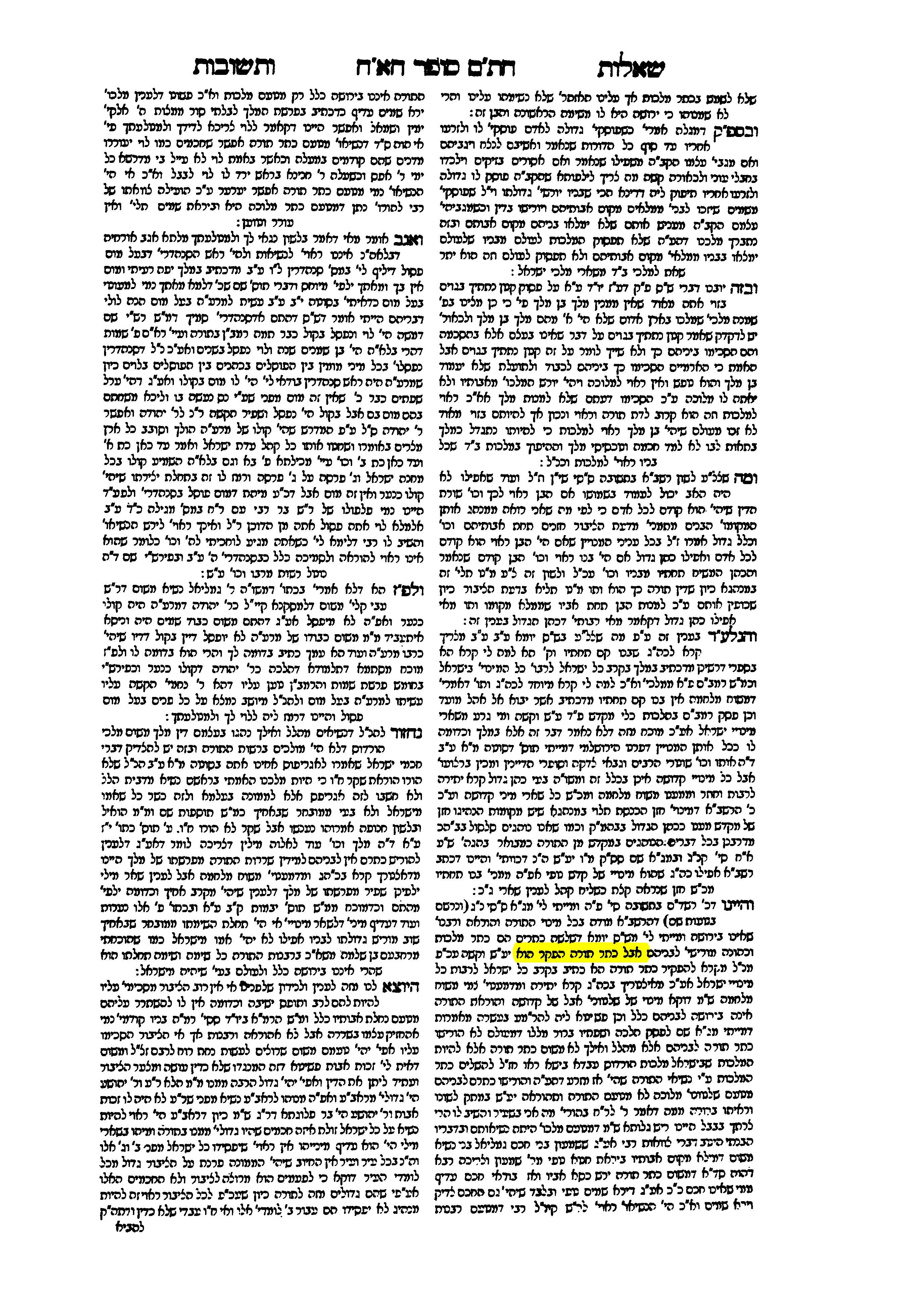
Hilchos Pesach seferid_25074_page_173
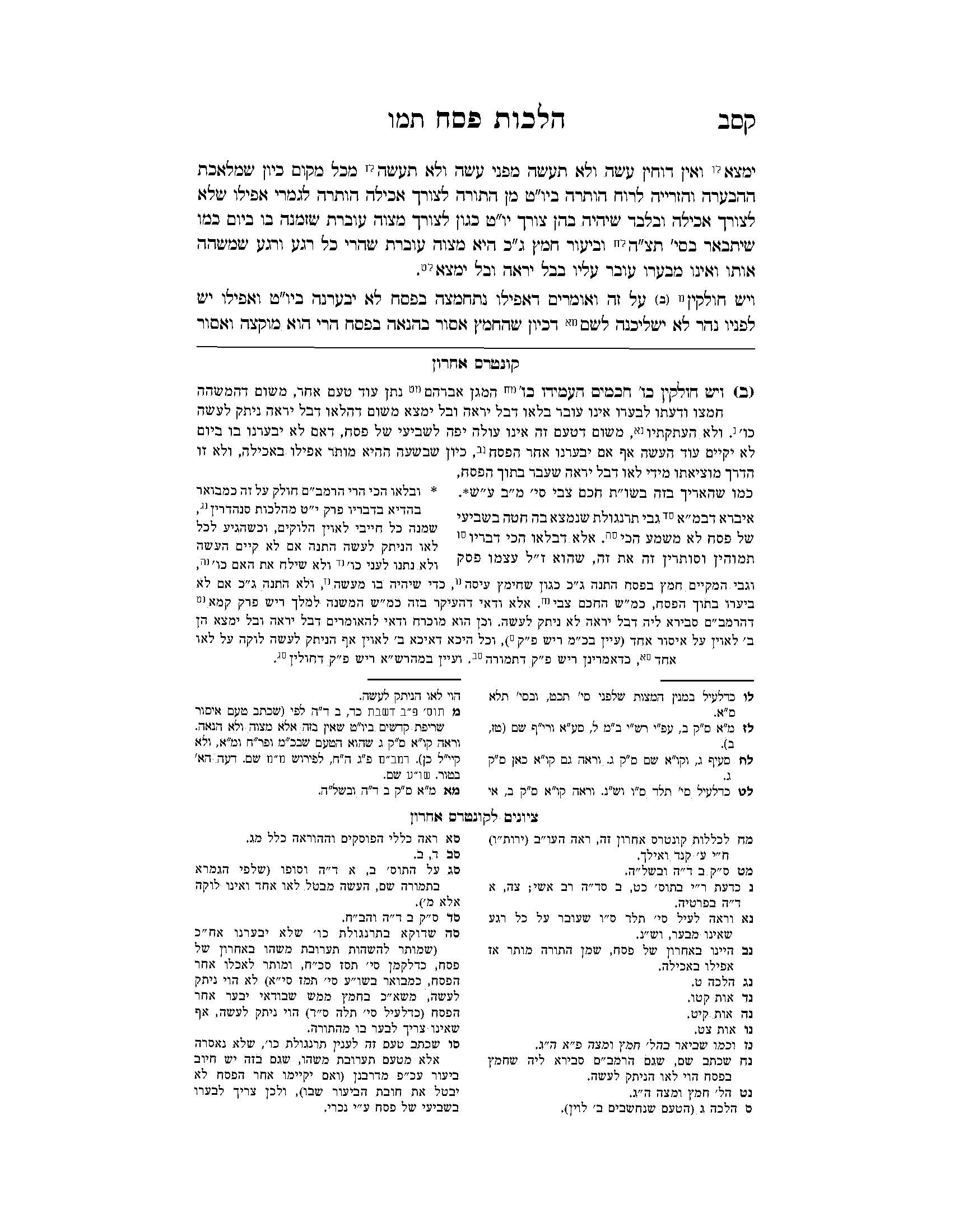
Hilchos Pesach seferid_25074_page_173

What happens if someone finds  Chametz in house on Pesach?  Generally, it is not such a big problem because since he did the Bittul before Peisach the Chametz  does not belong to him.

However what happens if someone by accident makes new Chametz on Pesach, in this case we have a problem because the Bittul that you did before Peisach does not apply, this is brand new Chametz.


The Magen Avraham suggests something interesting based on the Gemara in Shabbos:

The issur of Chametz on Pesach goes into the category of an Aveirah that the Torah allows for a correction to be done (Lav Hanitak L’E’se); there is an Issur of B’aal Yeraeh and B’aal Yimatzeh and there is the correction of Tashbisu (destroying it).

Based on the Halacha Kiymo ve’lo Kiymo it is possible that as long as he has in mind to burn the Chametz he is not going to transgress the Lav because he can always correct it.

Therefore the Magen Avraham suggests not to touch the Chametz (assur b’hanaah and muktzah) which was formed on Pesach, rather just have in mind that you are going to burn it and you will not be oveir on B’aal Yeraeh and B’aal Yimatzeh.

Despite the great admiration the Alter Rebbe had for the Magen Avraham in quoting him constantly, in this particular case he omits his suggestion and in the Kuntras Achron gives two reasons why:

  1. The suggestion only works for the first days of Pesach. However on the last day he must burn it right away. This is because if he waits until after Pesach, and according to everyone he cannot correct the Lo’Sa’se.
  1. (This is brought in a footnote) The issur of having Chametz on Peisach is 1. B’aal Yeraeh 2. B’aal Yimatzeh. However the correction is only 1. Tashbisu. Therefore although The E’se can cancel out (ONLY) one of the Lo’Sa’ses you are still left with another which you will transgress right away.

 http://beta.hebrewbooks.org/pdfpager.aspx?req=25074&st=&pgnum=173


Makos 14b (2)  Shiur 3/10/15

Makos 14b (2)

  1. The Gemara notes that according to Reb Yochanon that the Pasuk of “B’chol Kodesh Lo Siga” is referring to a person who is Tamei prohibiting him from touching Terumah.

Tosfos asks how is it possible that we find something which is more stringent with Terumah (not touching) then by a Kodesh object, which a person who is Tamei seemingly is allowed to touch it?

Tosfos brings an answer from a “R’ Shlome Midroi”sh Nishmoso Eiden”. A rare description in Tosfos.

http://www.jewishencyclopedia.com/articles/13870-solomon-ben-judah-of-dreux

Who is this Ba’al Ha’Tosfos that merited this  Nishmoso Eiden?

R’ Shlomo is also known as Hakadosh Miradush. The martyr of Radush.

(There are two versions as to what city he was from either Radush, or Droish know in French as Druex.  Seemingly the right version is Radish see here)

directions

Although it is very rare for Tosfos to give any titles to any of the  Balei Hatosfos, because he was killed Al Kidush Hashem he was given these accolades. No details are known about his death.


One of the most famous Pesakim from the Kadosh Miradush is that by Kidushin one Shliach cannot make another Shliach to be Mekadesh a woman.

  1. We spoke about the Vort of the Maharil Diskin (See here in English Hebrew) in the beginning of this weeks Parsha.


“Six days work shall be done, but on the seventh day you shall have sanctity, a day of complete rest to the Lord; whoever performs work thereon [on this day] shall be put to death”.

He notes that it does not say “Six days you shall work” rather it says “six days work shall be done“? Which seems to a imply a type of work that is being performed on its own and that type can be performed six days a week but not on Shabbos.


He explains that when Moshe was erecting the Mishkan all he had to do was to act like he was putting it up and an angel would help him erect the entire structure.


Similarly, when actually building the Mishkan they were assisted by angles. So in a sense there were “two people” working with the materials.

If so, one might think that you can  continue to build the Mishkan even on Shabbos because the Halacha is that when two people perform a Melacha on Shabbos they are  Patur!


This is why it states “it shall be done” as if to say it was done by itself… With the help of the Malachim…..

And nevertheless this should only be performed on the six days and not on Shabbos.


Why? There is more than one person doing it?

This is why the Pasuk continues “whoever (singular) performs work [on Shabbos] shall be put to death”.

meaning that because the Malach does not work on Shabbos therefore if you do work you will be doing it on your own.


Purim Shiur 3/4/15 –

Purim Shiur

  1. 3/4/15 -One of the first decrees that Haman instituted on behalf of Achasveirosh after the debacle with Vashti was that “every man should be ruling his family and should be speaking the language of his own people”​. [Meaning that the dominant language of a house should be the mother tongue of the husband, not of the wife].


The question is asked, we can understand why Achasveirosh wanted the man to be the ruler of the house, but what is the importance as to what language they speak at home? ​


​Answer: Achasveirosh was from Iran, he thus spoke Persian. His wife Queen Vasthi being Nevuchadnetzer’s granddaughter spoke Babylonian/Acadian.


When the king’s messenger’s came to get Vashti she refused to go. She started swearing in her native language: Babylonian. “Tell than low life …….

The Persian messengers did not understand what she was saying. Had they an inkling of what Vashti had to say to Achasveirosh they would not have repeated it. They went back to Achasveirosh and repeated word for word what she said in Babylonian causing him great embarrassment because many were of his guests spoke Babylonian.


As a result he instituted that all families should only speak the husband’s language!


Melech “ti’pesh” indeed.


  1. We mentioned the Vort from Reb Yonoshon Eibshitz why it took 70 days from the time of Haman’s demise [Nisan 16] until the new decree from Achasveirosh (allowing the Jews to defend themselves, sent at the urging of Mordechai), were sent out [Sivan 23]?


  1. see below:

Shiur Table of פורים עה

shiur table purim 2015

1- The decree was ordered on the 13th of Nisan.

2- Three days of fasting were declared.

3- Esther approached the king on the “3rd day”.

4- Esther hosted two feast on two consecutive days.

5- Haman was hung at the conclusion of the second feast.


Besides #1, when did numbers 2 to 5 occur?


L’halacha it is paskened that Haman was hanged on the Second day of Pesach- Nisan 16. Therefore the Alter Rebbe says a person should add something extra on the second day Pesach meal to commemorate hanging of Haman. See here.


As you can see in the table above there is a difference of opinions between the Midrash and Rashi regarding when the first day of the fast was; the 13th or 14th of Nisan.


The Rebbe explains that according to Rashi the meaning of the verse in the Megilla “And Mordechai knew all that was happening” means that he found out in a dream, therefore the fast was only instituted untill the next day.


However, according to the Midrash, Mordechai knew either through Ruach Hakodesh or through Eliyahu Hanavi therefore he was able to institute the fast right away.


See here for the source.


Makos 14b

Makos 14b

  1. We spoke about the difference of a Gezera Shava (two similar words in the Torah,   – similar laws, similar verdicts) as opposed to a Kal Vachomer (a fortiori).

The Gemara states  ​​that a  person cannot “create” a new Gezera Shava; ” Ein Adam Dan Gezera Shava M’atzmo  (No one may draw a conclusion from analogy upon his own authority​)​”. One must have received it from his teacher and his teacher from his teacher etc. all tracing it back to Moshe Rabeinu.

​The Ramban explains the reason for this is because in the Torah there are many duplicated words and if every person will make his own analogy’s there is no limit to where this might lead.

Nevertheless we find arguments concerning Gezera Shavas. One of the reasons explaining  this conundrum​ is that over the years the exact words used in a  Gezera Shava have been forgotten.

Alternatively, the original Gezera Shava was given at Sinai in a general way allowing different opinions as to the exact words.

​For example, it was said that two Mitzvos have similar words and therefore the rules of one apply to the other. However it was never stated where in the Torah this particular word is. Therefore we find  Machlokes about which word it alludes to, etc….​

Tosfaos writes that each ‘school’ had a Kabalah of the total amount of Gezera Shava’s that were transmitted by Moshe. Thus each school was unable to accept a Gezera Shava (claimed to have been received) by another ‘school’ because then the total number would exceed their received total.


2: See previous Shiur  regarding the Machlokes between the Ramabam and Raav’ad if someone did not have a bris.


​Reb Elchonon Wasserman (who is seen in the recent video) explains the machlokes in a unique way:


According to the Ramabam, a person is only Chayav Kares at the last second before he dies. In other words during his whole life period he was never in state of Kares until the last moment.


However according to the Raava”d every day that you don’t have a bris, you are chayav kares (if you eventually get a bris you fix the sin retroactively and you are patur) but ultimately this man is a walking “kares”.


​Reb Elchonon explains that there is a nafka mina l’halacha between the two:

What happens if someone at the last moment of his life he was an Ones, i.e. it was impossible for him to have a bris at that time?


According to the Ramabam because kares is only applied at the last moment and at the last moment it was not possible for him to have a bris, he will be patur from kares.


According to the Raava”d however, since he was always chayav kares, the last moment of his life is only considered the last time he a chance to fix the sin, but Kares was always there. Therefore the fact that he was an ones at the end is insignificant and thus this person lived and died with Kares.

3- If a Jewish uncircumcised male surgically changes his gender……he cannot obviously be circumcised. He then walks into a Chabad House…. one would assume that according to both above opinions he is a “daily kares” candidate……

S’iz nishto mit vos…….

See below:

http://daattorah.blogspot.com/2013/01/tzitz-eliezar-sex-change-by-surgery.html

Special Video: 1923 Knessiah Gedolah in Vienna

Below is part of a fascinating historical clip from the Knessiah Gedolah of 1923 in Vienna, Austria, when over 900 Jewish leaders met to address issues important to Jewry.

At the beginning is a rare appearance of the Chofetz Chaim, nice and clear.

Among the participants are

  • the Chafetz Chaim,
  • the Rebbe Rabbi Avraham Mordechai Altare of Gur,
  • Rabbi Chaim Ozer Grodzinski of Vilna,
  • the Rebbe Rabbi Israel Friedman Tchortkov,
  • Rabbi Moshe Friedman of Boyan,
  • the Rebbe Rabbi Yitzchak Zelig Morgenstern of Sokolov,
  • Rabbi Meir Dan Plotzky the “Kli Chemda”,
  • Rabbi Meir Shapiro of Lublin,
  • Rabbi Moshe Mordechai Epstein of Slabodka,
  • Rabbi Meir Atlas of Shawil,
  • Rabbi Yosef Yehuda Leib Bloch of Telz,
  • Rabbi Yehuda Leib Tzirelsohn from Kishinev,
  • Rabbi Isser Zalman Meltzer of Slutsk.

The opening speech: Chofetz Chaim.

Important takana: the announcement of the Daf Yomi, by Rabbi Meir Shapiro of Lublin.

An important hachlata: the establishment of “Keren Hatorah”, financial assistance religious institutions because of the difficult situation after the war (WWI).

Knessiah Gedolah is the official name of the conference’s main World Agudath Israel movement in the world, with many participants and political and spiritual leaders, from Israel and abroad. To date, six Knessiahs have been held, the last of which in 1980.

Also seen are the Tchortkover, Rabbi Menachem Ziemba, Rav Elchonon Wasserman, Harav Perlmutter from Warsaw, Rav Y. Rosenheim, Rabbi Meir Shapiro, the Nitra Rav and Rav Sh. of Bobov as a bachur.
In the film also seen are Hagaon  Rabbi Yaakov Meir Biderman and the Rav of Bendin.

See the entire clip here:  http://mirc.sc.edu/islandora/object/usc%3A30855

Makos 13b Shiur 02/17/15

Makos 13b

  1. In continuation to last week’s discussion whether or not a person can do Teshuvah on something that he is Chayav Kares, We mentioned the Teshuvah of the Noda B’yehudah (See here in English Hebrew):

The Noda B’Yehudah, Rabbi of Prague, in a famous  responsum (Noda B’Yehudah Kama, O.C. 35) addresses a question posed to him by a Yeshiva student who had transgressed the halachos of adultery (“consecutively for three years”) and was now married the daughter of the adulteress.

The questioner he asked; was he required to divulge his transgression to the husband of the adulteress (who was his father-in-law!).

Halachically, it would seem that this poor the father-in-law cannot continue living with his wife, the adulteress.

In response, the Noda B’Yehuda assumed that the decision about whether or not to inform was based on the difference of opinion between the Rosh and the Rambam.

The Noda B’Yehuda wanted to rule leniently in that case, citing p’gam mishpacha – or the potential disaster this revelation would have had on the family.

the Noda B’Yehuda weighs in:

However, in the end, he too rules that the husband needed to be informed because the intimate relationship between the older man and his adulterous wife would be ongoing – with constant, recurring sin.

Part of the teshuvah addressees the request of the yeshiva student asking for a path of teshuvah to repent for his grave sin.


The Noda B’Yehudah discusses at length the concept of Teshuvah.

[We mentioned the sharp words the Noda Biyehuda, an opponent of Chasidus,  has for the “contemporary musar books”. Was he referring to books of Chassidus?]


His basic assumption is that one must accept that there is no sin that teshuva can’t atone for.

On the other hand, we must say say that a Beis Din, despite the claim of teshuva by the accused, still dispenses malkus/misah (depending on the sin).

Image result for no sin which repentance

The reason for this anomaly is because if Beis Din were to accept the accused’s Teshuva then the entire concept of Malkus/Misah would be nixed. Every defendant would obviously tell the Beis Din “I did Teshuva and G-D forgave me……”

So we must say that the reason Beis Din still imposes punishment is because it is a Gezeiras Hakasuv that even though a person does Teshuvah he still gets punished by Beis Din for it.

Image result for no sin which repentance

See here  for the Teshuvah at length


  1. It is interesting to note that the Rebbe in Likutei Sichos  (Footnote 5) always quotes this Noda B’Yehudah but gives the reason of why Beis Din still punishes even though he did Teshuvah because of the rule “Ein Ledayan Ela Mah She’ainov Ro’os”  – a judge can only rule on what he sees, and because the judge cannot see if the person really did teshuvah or not, he therefore still gets punished.

However  the Noda B’Yehuda seemingly does not say that. He implies that the reason is because it is a Gezeiras Hakasuv.

See here  for a lengthy discussion on this topic.

  1. We quoted the Ramabam in Hilchos Milah:

“If a father or Beis Din did not circumcise the child……when [the child] reaches bar mitzvah, he is obligated to circumcise himself. With each and every day that passes after he has reached bar mitzvah, he negates a positive commandment.

He is not, however, liable for karet until he dies uncircumcised, having intentionally [failed to perform the mitzvah].”

rambam milah 1 seferid_9713_page_278

Rambam Milah 1

We discussed to wording of the Rambam that seem to imply that one who does not circumcise himself gets Kores ….when he dies?! 

The Raavad comments  on the last sentence and seems to say that he does not understand how the Rambam can say someone is Chayav Kares after he passes on!!

Rather he holds that he is Chayav kares every day that he does not circumcise himself.

More next week for some explanation into the Ramba”m…

 Hit up the comments for some thoughts!

Makos 13a (2)  Shiur 02/10/15

Makos 13a (2)

Thanks to Eli Chitrik


  1. We mentioned the Machlokes of Rashi and Tosfos in our Mishnah if Min Ha’Torah a Kohen can marry a Chalutza.


Chalutz a
Chalutz a

Rashi follows the opinion that a Chalutzah is Biblically prohibited to a Kohen. This prohibition, is not stated explicitly in the Torah, rather it is derived from the Issur of a Gerusha.

Tosfos maintains that a Chalutzah is prohibited to a Kohen only Rabbinicaly.

2. We started to discuss the concept of if a person is chayav Kareis can he ask Beis Din to give him Malkus to rid himself from the Kareis? Assuming he can, it would only work if the Beis Din was granted the ability (not physically) to administer proper Malkus for it to count as an atonement to cancel the Kareis.

this image has no connection to the text.

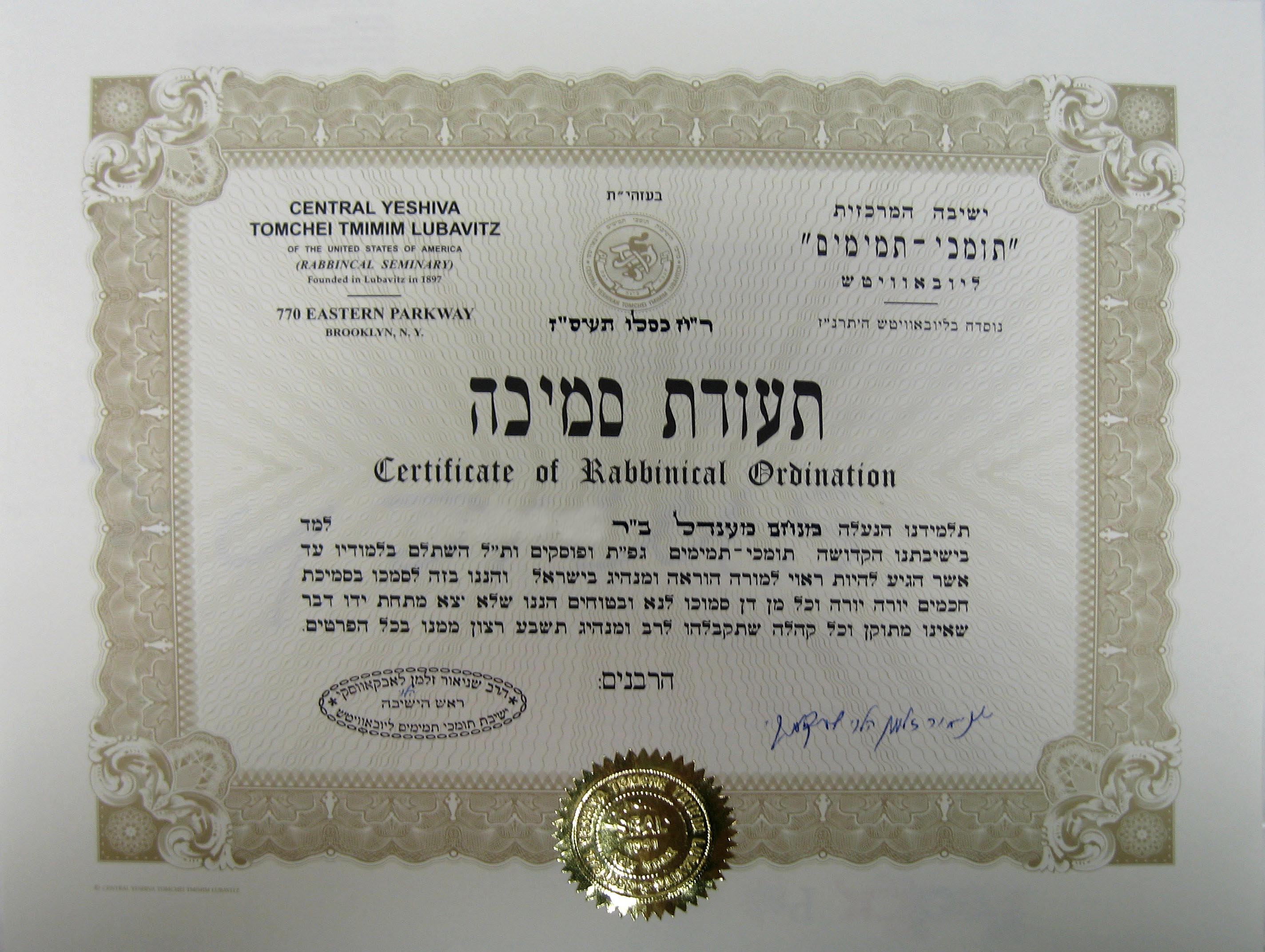
But there is no such Beis Din today that has that power since we do not have a members of the Beis Din that have received a proper “Smichah”!

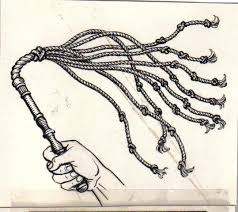
Whip

Whip for Malkus

This concept was argued in great detail about 450 years ago as part of an overall argument that split gedolei Yisroel into two camps:

agudah


(Parts of this portion were taken from this website.

Thank you Moshe Rosenfeld) You’re welcome.

cgi

  1. After the Spanish expulsion, many Jews remained in Spain, practicing their Judaism in secret, while publicly appearing to be Christians. Thousands of these Marrano Jews eventually escaped to areas where they could practice their religion with relative freedom, yet they were haunted by the sins they had committed in previous years.


expulsion

1492

Many were concerned that they would never escape their more serious sins, many of which carried the punishment of Kareis. Although they had become true baalei tshuvah, they lived in fear of their ultimate day of judgment when they would have to give a reckoning for their actions and face the serious consequences.

baal teshuva


As chief Rabbi of Safed, Rabbi Yaakov Beirav came up with an original solution to the problem. He proposed the creation of Jewish courts that would carry out the punishment of Malkus – lashes, which releases someone from the punishment of Kareis. There was one serious problem with this proposal. In order to create Jewish courts that can exact these punishments, one must have dayanim who have received a special semicha that can be traced to Moshe Rabbeinu.

smicha2.jpg

  1. The Rambam taught that if the sages in Eretz Yisroel would agree to be somech (ordain) one of themselves, they could do so, and that the man of their choice could then ordain others. For a year, Rabbi Yaakov Beirav discussed the halachic issues of re-establishment institution of semicha with the scholars of Safed. After much discussion,  the scholars at Safed came to the conclusion that Rambam’s view was correct, and that there was a pressing need to re-establish the Sanhedrin. In 1538 twenty-five Rabbis met in an assembly at Safed and ordained Rabbi Yakov Beirav, giving him the right to ordain others who would then form a Sanhedrin.

smicha


After sending a delegation to Jerusalem, Rabbi Yaakov Beirav expounded on Shabbat before all the scholars of Safed the halachic basis of the re-establishment of semicha and its implications, with an intent to dispel any remaining doubts. On hearing of this event, approximately two hundred scholars, most of the scholars in Eretz Yisroel, also expressed their consent. Rabbi Yaakov Beirav then ordained a few other Rabbis, including the chief Rabbi of Jerusalem (the Mahralbach), Rabbi Yoseph Karo, Rabbi Moshe of Trani, Rabbi Yosef Sagis, Rabbi Yoshiyahu Pinto, Rabbi Abraham Shalom and Rabbi Israel de Curial. Rabbi Yoseph Karo later ordained Rabbi Moses Alsheich, and Alsheich ordained Rabbi Hayyim Vital around 1590.


To be Continued….


Makos 13a. Shiur 2/3/15

Makos 13a.

Thanks to Eli Chitrik

1- Identify yourself!

The Mishnah says that the shogeg, upon entering the city he chooses for asylum, needs to identify himself and advise the inhabitants that “I am a shogeg refugee“. If they show no interest in his status he does not need to remind them again. This is derived from a verse in the Torah.

refugee

We mentioned the Yerushalmi that derives from this law that a person who is, say, versed in one Mesechta and he meets people that believe he is knowledgeable in three Mesechtos, he must advise them of their error and humbly admit his limited knowledge!

This is brought down l’halacha in the Hago’os Maimonis.

2- Chazakos of Public Office

The Mishnah continues about the state of the Shogeg upon his release from the city of refuge (as a result of the death of the then presiding Kohen Gadol).

So he goes back to his family to live without fear of retribution from the goel hadom and tries to pick up the pieces of his life.

What if he had a position in his community prior to the accident that caused his exile? Suppose he was the local favorite Chazzan or Rosh Hakahal of his Shtetl; does he have a right to reclaim his position? What if someone else was appointed in his absence?

The Mishnah says that there are two opposing opinions whether or not he can indeed reclaim his original position.

This topic of a Chazakah of public office and if one inherits such a post from a father is rather wide and much has been written about it.

We scratched the surface by discussing a few basic sources on this topic.

Generally, there are a few references in Chumash that a son, if he can “fill his father’s position” is entitled to inherit the position. These references pertain to a King and a Kohen Gadol.

We find this concept of inheriting a position in areas of a different nature, (not monarchy or Kohen, but) positions such as a Rav or a Chazzan.

At first glance it seems from the above two references that all positions (King, Kohen, Rav, Rosh Yeshiva, Menahel etc.,) should have the same ruling, i.e., automatic yerusha to a fitting descendant.

The problem is that the Rashba was asked about a situation of a Chazzan and surprisingly he answers that “it depends on the Minhag”.

But if it is a Biblical directive then the Minhag should have no sway!

So we must say that there are two categories in public positions:

  • One which follows the Torah directive of a son inheriting the position.
  • One which is dependent on the individual community Minhag.

We find a few opinions on how to define and categorize the above two groups.

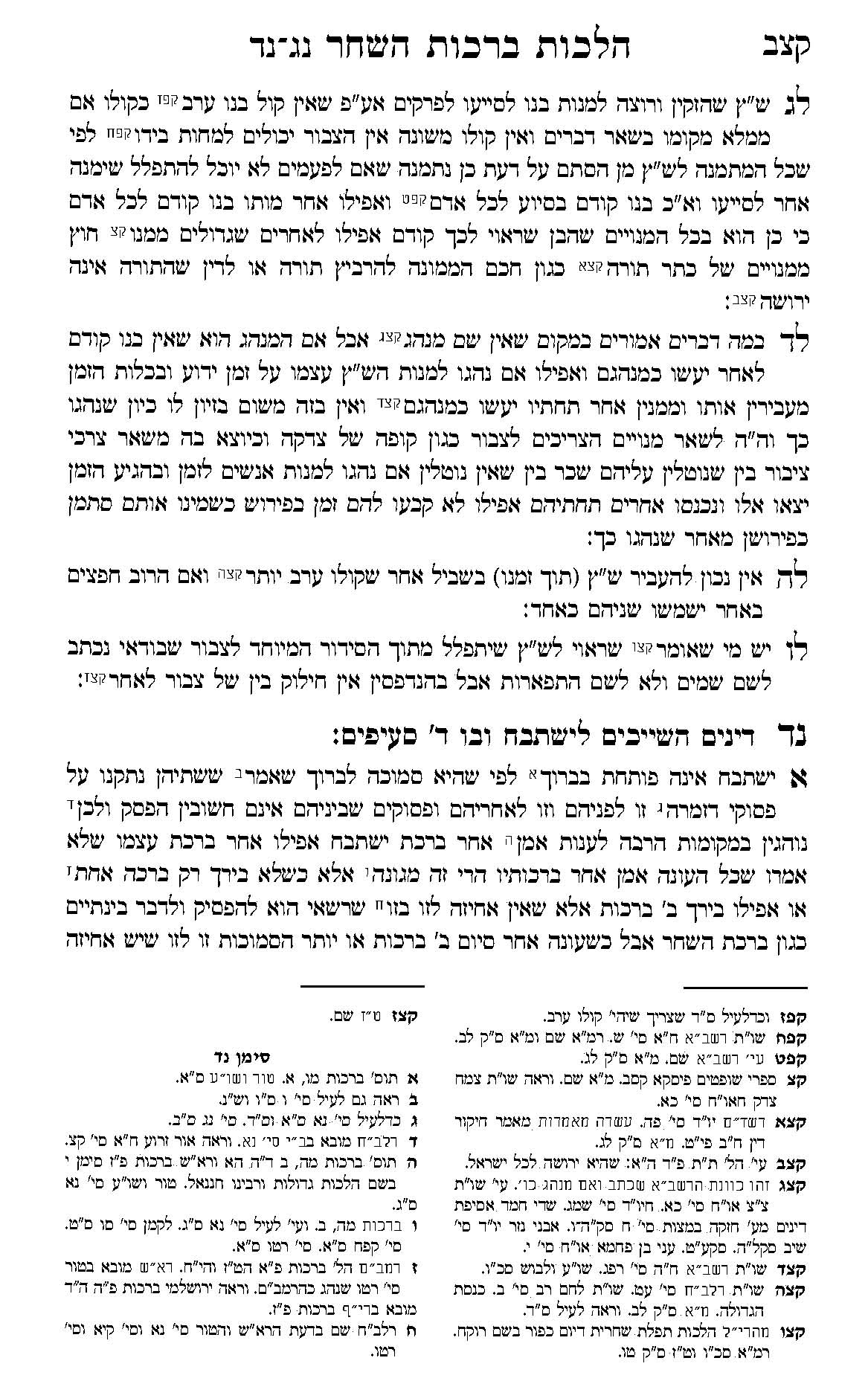
The Alter Rebbe (O”C 53, 33-34) writes that firstly in regards to a position of Torah – such as a chacham who is appointed to teach Torah or to be a judge there is no automatic inheritance for “Torah is not inherited”;  It is free for anyone to take it. Thus, anyone capable of assuming the post has a right to the vacated position no less than a son. The community thus decides.

alter rebbe oc 53 33-34

[Does the Alter Rebbe’s “Torah category” include a Rav, Dayan or Rosh Yeshiva? Please comment]

On the other hand

1) A non-Torah job such as a Chazzan, then his son, if he fits the position of course, come before other candidates.

2) Now if the Minhag is for the son NOT to inherit his father’s position then all candidates have an equal chance. And in such a case, where the Minhag was not for a son to automatically inherit the position, was the scenario the Rashba was referring to. But if there is no such Minhag then the community must adhere to the Torah principal of a son inheriting his father’s position.

Photo by Nachman Hellman

In short the Alter Rebbe’s opinion is that with regard to inheritance:

  • All positions (except a Torah one) must follow the Torah law.
  • Where there is a Minhag not to follow it!

[Is this a case of Minhag mevatel Halacha?… Please comment]

The Chasam Sofer (O”C 12 ) has a different take on this. He also says that any Torah position is free for all to take. But his opinion is that:

  1.  Any position of authority and communal obligation (like a king) falls into the Torah directive of a son inheriting the position, and
  2. This rule does not apply to any non-authoritative position such a Chazzan or Rav (who is a purely Torah figure with no authority or obligation…).

PDF: chasam sofer oc 12

chasam sofer oc 12


Thus the Rashba, who was referring to a Chazzan, states that one should follow the Minhag and not follow the Torah directive.

We spoke about the story of Rebbi – Reb Yehuda Hanasi – who instructed that his son Reb Gamliel should inherit him as Nasi despite his other son Reb Shimon being a greater Talmud Chacham.


Yanki confirmed via Chazzan Kwartin in his famous piece on the Asara Harugei Malchus that it was in fact Reb Shimon the son of Reb Gamliel who was martyred.

The Tzemach Tzedek (OC 21) writes that the categories (and the reconciliation of the Torah instructive and the Rashba) of the Chasam Sofer are “dochuk“, meaning difficult to accept.


Interestingly, the Chasam Sofer, ten years after penning his first letter had second thoughts about the idea that a Rav has no community obligation.  See here (13)


Makos 12b (2). Shiur 1/26/15

Makos 12b (2)

Thanks to Eli Chitrik

  1. The Gemara mentions that if a person who is already in the Arei Miklat kills beShogeg again!!!!! he needs to go to Galus.  But he is exiled from his neighborhood to another within his Ir Miklat, being forbidden to roam around the entire Ir Miklat he must stay in the confines of the neighborhood.

So now there are two Goel Hadams running after this fellow refugee. He is protected from the first as long as he stays in the city limits. And protected from the second as long as he stays inside his new neighborhood.

Based upon this the Aruch Laner brings up an interesting question.

What happens if this shlemazel leaves the neighborhood (the second place he went to) but stays within his Ir Miklat?

The second Goel Hadam is permitted to take revenge on him since he left the new designated neighborhood (within the Ir Miklat!).

Asks the Aruch Laner: Perhaps the first is also permitted to take revenge because although he has not left the city confines and he is still in the Ir Miklat, he nevertheless has left the ‘new place of refuge’ where he must be confined to!

And as Berel (from the famous Malachowski family) pointed out, this is a good ‘Heiche Timtza’ of how a Goel Hadam is permitted to kill the refugee inside the Arei Miklat!

2 The Luzzatto family was discussed.:


Firstly the holy Ramcha”l,  Reb Moshe Chaim Luzzatto who was a Mekubal and prolific writer who lived in the times of the Baal Shem Tov.  He authored  the Mesilas Yeshorim. The Tzemach tzedek mentions him at least one time.

On the other end of the spectrum is Shmuel Dovid Luzzatto, known as the Shada“l. (See here in English Hebrew)


Note: we mention these two individuals with the same family name – taking note that of them being worlds apart– to discuss the novel idea of the Shada”l in regards to the entire concept of “Arei Miklot”.


FULL DISCLOSURE


The writings of Shada”l is not something that Orthodox Jewry commonly quotes. His novel ideas are generally frowned upon. Although he was  personally frum and a staunch defender of the frum world, his ideas on translating. emending and explaining Tanach are viewed as crossing the line of our Mesorah. See here


The Rebbe references an antique manuscript that was edited by Shada”l. See here. (Thanks to David Olidort for this reference)

olidort


Background to one of Shada”l’s novel ideas:


The much quoted Rambam in Moreh Nevuchim about the nature of the Korbonos. He states that the commandments to bring sacrifices were merely a method to gradually wean people away from sacrificing to Avoda Zara.


See here and more.


The Ramban objects (to say the least) to this. And of course Kabalah and Chassidus could not agree more with the Ramban. See Basi Legani etc.


Now to our topic: Shada”l  takes the Rambam’s reasoning to explain the idea of Orei Miklot.


In days of old it was common for revenge to be extracted by the victim’s family from killer. Regardless if the death was intentional or not.

At Matan Torah, in order for to establish some form of order and justice the Torah subscribed rules on how to deal with murder. It was the intention NOT to allow revenge killings under any circumstance.

Therefore, when it was clear that the murder was intentional, the Torah mandates that accused is to be judged and protected by Beis Din from the avenging family. It is up to the courts to pass judgement and if found guilty to put to the murderer to death.

However,  if the killing was done inadvertently, although Torah allows the Goel Hadam to pursue the murderer, the Torah clearly prefers and attempts to prevent revenge killings through the escape of the Arei Miklat.  Time is given for tempers to calm down.


A novel idea from the Shada”l.


Makos 12 b. Shiur by Alex Heppnheimer

Makos 12b.

Shiur by Alex Heppnheimer

Special thanks to Alex Heppenheimer and Eli Chitrik.

We went over the story (mostly previously told in Sanhedrin) of how Yoav ended up holding on to the horns of the mizbeach – and the whole “cycle of violence”.


1) First, Avner kills Asahel (Yoav’s brother) who had been chasing him with intent to kill (leading to the question: was Avner justified in doing so, or should he have attempted to disable Asahel rather than killing him? And did his well-placed blow prove that he knew exactly what he was doing?). Then – count #1 against Yoav – he kills Avner (was he justified in doing so, as the goel hadam for his brother Asahel?).

2) Next, years later comes count #2: Yoav kills Amasa (who had been sent by David to gather the army but had delayed in doing so: was Yoav justified since Amasa disobeyed the king, or was Amasa correct because he didn’t want to interrupt the chachamim’s beginning of a new masechta?)

3) Finally – count #3 – Yoav joins Adoniyahu in his abortive attempt to become king against David’s wishes (thus making Yoav a mored-b’malchus). David’s last testament to Shlomo includes that he should punish Yoav for these killings (David himself was never able to do so, because he needed Yoav too much).

So Yoav had quite a few people possibly gunning for him (for the above mentioned reasons):

  • the Sanhedrin
  • Avner’s and Amasa’s goalei hadam
  • and Shlomo

The Rambam, presumably based on our Gemara, says that only the mizbeach in the Beis Hamikdash protects a rotzeach, and then 1) only if he’s standing on its roof and 2) is a kohen performing the avodah. However, he then adds two things that aren’t so obvious: 3) that it protects only a shogeg and not a mezid; and 4) the mizbeach protects him even if he’s only next to it, and even if he’s a zar, from the king killing him according to din malchus (extra-judiciously), or the Sanhedrin killing him based on horaas sha’ah.

Which leads to a lot of discussion. For one thing, the Kesef Mishneh asks: if so, then Yoav didn’t make any mistakes – he was trying to save himself from din malchus! Also, he asks how Tosafos can say that ultimately Yoav was able to “beat the rap” on the killings and was executed only because of count #3, when the pesukim clearly state that it was because of counts #1 and #2 (Avner and Amasa)?

On that last question, Kesef Mishneh says that maybe indeed a mored bemalchus isn’t protected by the mizbeach.

That in turn leads to a question discussed by R. Yechiel Yaakov Weinberg (Seridei Eish – mentioned in the Shiur points a couple of weeks ago (see here in English Hebrew), and here : why would din malchus be more lenient than mored bemalchus? Shouldn’t it be the other way around, since the latter is a judgment call on the king’s part, and he can overlook the person’s disobedience if he wants?

He answers with an interesting chiddush: in a case of din malchus – where the Sanhedrin couldn’t convict the guy because of technicalities (such as a lack of edim vehasra’ah) but where we know he’s guilty (or in our case, where Yoav claims to be a shogeg, because he thinks he was entitled to kill Avner and Amasa) – the king becomes the goel hadam. And so, just as the mizbeach protects from the goel hadam, it protects from din malchus too. Whereas a mored bemalchus is guilty al pi Torah (all the more so according to Tosafos in a number of places in Shas, that he has to be judged by the Sanhedrin), so the mizbeach doesn’t protect him, just as it doesn’t protect any other person who is chayav misah.

Now, last week it was mentioned that the Yerushalmi says that indeed Yoav didn’t make a mistake – when it says he ran to the “corners of the mizbeach,” it means the Sanhedrin. The Mirkeves Hamishneh explains: he did actually hold on to the corners, but his purpose was to get out of the jurisdiction of din malchus (as per Rambam) and put himself under the jurisdiction of the Sanhedrin.

Then, he figured either he’d be able to escape, or that he’d be able to convince the Sanhedrin that he had good reasons for the killings. (And if worse came to worst and the Sanhedrin didn’t buy those reasons, at least his “estate planning” – as discussed previously – would have worked.)


What happened in the end, though, was that he realized that the king could send the goalei hadam against him – and then even if he climbed onto the (roof of the) mizbeach, he’s still a zar (and it’s the wrong mizbeach anyway) – so at that point he realized the only thing he can do is make sure David’s curse against him is lifted (and placed onto Shlomo and his descendants, as we learned in Sanhedrin), and then at that point he was ready to give in, leave the mizbeach, and let Benayahu get him.

This also explains why the Gemara doesn’t add another mistake of his, that (per Rambam) the mizbeach protects only a shogeg and not a mezid: he argued that indeed he was a shogeg.

*The Gemara then goes on to tell about the 3 mistakes the Sar Shel Romi will make in the future: attempting to escape to בצרה (rather than בצר), and overlooking the fact that he’s a mezid (not a shogeg) and that he’s an angel (not a human).

There is a vort that all three of these mistakes are refuted in the very pesukim where בצר and the other two arei miklat are designated. The Torah says:

אשר ירצח את רעהו בבלי דעת… את בצר… וזאת התורה אשר שם משה לפני בני ישראל.

“בבלי דעת” – not a mezid; “את בצר” – not בצרה; “לפני בני ישראל” – not malachim!

The Chasam Sofer gives a deeper explanation of this Gemara.

The three arei miklat that Moshe designated represent three reasons that Hashem is willing to forgive our aveiros. (1) בצר means “reduction” (as in בציר מהכי), and it represents the fact that we Jewish people are humble. And ראובן, ראו מה בין בני לבן חמי – look at the difference in this regard between the Jews and the goyim. (2) For those Jews who do feel proud – רמות, “heights” – that can be attributed to גד, the fact that they have good mazel. (3) We are in גולן בבשן, in galus בין שיני אריה, between the teeth of the lions.


Now, the Sar Shel Romi – who also wears lots of other hats: הוא שטן, הוא יצר הרע, הוא מלאך המות – figures to use the first of these. He’s a very humble fellow, after all – like a persistent shnorrer, he’s learned to set aside his self-respect and keep bugging us! So he tries to “run away to בצר.”

His mistakes, though, are: (1) his “humility” is the wrong kind. Ours is to increase the glory of Hashem (represented by the last hei of His name), while his is to decrease it – to “בצר” the “ה”. Thus he winds up in בצרה. (2) Sure, some of us are meizidim, but after all, it’s he who’s convincing us to do so! Which makes him the mezid and us the shogegim. (3) All malachim are humble – they all have bittul to Hashem – so what does he think makes him special? And with all of that, he’s defeated.