Makos 8a
Thanks to Eli Chitrik
- The Mishna states the following:
The Torah gives an example of killing someone inadvertently as “chopping wood in the forest and the axe slips and kills a bystander”. The example is to teach that just as chopping wood is voluntary, not a Mitzvah, so too, any act causing death in order for the law of exile to apply must be an non-Mitzvah action. This excludes for example a Shliach Beis Din (agent of the court) who inadvertently kills someone, since they killed while engaged in a Mitzvah.
What is the definition of the “Shliach Beis Din” who killed someone? It cannot mean giving extra lashes (39 plus) because on Daf 22b it states that if extra lashes are given and the person dies it is a case of Golus if given unintentional, or Mayzid if done intentionally.
Rashi here learns that it is someone who was assigned the Task of giving Malkus to someone and inadvertently killed him. Meaning within the amount of lashes he was appraised to be able to receive.
The Raava”d however objects, being that before the court administers Malkus, it medically evaluates the offender and determines how may lashes he can sustain without dying, thus if the agent killed the offender by applying this precise number of Lashes, he should be exempt from exile because the death was not his fault (it was an Oines). Thus, there is no need for the Posuk to exclude him from Golus.
To resolve this problem, the Raava”d explains that the agent inadvertently killed the victim by mistakenly losing count and applying an extra lash.
Therefore it is would be a true Shogeg and without the exemption of the Torah he would be be exiled.
The Ramaba”m explains the Mishnah totally different. According to him the agent mentioned here was serving as a marshal, which entitles him to use force to compel people summoned by the court to appear.
- In light of this Machlokes the Chasam Sofer has a very interesting Teshuvah.
He was asked the following question:

A Jewish cleaning lady was prank’d on, and because of the shock of the prank she passed out. Her employer, the wife of the house, reached for some alcohol (A kapitchke) to give her in order to wake her up. Those were the days….
Accidentally she reached for the petrol, which she gave to the Jewish cleaning lady, resulting in her immediate death r”l.

The Chasam Soifer was asked if the poor housewife would need Kaparah and be obligated to go to Galus?
Very methodically he goes through all 3 Shitos and concludes that we must say the right interpretation is the Raava”d’s.
And he makes a Kal Vochemer to our case:
In the case of the Mishna, the Shliach Beis Din finished administrating all the necessary Malkus and the Mitzvah was finished. Nevertheless if he gave him one extra hit he is not obligated to exile because it was ‘part of the Mitzvah’. How much more so in our case where the Jewish lady was involved in the Mitzvah of bringing someone back to life, of course she does not need Kapara and would not be be Chayav Galus.
And he goes a step further:
Even according to those opinions that any time your actions causes death, (see Shiur Points of 9/10/14. Item #3) despite it being indirect (Like the Story with Dovid and Doeg) you need Kaparah,
in our case since this lady was employing poor Jewish workers which is a great Mitzvah, even that small Kaparah is not necessary for her.
Interesting to note his opinion on the importance of hiring Jewish workers- especially needy ones!
See here the Teshuvah at length.
- The Gemora discusses the possibility of chopping wood for a mitzvah and offers two examples. 1- Wood for the Mizbeach .2 Wood to build a Sukkah. It then states that chopping wood for the above examples is not a Mitzvah for itself but rather a Hechsher Mitzvah as opposed to the actual building of the Sukkah which is a Mitzvah in itself.

In Tanya IGH”K 20 the Alter Rebbe explains the importance of Mitzvos and how it is the ultimate purpose of creation. He adds quoting the Yerushalmi that even Reb Shimon bar Yochai, who due to his intense Torah study, would not interrupt his studies for prayer, nevertheless he would most ‘definitely stop for Lulov’.
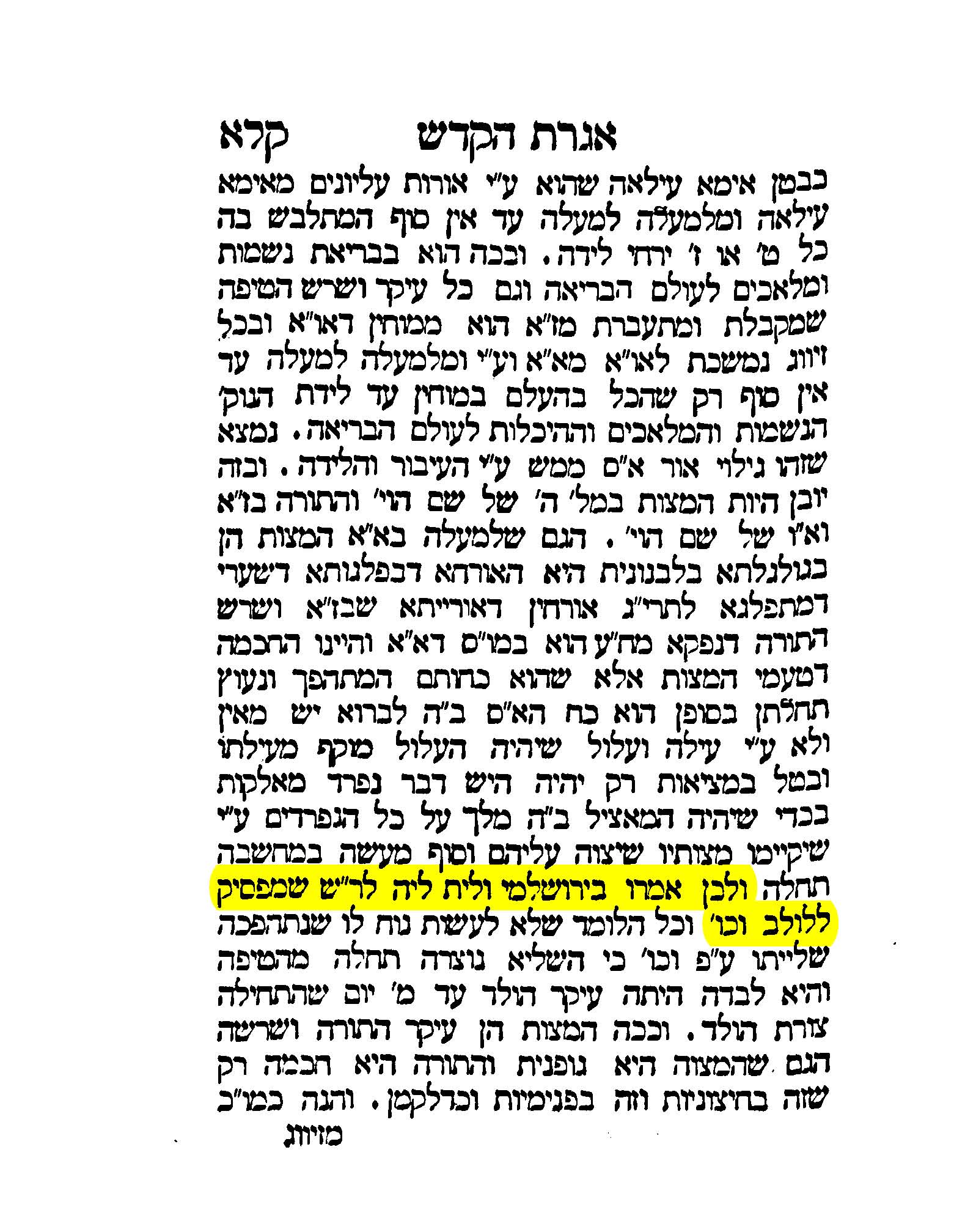
What is the meaning ‘stopping for Lulav’? Binding the Lulav together or shaking it?
See here the Rebbe’s comments.