Shiur 06/27/17 – Beitza 22b


Beitza 22 a-b


1- Our Gemara addresses medicinal treatment on Shabbos for an eye condition that does not pose a threat to the life of the patient. The only dispute regarding this issue presented in the Gemara is whether the Jewish patient is permitted to assist the non-Jew with the treatment, but all opinions agree that a non-Jew may be asked to administer this treatment.


2- A Baraisa records a dispute between Beis Shammai and Beis Hillel regarding the permissibility to bake thick loaves on Pesach.


R’ Huna defines a thick loaf of having the thickness of Tefach based on the precedent of the Lechem Hapanim.
 

R’ Yosef questions whether one could use the Lechem Hapanim as precedent for baking thick loaves on Pesach.
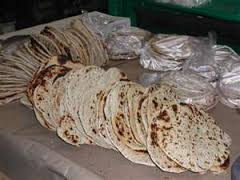
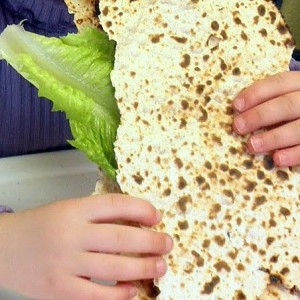
Yemenite Matza


R’ Yirmiyah bar Abba in the name of Rav explains that the dispute in the Baraisa relates not to the thickness of the loaves but to the number of loaves that are baked – פת עבה = פת מרובה – , and the issue here is regarding baking more than necessary on Yom Tov.


This explanation is unsuccessfully challenged and a Baraisa is cited that supports this explanation.


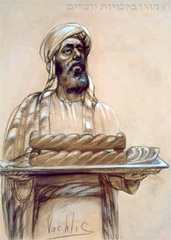
3- We discussed the Lechem Hapanim and the meaning of “Panim. On the surface it means that it was shaped like a U and thus had ‘sides’ and therefore called Ponim.


We spoke about the issue of eating a cake with that has letters on it.
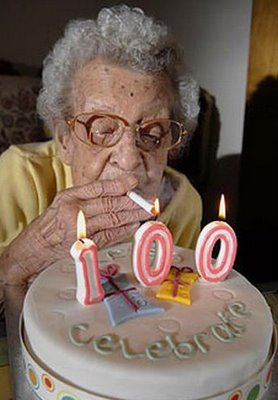
 

We read the text of the Ramo. The Mogen Avrohom (6) adds that the prohibition is not limited to letters but also to pictures. צורות.
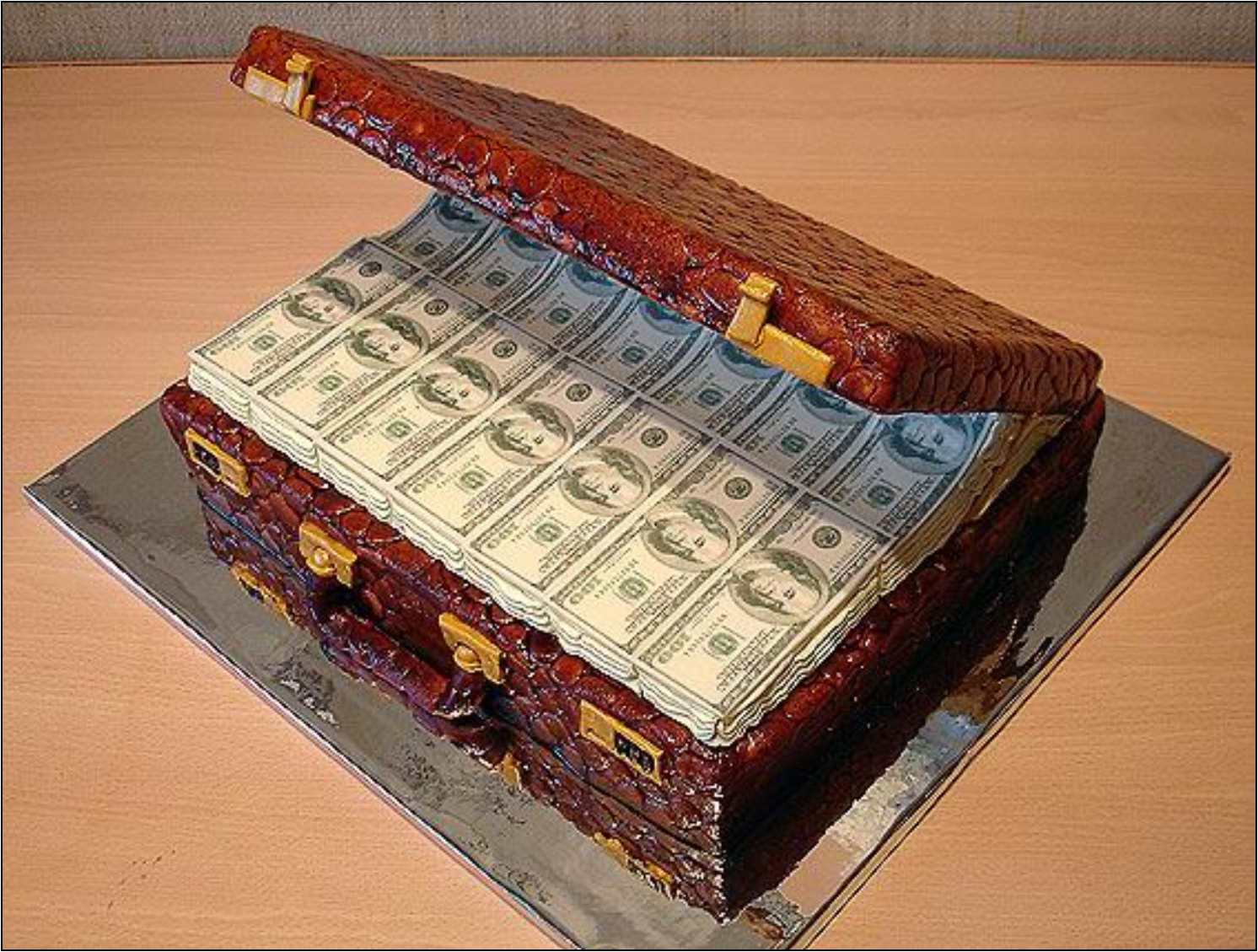
We then discussed shapes- meaning if the cake or cookie itself is in the form of shapes. The Mogen Avrohom brings an opinion that it is permitted but ends of with a צריך עיון.


The Alter Rebbe writes about letters. Not shapes. Here.


4- We mentioned the interesting take of the Yavet’z. His opinion is that the Lechem Haponim means “faces”. Literally pictures! He states that from the fact that the Lechem Haponim were eaten on Shabbos is proof that one may eat cakes and breads that have a form of letters and pictures!
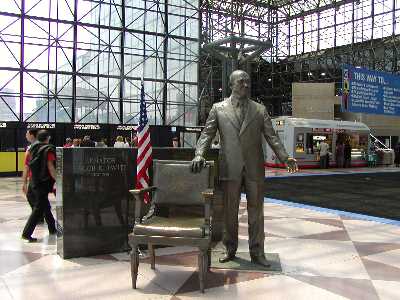
Image result for jacob javits statue

Sen Jacob Javits


See here and here.

5- We mentioned the old Yeshivi’she saying that to be successful in learning one must be like a Kosher egg…..

The siman of a Kosher egg is that one end is round and the other pointy. Both round or both pointy are non-Kosher.

In learning, round on both sides (diligence but with non-sharp head) or sharp on both ends (sharp mind but no diligence) is not a good sign.

To be successful one needs to be round on the bottom…. meaning ‘zitz fleish’…… and sharp on the top meaning a sharp mind…..

Related image

See here.

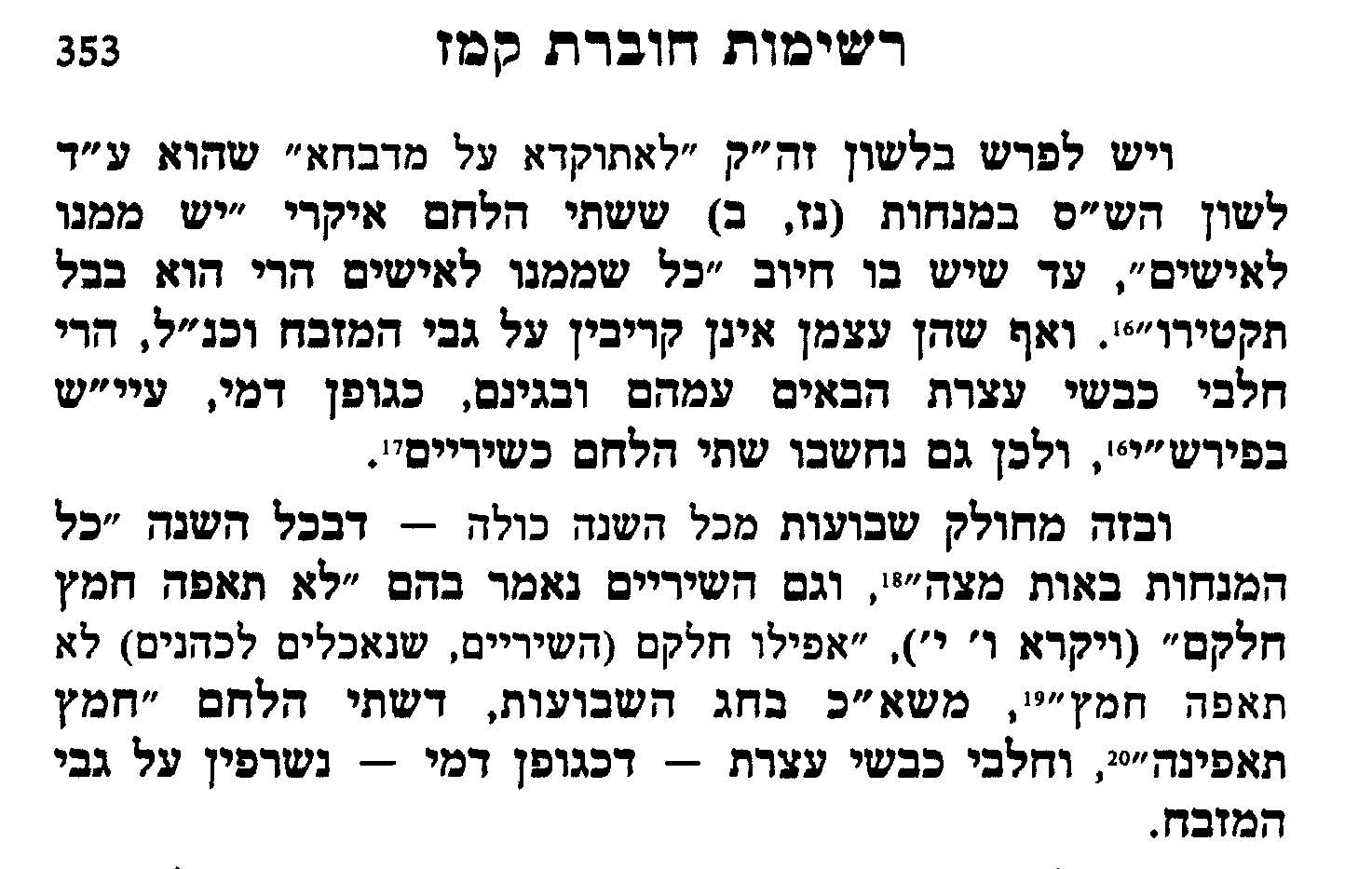
6- For Gimmel Tamuz we studied a footnote (18) written by the Rebbe where he writes that “it is a sharp idea” !

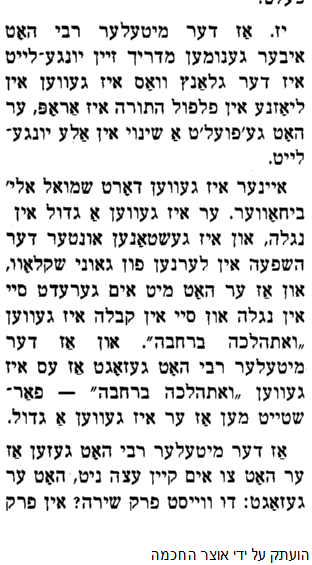
Here is the accompanying page:


נֶ֚פֶשׁ כִּ֣י תֶֽחֱטָ֔א וּמָֽעֲלָ֥ה מַ֖עַל בַּֽיהֹוָ֑ה וְכִחֵ֨שׁ בַּֽעֲמִית֜וֹ בְּפִקָּד֗וֹן אֽוֹ־בִתְשׂ֤וּמֶת יָד֙ א֣וֹ בְגָזֵ֔ל א֖וֹ עָשַׁ֥ק אֶת־עֲמִיתֽוֹ:
אוֹ מִכֹּ֞ל אֲשֶׁר־יִשָּׁבַ֣ע עָלָיו֘ לַשֶּׁ֒קֶר֒ וְשִׁלַּ֤ם אֹתוֹ֙ בְּרֹאשׁ֔וֹ וַֽחֲמִֽשִׁתָ֖יו יֹסֵ֣ף עָלָ֑יו לַֽאֲשֶׁ֨ר ה֥וּא ל֛וֹ יִתְּנֶ֖נּוּ בְּי֥וֹם אַשְׁמָתֽוֹ:
פאה פרק ח משנה ח
מי שיש לו מאתים זוז, לא יטול לקט שכחה ופאה ומעשר עני.
Theft $50.00 היו לו מאתים חסר דינר, אפילו אלף נותנין לו כאחת, הרי זה יטול.
“Choimesh’ $12.50 היו ממושכנין לבעל חובו או לכתובת אשתו, הרי זה יטול.
1/5 of $62.50 אין מחייבין אותו למכור את ביתו ואת כלי תשמישו.
משנה ט
מי שיש לו חמשים זוז והוא נושא ונותן בהם, הרי זה לא יטול.
Investment $50.00 וכל מי שאינו צריך ליטול ונוטל, אינו נפטר מן העולם עד שיצטרך לבריות.
Total Profit $150.00
Monthly $12.50


Beitza 22a.

Beitza 22a.


1- We began with the Gemara: Aba bar Marta asked Abaye if one may extinguish a flame on Yom Tov for the sake of “Davar Acher

Abaye first replied that one should use another house (or room) and not extinguish a flame.

If no other house is available, then one may set up a partition (Mechitzah) in his room.

If no partition is available, then he should place a utensil over the candle.


Utensil over candle

If none of these alternatives are available, one may not extinguish the flame.

We discussed as to why if Abaye maintained that one may not extinguish a flame for the sake of “Davar Acher,” then why did he not say so in the first place?

הלכה ואין מורין כן…


2- We tried to give a general overview of one of the fundamental (and difficult) issues in our Mesechtah.


Briefly:

1- The Torah only permits work on Yom  Tov that is ‘for the purpose of eating’.

2- The principle of “Mitoch” teaches that any Melachah permitted for the sake of Ochel Nefesh is also permitted for other purposes. Such as carrying a siddur to Shul.  

3- Extinguishing a flame is prohibited according to the Chachamim who prohibit ‘machshirim’ – or preliminaries – and permitted according to Rebi Yehuda who permits ‘machshirim’.


So far so good.


The problem is the ruling in our Gemara where it concludes that one is not permitted to extinguish a candle for “Davar Acher” because it is ‘machshirim’!


How is extinguishing a flame ‘machshirim’?


The Melachah of Mechabeh-  כיבוי ,extinguishing, is clearly permitted for the sake of Ochel Nefesh, as the Gemara teaches on the next Daf, when it says that one is permitted to grill meat on top of burning coals on Yom Tov even though the fat that drips from the meat extinguishes the coals. This is even according to the Chachamim!


מתוך שהותרה לצורך אוכל נפש…


Since “Mitoch” permits one to extinguish for any purpose, why does the Gemara here question whether one is permitted to extinguish a fire on Yom Tov? Moreover, why does the Gemara conclude that one is not permitted to extinguish a fire in our case?

Similarly, the Gemara teaches that the act of Mechabeh is permitted for other forms of Ochel Nefesh: When a flame is smoking and is going to ruin the food, one is permitted to extinguish the flame in order to save the food.

Since Mechabeh is permitted in that case because of Ochel Nefesh, why is it not permitted for other purposes because of “Mitoch”?


We spoke about the long Kuntres Achron of the Alter Rebbe that tackles this issue.  We the comments of the Sfas Emes and the Avnei Neizer on the Alter Rebbe.


3- We had a brief farbrengen in honor of Avrohom Niyazof’s yom Holedes.  


We spoke about the famous ‘Perek Shira’ which is an ancient Jewish pamphlet that contains 85 sections, in each,  elements of creation beginning with the sun and moon and ending with animals, use various verses in order to sing God’s praises.


See here in Hebrew.


The Alter Rebbe mentions this composition in a few places. See here.


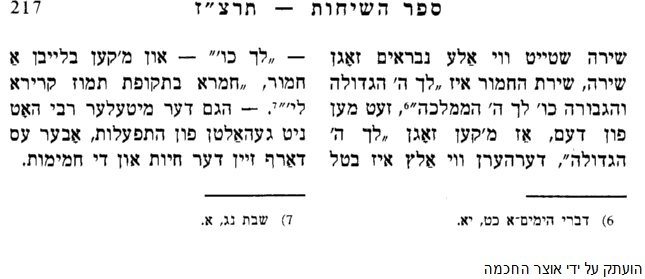
We mentioned the sharp words of the Miteler Rebbe utilizing the verse said by the mule.


Shiur 06/06/17 – Beitzah 22b

Beitza 22b.

1- Our Mishnah relates that Rabban Gamliel enumerated three opinions of Beis Shamai that he and his family followed. This is despite the fact that Halacha (and descendants of Hillel) generally follows Beis Hillel.

Image result for cover pot with towel

The first one is regarding the permissibly of Hatmanah (vs שהייה– insulating water- on Yom Tov right before Shabbos.

a- R’ Huna explains that the dispute between Beis Shamai and Beis Hillel regarding insulating water refers to a case where the person did not make an eiruv tavshilin. The reason Beis Hillel permits insulating the water is that in such a circumstance they allow another person to make minimal preparations for him for Shabbos. (see below)

Image result for necessity vs luxury

Beis Shamai would agree, except for Hatmanah. Why? Because keeping food warm is a luxury. Thus, someone that forgot to make an Eiruv Tavshilin is not granted a pass for Hatmanah.

b-  Rava maintains that Beis Shammai and Beis Hillel are discussing a case where an eiruv tavshilin was indeed made.  Nonetheless, Beis Shammai say that insulating is unique because it is obvious that it is done for Shabbos – i.e, later on in the evening and not for immediate use. Thus it is prohibited.

Related image

c- Abaya offers an alternative explanation of the dispute. According to Beis Shamai (as per Chanania) one needs to make a separate eiruv tavshilin each for cooking, baking and Hatmanah.

Performing one does not permit the others. So this chap made an eiruv tavshilin for cooking but not Hatmono. Beis Hillel say he can do all forms of work on Yom Tov for Shabbos. Beis Shamai limits him to cooking only.

2- We discussed the text of R’ Huna above and a Beraisa: ” A person did not make an eiruv tavshilin may have another person make minimal preparations for Shabbos.

One loaf of bread.

Image result for loaf of bread

One cooked dish.

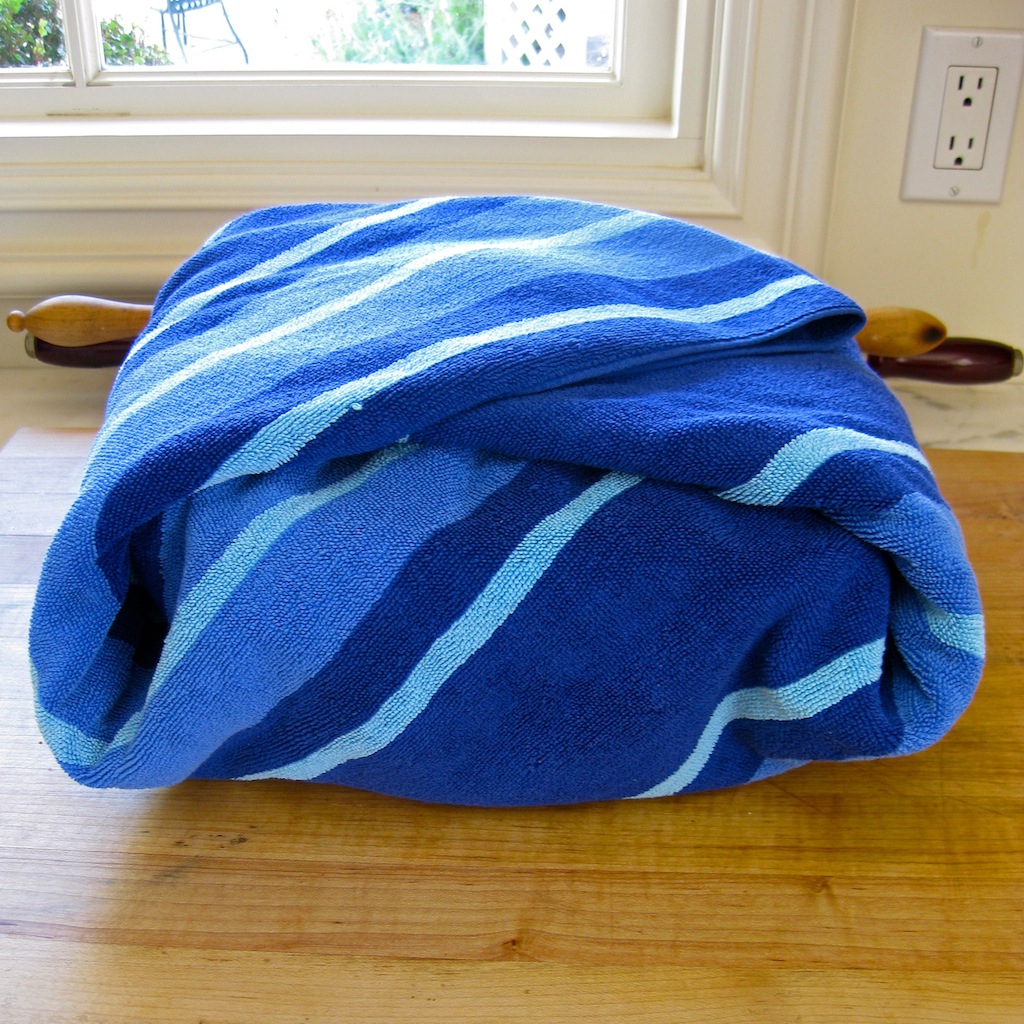
One insulated pot.

Image result for pot wrapped in towel

A candle may be lit for him.

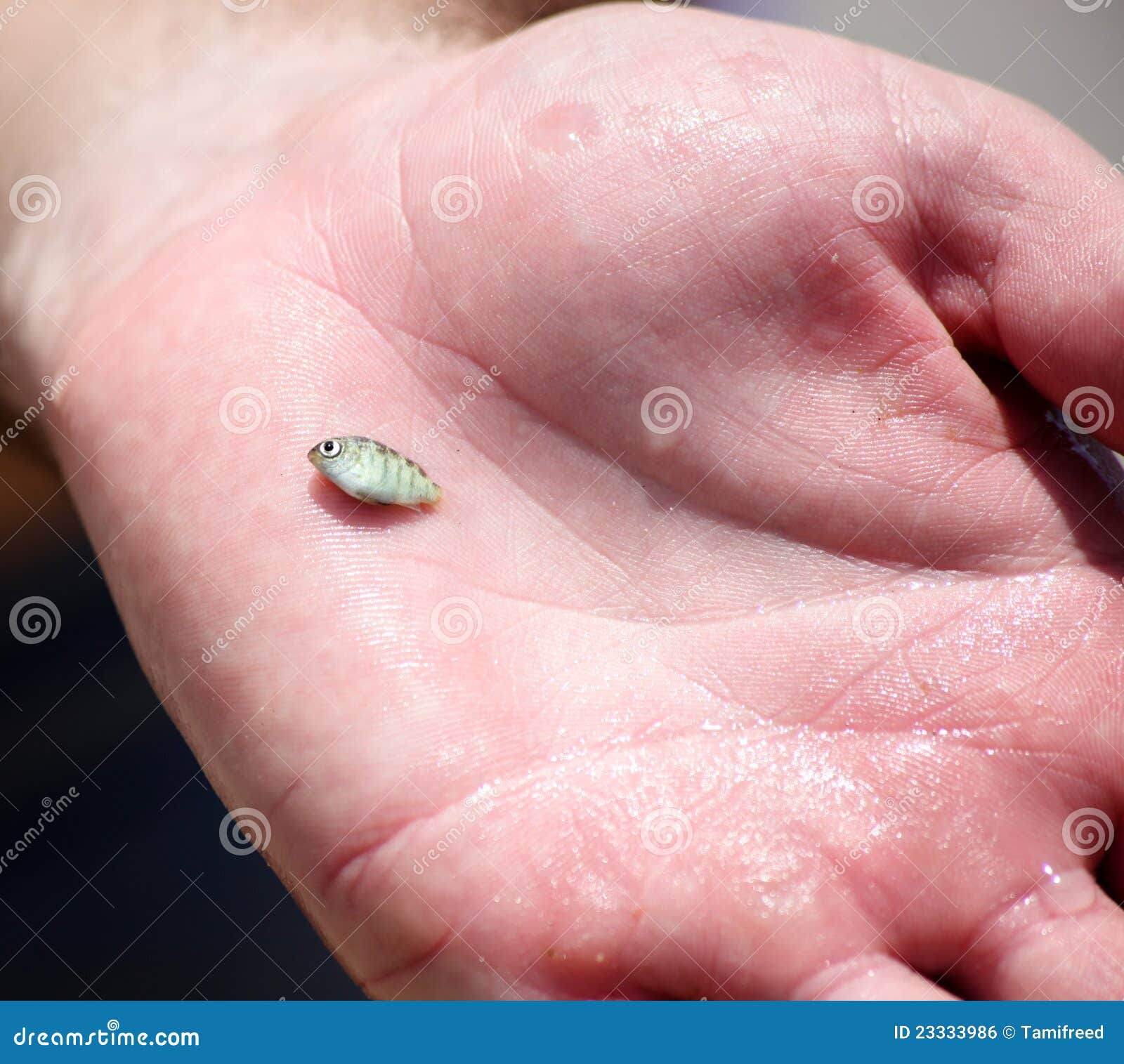
One small fish. (Herring?)

Image result for tiny fish

One pot of hot water.

Notice the omission of the word one when referring to candles.

The Rif and the Rambam see this as evidence that one may light as many candles as one wishes (despite his not making an eiruv tavshilin) and derive from this that one need not to mention in the eiruv tavshilin the “lighting of candles”. That type of work needs no eiruv tavshilin.

Image result for many candles

Tosfos argues and one needs to mention all types of work. That is the accepted Halachah.

“בדין יהא שרא לנא לאפויי ולבשולי ולאטמוני ולאדלוקי שרגא ולתקנא וולמעבד כל צרכנא מיומא טבא לשבתא לנא ולכל ישראל הדרים בעיר הזאת”. תרגום ללשון-הקודש: “בעירוב זה יהיה מותר לנו לאפות ולבשל ולהטמין ולהדליק נר ולעשות כל צרכינו מיום טוב לשבת, לנו ולכל בני העיר הזאת”.

3- The second one is regarding the permissibly of ‘straightening the candlestick’.

Image result for bent candles

What does that mean?

R’ Chinana bar Bisna explains that the dispute relates to the issue of whether or not the prohibitions against construction and demolition ( בונה     and/or סותר) apply to utensils. Building or destructing a keli – יש / אין בנין בכלי.

A related incident is recorded where the Shammash of Ula tilted the oil candle to cause the candle to extinguish sooner.

Image result for tilted oil candle

We learned the Tosfos that explains the prohibition is not because one hastens the extinguishing later on. That would be permitted, such as placing buckets of water to stop an approaching fire. The issue here is that at the moment that one reduces the amount of oil the luminous of the candle is diminished. 

Similarly, adding oil is prohibited only when the candle will emit more light as a s result.

The Rosh argues on this:

אבל הכא השמן והפתילה שתיהן גורמים את הדליקה והממעט מאחד מהן וממהר את הכיבוי חייב

4- We related a story that pertains to our Gemara. Here it is from the Internet:

Once, the Rebbe of Ger, zt”l, came to visit Rav Chaim Soloveitchik, zt”l, the Rav of Brisk. 

Related image

The two spent a long time in private conversation in a side room, and when it was time for the Rebbe to take his leave, the Rav accompanied his guest to the door. 

Just before he left, the Rav of Brisk asked his illustrious visitor a question. He said, “I have always found a certain statement of Chazal quite perplexing. Perhaps you have an answer. 

The Midrash on Parshas Tetzave teaches that we find that Rabbi Chaninah s’gan kohanim said: When I served in the Beis HaMikdash, I would light the menorah on Rosh HaShanah, and it would miraculously stay lit until the following Rosh HaShanah. 

But we know that lighting the Menorah was a positive commandment that was to be performed every single day! How could it be that they did not fulfill a מצות עשה for an entire year?” 

The Gerrer Rebbe answered without missing a beat, “Don’t we find that it says in the Baraisa brought in Beitza 22a that one who adds oil has transgressed the prohibition of מבעיר ?This is true even if a person only added a single drop. If so, it could have been that they added a single drop of oil every day for the sake of fulfilling the mitzvah, and because it was only a drop, there was also a miracle occurring. בדיעבד ,adding less than the full amount of oil to the Menorah is not מעכב “!

With that the Rebbe went on his way. 


Afterward, the Rav of Brisk praised the quick-witted response to those with him. “What a lovely p’shat,” he said. “Wonderfully clever!


Shiur 05/16/2017 Beitzah 21 a, b

Beitza 21a-b.

1- So the story is about Shimon of Timna who missed coming to the ‘Drashah’ of Reb Yehuda on the night on Yom Tov.

We mentioned that this is perhaps the ‘minhag’ to go on ‘tahalucho’ to say/hear a dvar Torah on the second night of Yom Tov.

Illustration photo by Mendi Toledano

Shimon replied that his town was besieged by a garrison  –  “בלשת” –  of soldiers who threatened to loot all Jewish monetary possessions. In order to appease them the Jews prepared a meal by slaughtering a calf for the soldiers to feast on. Being occupied with this unfortunate situation, concluded Shimon, did not allow him to attend the  ‘Drashah’ of Reb Yehuda.

Image result for roman garrison
בלשת

Reb Yehuda tells Shimon “I wonder if your gain (of averting the looting of property) is negated by the loss of transgressing the prohibition of cooking for a goy on Yom Tov.”

Or as Binyomin Rosenberg phrased it: The Juice is not worth the squeeze.  

Image result for jew cooking

From Reb Yehuda criticism of the actions of Shimon (slaughtering the calf and thereby saving the town from being completely plundered) it seems that if he were asked, his ruling would be to allow themselves to be robbed and  lose everything in order not to transgress the prohibition of cooking for a goy on Yom Tov!

2- We mentioned the general rule of how much a person is obligated to spend on Mitzvos.

The consensus is, as per the Ramo, that for a Mitzvas Ese  (or any passing Mitzvah) one needs to spend up to one fifth of his net worth. So if someone is stuck on an island and only one Esrog is available but at an exorbitant price, he is obligated to purchase it if the cost is up to a fifth of all he is worth.


Image result for 1/5

To put this in perspective: A homeowner living in in Crown Heights – BH the value of the property is easily $1 million. Say with a mortgage of $600,000 leaving equity of  $400,000….one would need to spend up to $80,000 for the אתרוג…

On the other hand, in order not to transgress a lo sa’se one must spend his entire net worth! 

For example, if one is forced to eat crabs and the only way out is to bribe his captors, he is required to give them all he owns not to eat the non-kosher food.

Image result for crab

3- Now let us understand the story of Reb Yehuda and Shimon.

The transgression of the prohibition of cooking for a goy on Yom Tov is an עשה.  One is permitted to cook on Yom Tov but only for the purpose of eating and for a Jew only.  לכם ולא לנכרי.  But that is an עשה, and a maximum of a fifth is to be spent as above.

So why did Reb Yuhuda rebuke Shimon? The town acted accordingly in not allowing to lose everything they owned just to fulfill an עשה!

4- We discussed the logic of the above rule. עשה versus  לא תעשה.

In general – which is more important? An עשה  or לא תעשה? From the fact that עשה דוחה לא תעשה  it seems that an עשה is greater.

The Alter Rebbe states it explicitly in the beginning of Igeres Hatshuva. [He explains there as to why תשובה for an עשה is easier that for a לא תעשה].

But in a certain aspect the opposite may be true. By not performing an עשה (like not eating Matzah) one does ‘nothing’. There is nothing ‘acitve‘ on his part by not eating Matzah. He just sits back and lets the night pass by.

Image result for clock runs out

Conversely, by transgressing a לא תעשה, one is actively performing a prohibited commandment. The חוצפה so to speak and the ‘rebelliousness’   – מרידה , is more evident in a לא תעשה than a מצוות עשה.

Related image

So perhaps this the reason one is required to spend everything on not transgressing a לא תעשה: One needs to avoid to ‘rebel’ at all costs!

5- In light of the above – we spoke about a case of transgressing a מצוות עשה, but with an act that is proactive – קום ועשה.

For example our case. Under normal circumstances the  לכם ולא לנכרי is a passive עשה. ‘Cook (but) only for yourselves’.

But in our case, by cooking for a goy, one transgresses the עשה in an active way!

So therefore Reb Yehuda was correct in telling them that they acted incorrectly for they needed to spend everything to prevent transgressing this עשה.

We mentioned the משנת חכמים  that tackles this issue. See here.

(ראה מ”ש בפת”ש סי’ קנז סק”ה מחלוקת הפוסקים אם החיוב בל”ת להוציא כל ממונו הוא דוקא בלאו שיש בו מעשה)

6- We also mentioned the מהרש”ם of Brezan and his take on this. In passing we spoke about his grandson the famous Magid from Yerusholayim.

We related one of his quips as to why American Jews assimilated.

See the Pushkas for Yeshivas.

7- We concluded with a riddle as to where the Alter Rebbe writes (and it pertains to our Gemara):

ומילתא דפשיטא שאין לסמוך על התניא


Shiur 05/02/17 – Beitza 21a

Beitza 21a.

1- A synopsis- We have been studying for a few weeks now the general consensus that all ‘נדרים ונדבות’ [Korbonos that are not obligatory but are ‘freely donated’] cannot be shechted and placed on the Mizbeach on Yom Tov.

Image result for sacrifices

Briefly, the reason to allow: 

Shalmei Nedava are partly eaten by both the Kohanim and the owners. Cooking for this purpose should be permitted on Yom Tov, as the tzorech ochel nefesh is clearly present.

The reason to prohibit: 

Part of the korban is partly consumed by the Mizbeach. That is not considesred ‘לכם’ and therefore cannot be brought on Yom Tov.

Our Gemara presents a final reason: משולחן גבוה קא זכו.

Image result for ‫מזבח‬‎

Meaning it’s not that the mizbeach and the Kohanim-owners ‘share’ the meat of the Korbon. Rather, the part not consumed upon the  Mizbeach is granted to the Kohanim and the owners from on High.

Thus the primary intent in the Shechita and burning on the Mizbeach is not for humans. It is for the Mizbeach.  Only afterwards, the Mizbeach ‘gifts‘ part of the Korbon to the Kohanim and the owners. It is therefore prohibited to be brought on Yom Tov.

Image result for grilled roast

On the other hand, Shalmei Chagiga, where even Beis Shammai permit its bringing on Yom Tov is because the Torah specifically instructs a person to bring this Korbon for him to have meat to be eaten on Yom Tov.

3- We mentioned a ‘Polisher Torah’….

Why does the Gemara discuss  [pros and cons above] only of the scenario of ‘nedorim unedovos’ and come to the final answer of  ‘משולחן גבוה קא זכו’?  What about the שתי הלחם? These loaves must baked before Yom Tov despite the fact that no part of them are ever placed on the Mizbeach. See here last week’s shiur.

Since these breads are eaten entirely by the Kohanim, why can’t they be baked on Yom Tov? The answer is, as above, ‘משולחן גבוה קא זכו’. But why does not the Gemara discuss it?

Image result for ‫שולחן עננים‬‎

So the Avnei Nezer answers that all the Kohanim had to share these two loaves and the Gemara says in that due to the large number of kohanim, each received a piece smaller than a ke’zaiyis’.

Now the Torah permits to cook on Yom Tov for the purpose of eating. (אך אשר ייאכל לכל נפש הוא לבדו ייעשה לכם . ” (שמות יב,טז “. By definition ‘eating’ means a Ke’zayis or more. Therefore the baking of the Shtei Halechem bread does not constitute ‘eating’ because of the small amount each Kohen receives!

Image result for one olive

3- Our Gemara relates the story of Rav Huna who when asked a question on Yom Tov responded in a perplexing manner by saying “ravens fly”.

Related image

We mentioned the Chasam Sofer’s explanation based on the the nature of a raven. Its color is black and is cruel to his children. The Gemara says that one who wants to succeed in his learning needs to be ‘like a raven’. ‘Blacken himself’, meaning to study diligently to the point of becoming ‘black with toil’. Also meaning that he needs to be ‘forget’ to his body, family and physical needs.

Rav Huna meant to say that he has been teaching from morning to afternoon on Tom Tov. It is now after Chatzos and he needs to begin seudas and simchas Yom Tov. So he says: No more questions, “ravens fly” – the time for ‘ravens’ (studying) has flown…… time to eat and feast on Yom Tov….

Image result for raven flying in sunset


Shiur 4/25/2017 – Beitzah 20b

Beitzah, 20b.

1- We studied the back and forth arguments concerning the machlokes if one may bring the korban Re’iya – עולת ראייה – on Yom Tov or one needs to wait until after the first day Yom Tov.

2- Our Gemara mentions the ‘Shtei Halechem’ –  שתי הלחם. On Shavuot the first offering from the new wheat crop, known as the “Shtei HaLechem” the two loaves, was brought as part of the Korbonos.


Related image

Along with the two loaves, two lambs were included in the offering. The priests would wave the lambs and the loaves in all four directions and up and down, and then place the אימורים of the   lambs on the mizbeiach (altar). The loaves were then eaten by the kohanim. 

Image result for 2 lambs

3- We mentioned a perplexing Zohar that seems to imply that the 2 loaves were placed on the mizbeiach and consumed by the fire as well. This is a difficult passage indeed since the ‘Shtei Halechem’ was chometz and there is an unequivocal prohibition from placing anything made with from chometz on the mizbeiach. 

The korbon Toda also needed 100 chometz loaves to accompany the animals but that too was never placed on the mizbeiach. 

So we related some interesting Chabad history:

The Tzemach Tzedek’s parents were Devorah Leah (daughter of the Alter Rebbe) and Reb Sholom Shachne Altshuler.

רבי מנחם מענדל שניאורסון (אדמו"ר הצמח צדק) – חב"דפדיה

Reb Sholom Shachne was a chosid of Reb M. Mendel of Vitebsk and was involved in the first printing of the Tanya. His name is mentioned in one Haskomo written by the  Alter Rebbe’s colleague.

Tib cim039.jpg
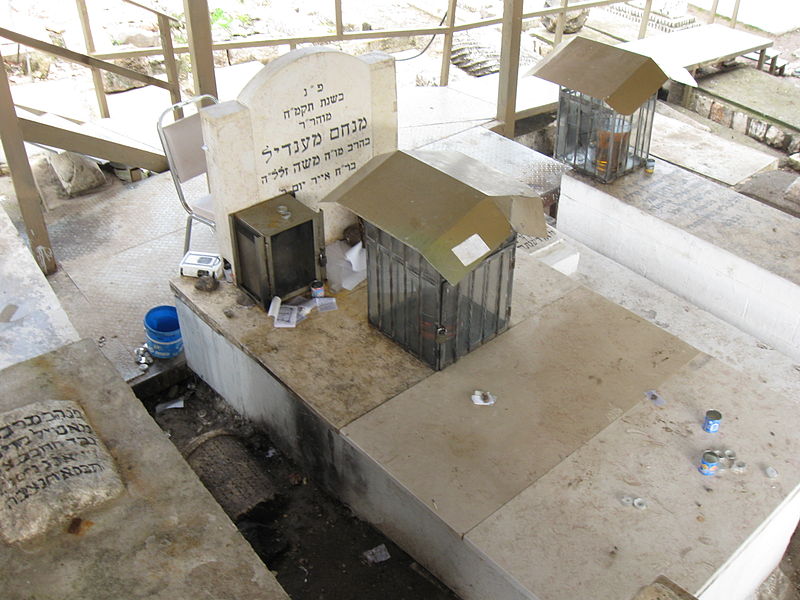
קברו בבית הקברות בטבריה

We’re familiar with the tragic story of Devora Leah who passed away as a young mother. But what happened to Reb Sholom Shachne? Well, he married Rivka [Riva’le] a granddaughter of the famed Reb Aharon Karliner.

[Rivale’s sister was Sara who married Reb Mordechai of Chernoble. עדן ציון 212].

In turn they had two daughters, Devora Leah (named after Reb Sholom Shachne’s first wife) and Ester Haddasa [Hodos]. Both were half sisters of the Rebbe the Tzemach Tzedek.

Devora got married, gave birth to Beila [Beilike] and tragedy struck again with Devora Leah (the 2nd) passing away at a young age. This young Beilike grew up in the home of  her cousin, the Tzemach Tzedek.

Now the Tzemach Tzedek had an elderly chosid by the name of Reb Yeshayohu Haleivi Horowitz. He was a descendant (9th generation) of the original Reb Yeshayohu Horowitz, the Shalo Hakodosh. After many years of a childless marriage  the Tzemach Tzedek tells him: Today in middle of Shmonei Esrei [at the brocho of ‘ato chonein’]  it occurred to me that you should get divorced, remarry and you will have children!

Picture

Lo and behold Reb Yeshayohu Haleivi Horowitz marries…..Beilike! They had five children and when Reb Yeshayohu passed away, (two years before the צמח צדק)  at the suggestion of the Tzemach Tzedek, Beilike moves with her 5 boys  to… Tzfas. They took part in the reestablishment of the Chabad comminity in צפת.

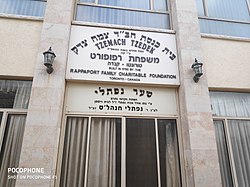
בית הכנסת צמח צדק חבד

See here a recently found and published letter to him concerning the shul in Tzfas. Page 14. See the footnotes there.

One of her grandchildren, Reb Yeshayohu Horowitz (the 3rd) was a great Talmid Chacham who was a member of the Beis Din in צפת.

[Parenthetically, another descendant was the sofer, Reb Yeshaya Matlin, who lived on Kingston Ave until his passing in 1996 and was the the sofer for 770 and the Rebbe. His children are Mrs. Zakon, Charitonov and Shechter].

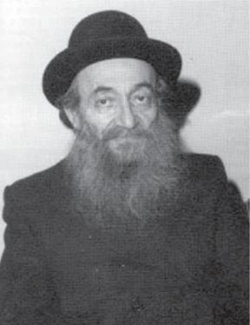
R Yeshaya Matlin

Reb Yeshayohu was a noted תלמיד חכם  and a multi-talented individual who eventually moved from Tzefas to Winnipeg Canada in 1923 where he was the Rov of the old Lubavitcher Shul there.

His books:

More

See in the preface where he writes his family history. When he mentions the Rebbe he added the ש”ב, meaning ‘my family’.

When the Rebbe Rayatz passed away he was one of the first people to write to the Rebbe to accept the ‘nesius’. The Rebbe responded to him saying “I’m shocked at the suggestion.  [that I accept and become Rebbe] …

ב”ה, כ”ו אדר ה’תש”י

הרה”ג הרה”ח הוו”ח אי”א נו”מ וכו’ וכו’

מהור”י שי’ הלוי

שלום וברכה!

… בטח הגיעו הקונטרס לפורים עם המצורף לו. כן הגיעני מש”כ על הביל ומכתבו מי”ג אדר. ונבהלתי בקראי אותו – לדרוש ממני ענינים שלא נתנו לי ואינם בי לא מהם ולא ממינם. ואין טענתי על כת”ר באשר אינו מכירי פא”פ אבל חקירה ודרישה הו”ל לעשות מקודם, כי דיני נפשות בזה. וה’ יזכנו כולנו להתקשר באילנא דחיי באמת.

My complaint is not against his Torah honor, as he is not someone who knows me, [we never met face to face]  but he certainly should have done prior research and inquiry , since this is an issue of life-and-death…..”.

דיני נפשות!!!

See here. (אגרות קודש, ג, ע’ תקעו)

After serving as a Rav there for many year Winnipeg he resettled back in Israel and passed away in 1978 and  is buried in Tzfas. Some of his descendants are became Chassidim of Breslov.

Now back to our question on the Zohar:

In 1944, Reb Yeshayohu Horowitz wrote to the Rebbe asking him to explain the Zohar. He quotes from the Shalo [his great grandfather x11+] that mentioned this Zohar. See here.

The Rebbe’s answer in brief (אגרות קודש כרך א, ע’ שז) is that the ‘Shtei Halechem’, although not being placed on the mizbeiach, the Gemara views them as part and parcel of the entire korbon of Shevuos. As opposed to the chametz loaves of the karban Toda, the ‘Shtei Halechem’ are considered a Mincha and thus part of the karban. They both comprise one unit.

Additionally, if the ‘Shtei Halechem’ are missing then the entire korbon is invalid. “The kevosim come because of the loaves”.

So when the Zohar writes that they ‘both’ were placed on the mizbeiach it means that by placing the animal parts on the mizbeach, the korban, both meat and bread, is validated.

The Rebbe also explains this topic as it is reflected in Chassidus.

The Rebbe wrote on this topic to Rabbi Pardes. Here.  and while living in France. See here.

Reb Yehaya Horowitz

Notes from Boaz Topol:


Auction of his notes on the Zohar. 

His lineage. 

תמונה

And:

בנו

שמואל היה עובד השם גדול שהתקרב לחסידות ברסלוב

נסע לאומן במסירות נפש וישב בכלא הרוסי הרב קוק סייע להוציאו מהכלא

אפשר לקרוא אודותיו בספר ימי שמואל

הוא נפטר עוד בחיי אביו ישעי’ה בשנת תשל”א כמדומני.

ר’ שמואל הורביץ הנ”ל מוזכר כמה פעמים בספרי הרב נריה (לפעמים, מוזכר שם גם שמו של אביו), למשל, ב’חיי הראי”ה’ עמ’ קעא.


Shiur 04/04/17 Beitza 20a-b

Beitza 20 a-b.

1- We went over the story of Hillel who brought his Olah to the Beis Hamikdosh on Yom Tov. He was confronted by the students of Shamai.


Image result for student confrontation beit hamikdash
Students of Shammai confronting

A discussion ensued and the rest is history… The Halacha was finally established like Hillel. One may bring the Olas Chagiga on Yom Tov which is completely consumed on the  Mizbeach, despite its having no other – מלאכת אוכל נפש – permissible use, such as eating of its meat.

The Gemara continues and relates another story, this time with an individual student of Beis Hillel bringing his Olah, yet again being confronted by a student of Beis Shamai, with the student of Hillel rebuking him. This story is perplexing: Was not the Halacha established in accordance with Beis Hillel?

Image result for korech
One Hillel sandwich, hold the tomatoes, to go

2- The Rebbe’s point is that despite the first story of Hillel and the acceptance by all of his opinion,  the custom was to not bring the Korban on Yom Tov. 

Image result for not today

This student’s action was the exception to the  normal custom.

3- The reason being that Shavuos is a Yom Tov that emphasizes the ‘Lachem’ – a must to eat and drink. As opposed to other Yamim Tovim that according to some opinions the the Lachem portion is optional.

(On the idea of what “lachem” means prctically

see תקכט דיני שמחת יום טוב ס”י)

To underscore the importance of ‘Lachem’ – Yidishkeit that encompasses gashmius as a fundamental basis of life:  Only karbanos which were eaten (e.g. Shlomim) were brought, even according to Hillel. As a result of this custom on Shavuos, all other Yomim Tovim followed not to bring the non-eaten Olah.

Image result for devash half and half

4- The Rebbe concludes that this is the source of the Alter Rebbe in Shulchan Aruch where he writes that ‘most Jews followed Beis  Shamai’.

5 – We spoke about the first story where Hillel tells the Shamai students that the animal he brought was a female when in fact it was a male.

A shepherd dresses one of his sheep in a Colombia national soccer team jersey before a Colombia vs. Brazil soccer sheep match in Nobsa, Colombia, Sunday, June 1, 2014. The match was part of the International Poncho Day, celebrated every year in this region of central Colombian where local craftsmen make sheep wool ponchos using ancestral techniques. (AP Photo/Javier Galeano)
מה טיבה של בהמה זו?

We read the text of the  the Alter Rebbe’s ruling that changing the truth is only permitted when relating a story of the past.  Discussed how this jives with our story.

6- We spoke about the Rebbe’s notes on the Haggadah regarding the status of the Yam Suf during its parting. Was the ground dry or semi dry?

See here at length.


Shiur 03/28/17 – Beitza 20a.

Beitza 20a.

1- We continued the discussion of last week concerning Maa’ser money.

Image result for ‫מעשר‬‎

We learned the Ramo, Shach and Taz.

See here

The final conclusion is that for items that one is obligated to do, Maa’ser money cannot be used. On the other hand items which are elective, such as buying an Aliya,  for this one may use Maa’ser money.

Related image
Can this be bought with Ma’aser?

Education for children is one item that a father is obligated to provide for (he can teach them himself if he so chooses). Thus Maa’ser money can not be used for tuition payments.

Image result for view from the bedroom
Dormitory

Yet, the cost of the food and dormitory is not something that a father is obligated to provide for above the age of 13. So this cost can indeed be paid for from Maa’ser money.’

Image result for hovel
“749”

See here at length an article that discusses these issues and more. Such as using Maa’ser money to buy a ticket to visit your Rebbe.

2- We tried to decipher a rather difficult piece of Gemara regarding the argument between Bais Shamai and Beis Hillel about the Semicha on animals.

The Gemara records two different traditions among the Tana’im with regard to the dispute between Beis Shamai and Beis Hillel about Semichah. Some Tana’im explain that the dispute is whether Semichah is permitted on Yom Tov or whether it is prohibited on Yom Tov because it involves a transgression of the prohibition against using a live animal (“Mishtamesh b’Ba’alei Chayim”). Others say that the dispute is whether or not there is an obligation to perform Semichah altogether for Korbanos of Shalmei Chovah (obligatory Korbenos Shelamim, as opposed to voluntary ones) even on a weekday.

Image result for ‫הלל הזקן‬‎

3- Next we moved on to the story of Hillel ha’Zaken who was approached by a large group of disciples of Shamai, who demanded to know what sort of animal he was bringing (they suspected that it was an Olah, and wanted to stop him from making Semichah on Yom Tov).

Image result for cow looks like a
What sort of animal is that?

He replied that the animal was a female (and must therefore be a Shelamim, and not an Olah); to prove his point (and put them off), he swished its tail. From this it seemed that Hillel seemed to have changed his mind. The students of Shamai seized upon this opportunity to establish the Halachah like Beis Shamai that day in the Beis Hamedrash, Ultimately, due to the intervention of one of the students of Shamai, Bava b.Buta, who crossed the aisle and cornered the market on Keidar meat, and then offering them to all to be used as offerings, thus assuring that the Halachah was fixed like Beis Hillel.


~ Short anecdote regarding Bava B Buta:

כאשר הרג הורדוס את החכמים, השאיר את בבא בן בוטא, כדי להתייעץ בו, אבל ניקר את עיניו. פעם בא אליו מחופש, ישב לפניו, החל לדבר רעות בהורדוס, וביקש ממנו שיקלל את העבד הרע הזה… בבא בן בוטא ניזהר מלהוציא דבר רע מפיו. לבסוף גילה שהוא הורדוס, שבא לנסותו, והביע לפניו את חרטתו על מעשיו. כששאל את בבא בן בוטא אם יש לו תקנה, הציע להורדוס לבנות מחדש את בית המקדש

ב”ב ג:ב-ד:א


Shiur 03/21/2017 – Beitza 19b

Beitza 19b

1- Our Gemara quotes a Beraisa in which three Tana’im argue about whether one may bring Korbanos of Nedarim and Nedavos on Yom Tov. They also argue about when one transgresses the prohibition of Bal Te’acher (see Chart). The Tana Kama says that one may not bring a Korban Todah on Shavuos because it is Yom Tov, but he may bring it on Sukos. The Gemara explains that he means that one may bring the Korban Todah on Chol ha’Mo’ed of Sukos.

Image result for ‫קורבנות‬‎

Why does the Tana need to teach that one is permitted to slaughter the Korban Todah on Chol ha’Mo’ed? It is not Yom Tov!

(סלותי מסלתינן – We touched briefly on the topic of assuming that shechting on Chol ha’Moed is actually permitted, either from a posuk, or m’drabbanan – from other gemaras).

According to  Abaye,  the Tana Kama teaches nothing about Nedarim and Nedavos on Yom Tov, rather his statement is intended to teach a Halachah with regard to the prohibition of Bal Te’acher – בל תאחר. Meaning that when one obligates himself to bring a Korban, he needs to fulfill his obligation within a certain amount of time.

The Tana Kama states that one who sanctified an animal as a Korban before Sukos is advised to bring it to Yerushalayim on Sukos (that is, not only may he bring it on Sukos, but he should bring it on Sukos). If he brings the Korban to Yerushalayim when he comes during Sukos, he will avoid the need to make a special trip to Yerushalayim after Sukos to offer the Korban before he transgresses Bal Te’acher.

Image result for ‫קרבן תודה‬‎

Since he cannot bring the Korban Todah during the other festivals (he cannot bring it during Pesach because of the loaves of Chametz that accompany it, and he cannot bring it on Shavuos because it is Yom Tov and since Shavuos has no Chol Hamoed yet – but Berel is working on it), he would have to make a special trip to Yerushalayim in order to avoid transgressing Bal Te’acher. Therefore, the Tana teaches that he should bring his Korban on Sukos, during Chol ha’Mo’ed, so that he not have to make a special trip to Yerushalayim.

2-  We diverged mid-Shiur to talk about the Ger Tzedek Avrohom ben Avrohom. [Thanks to Berel for bringing up this interesting topic]

Here is a brief bio from Wikipedia [with its usual skepticism] :

Abraham ben Abraham (Hebrew: אברהם בן אברהם‎‎, lit. “Avraham the son of Avraham”) (c. 1700 – May 23, 1749), also known as Count Valentine Potocki (Pototzki or Pototski), was a purported Polish nobleman of the Potocki family who converted to Judaism and was burned at the stake by the Roman Catholic Church because he had renounced Catholicism and had become an observant Jew.

Related image
The Vilna Gaon

According to Jewish oral traditions, he was known to the revered Talmudic sage, the Vilna Gaon (Rabbi Elijah Ben Shlomo Zalman [1720–1797]), and his ashes were interred in the relocated grave of the Vilna Gaon in Vilna’s new Jewish cemetery. Some historians who have studied his story have stated that surprisingly little evidence of Potocki’s existence has yet been discovered other than several 19th-century sources citing earlier oral histories, and they therefore consider that he most likely did not exist.

Thanks Boaz


See here:

http://www.daat.ac.il/daat/kitveyet/mahanaim/hagraf-2.htm

We discussed the fascinating “misnagdisher” result of him being burned at stake:

According to Jewish tradition, following Avraham ben Avraham’s death, the Vilna Gaon believed that the spiritual constitution of the world had become altered in such a way that a Jew was no longer bound to wash his hands in the morning (netilat yadayim) within four amot (cubits) of his bed, as explicitly taught in the codes of Jewish law such as the Shulchan Aruch and other halachic works. Rather, a Jew’s entire house would be considered as four amot for this mitzvah. This custom, begun at Avraham ben Avraham’s death, commenced with the Vilna Gaon and later became the practice of the Slabodka yeshiva in Europe, becoming today the routine of many leading Israeli rabbis who follow the Slabodka tradition.

See here:

הרב שלמה זלמן אוירבך אמר שמקובל לומר בשם הגר”א שאין להקפיד בהליכה ארבע אמות לפני נטילת ידיים, כיוון שיש אומרים שלאחר מותו של הגרף פוטוצקי, שמסר נפשו על קידוש השם, נחלשה

!הקליפה מאוד

כיתוב תמונה
הרב שלמה זלמן אוירב


See here a fascinating related subject, by Dr. Shneier Leiman- Who is buried in the Vilna Gaon’s tomb?

On the Ger Tzedek of Vilnius

3- The Graf Potozky’s undoing was, as per the story told, his rebuking a teenager for talking during Chazoras Hashatz. This lad reported him to the authorities and the rest is history…and negel vaser at the sink…….

We mentioned that the story repeated that the Alter Rebbe’s sharp words [last page of Tanya] against talking during Chazoras Hashatz using the term:

“How long will this be an obstacle for us? Have we not sufficient reproofs and troubles that have overtaken us?

בכתב יד: גוואלד גוואלד –  עד מתי יהיה זה לנו למוקש ולא די לנו בכל התוכחות  והצרות שעברו עלינו ה’ ישמרנו וינחמנו בכפלים לתושיה ויטהר לבנו לעבדו באמת.

 — refers to the story of the Graf Potozky!

That’s a difficult story to accept. Firstly, the last page in Tanya is not referring to talking during Chazoras Hashatz. It concerns davening without kavono.

Talking during Chazoras Hashatz is sharply rebuked upon in Igeres Hakodesh # 24.

Secondly, the story of the Graf Potozky occured in 1749. The Alter Rebbe was born in 1745!

4- We moved on to the Gemara’s next discussion.

Now there is an obligation on every Yom Tov to bring a Korban shlomim to have meat for simchas Yom Tov-  Shalmei Chagiga. [this is in addition to the Oilas Chagiga]

If a group is large, for all memebrs to have enough meat,  they may bring another supplemental shlomim- Shalmei Simcha.

The question concerns one who has a korbon Toda to bring. Being that is a Shlomim, there will be meat from this korban to be eaten by the donor.

Can he use this Toda meat for a dual purpose -for his korban Toda and to supplement the need of eating meat on Yom Tov?

The Beraisa states that for the Shalmei Chagiga one may not since one can not do two Mitzvos with one act. Shalmei Chagiga is a distinct obligation that cannot be fulfilled with another obligation such as a korban Toda.

Image result for 2 birds with one stone

On the other hand, the Shalmei Simcha can be indeed combined since there is no obligation per to bring such a korban. The obligation is to have enough meat – and any means that accomplishes it is fine.

We began to discuss the issue, based on this concept, that one cannot do 2 Mitzvos with one act. We went from there to the issue of paying for an Aliya with ma’aser money. Ditto for tuition. We mentioned Tosfos who points out that according to Rashi if the person says “על מנת” first,  before he took upon himself the obligation through “הרי עלי”, then it would work.

Much more next week.

Shiur 03/14/17 – Beitza 19a-b.

Beitza 19a-b.

1- Our Mishna discusses the machlokes of

Beis Shamai and Beis Hillel whether one may slaughter animals to offer as Shalmei Chagigah on Yom Tov.

Related image

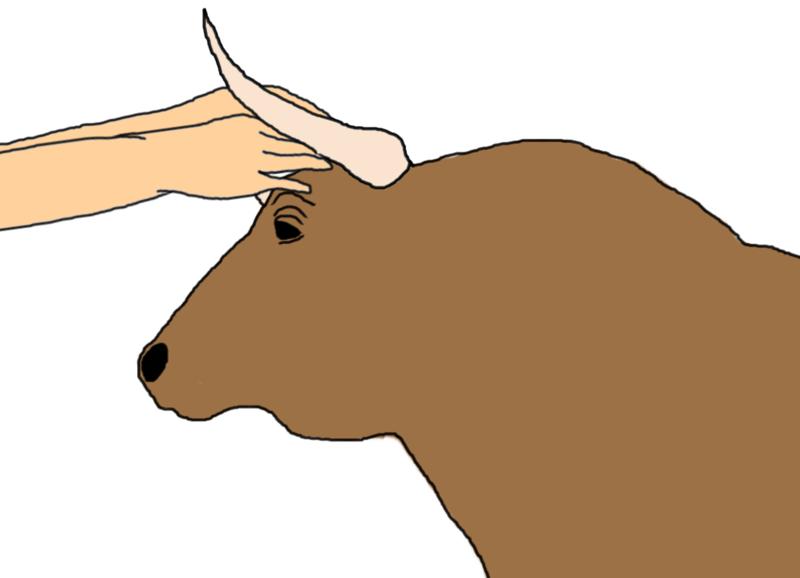
2- Additional, they argued if one is permitted to do the required  ‘semicha‘ on an animal.

Image result for ‫סמיכה‬‎

We discussed the history of this unique machlokes.

See here from chabad.org

The First Unresolved Halachic Dispute (Machlokes)

For more than 1,000 years, since the giving of Torah at Sinai, scholarship was on such a high level that no halachic question was left undecided. After an issue was debated, analyzed, and voted on, there was complete unanimity and clarity in the decision. However, in the days of Jose ben Joezer and Jose ben Jochanan, the initial Zugos, the first unresolved dispute arose. The case involved the permissibility of leaning one’s hands (semicha) on a sacrificial animal on Yom Tov, a holiday.


Image result for ‫סמיכה‬‎

The question was whether the mitzvah of semicha should be performed despite the prohibition of exerting pressure on an animal on Yom Tov. Despite the fact that only one dispute arose among the countless facets of Jewish law, and even that one was a relatively minor rabbinic issue, the Talmud viewed this event as a disastrous drop in Torah scholarship.

See more  here

3-  We began to talk about why this argument was not resolved for many years. To be continued.

4- The Gemara starts by quoting Ulla who says that they agree that one may not slaughter animals for Shalmei Nedavah on Yom Tov.

5- We discussed the regular korbanos tzibur that all agree were indeed brought on Shabbos and Yom Tov.

A korbon tzibur is defined as one bought from the machatzis hashekel collected every year.

Image result for ‫מחצית השקל‬‎

6- In short: We spoke about the previous Rebbe’s mamorim of 1934 while in Poland and their difficult and deep concepts. The complaint from some Chassidim that these mamorim were above the grasp of the crowd…..and thus the Rebbe should switch to easier mamorim…... The Rebbe’s disapproval of this comment to his father-in-law.

Image result for yosef schneersohn, maamor

The Rebbe printed these mamorim in 1951.

One idea discussed in the mamor is that despite reaching the greatest level of bitul (even in ruchniyosdike keilim) it still maintains somewhat of his earlier yeshus. The Rebbe adds a fascinating footnote.

ד”ה כי חלק תשי”א (תרצ”ד [קונטרס פג] סה”מ תשי”א ע’ 31)

Ki Chelek

See here. Bottom two paragraphs.

When one gives his machatzis hashekel we must say that his coin loses its individuality. It becomes part of the whole collection. For if not, then the korbon is not a tzibur one, but rather a korban of many individual people (like a partnership).

Image result for smelting silver

Thus all the coins in the collection necessarily need to become one entity with no ‘reference’ to the individual donors.

Nevertheless, we see that when Korach argued with Moshe Rabeinu, Moshe asked G-D  ‘al tefen el minchosom’. Meaning do not pay attention to their portion within the korbon tzibur.

Now how can that be if all coins must lose their individuality? Korach had no ‘portion’ per se as an individual in the pot of the machatzis hashekel. 

One must say, the Rebbe concludes, that despite the bitul of each coin within the total collection, it still maintains somewhat of its individuality.

Image result for individual


Ari Chitrik Shiur Points