Shiur 02/28/17 – Beitza 18b-19a

Beitza 18b-19a

1- Continuing the discussion concerning the toiveling of keilim on Saabbos and Yom Tov:

In the Beraisa, the Tanna Kamma and Rebbi Shimon Shezuri disagree about whether one may immerse a Keli on a weekday during Bein ha’Shemashos.

Related image

The issues:

  • Bein ha’Shemashos is a period of time of which we are unsure if it still day, night or both.
  • If it is night then Shabbos or Yom Tov have already arrived and the prohibition applies.
  • If it is day, the the tevila is permitted but the keli may only be used the following evening since we need
  •  הערב שמש – “He’erev Shemesh”.

So what is their argument?

When the Rabanan learned the Beraisa, they explained that the argument applies in a case in which a person was running with the Keli towards the Mikvah at Bein ha’Shemashos. He clearly wanted to immerse the Keli before sundown.

Image result for hurrying at sunset

The Tanna Kamma says that in such a case one may immerse the Keli during Bein ha’Shemashos on a weekday, since he demonstrates through his actions (by running with the Keli to immerse it before Bein ha’Shemashos) that he knows that the Keli needs “He’erev Shemesh” (sundown) in order to become Tahor for use with תרומה – Terumah.

Rebbi Shimon Shezuri argues and does not permit one to immerse the Keli during Bein ha’Shemashos, because he maintains that the person’s actions do not demonstrate that he knows that “He’erev Shemesh” is required (perhaps he was running in order to get back to his work). So he may toivel the keli and use it immediately.
2- We discussed the version appearing in our Gemara.

“a person was running with the Kli towards the Mikvah at Bein ha’Shemashos.”

The obvious problem is that if it is already 

Bein ha’Shemashos then in any case it is too late to toivel to allow the keli to be used that evening.

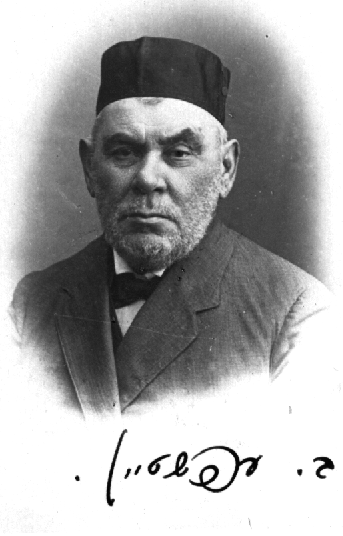
3- We spoke about the famous Reb Raphael Nathan Nata Rabbinovicz. Here is form the Jewish  Encyclopedia
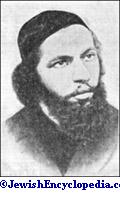
Talmudical scholar and antiquarian; born at Novo-Zhagory, government of Kovno, Russia, in 1835; died at Kiev Nov. 28, 1888. At the age of twenty-eight he left Russia, and, having spent some time in Lemberg, (Lvov) Pressburg, (Bratislava) and Eisenstadt, went to Munich, where he finally settled.

There he found buried in the royal library the famous “Codex Hebraicas.” This manuscript of the Babylonian Talmud was written in 1342 and had the good fortune to escape the hands of the censors. One hundred and fifty years before Rabbinovicz first saw this manuscript its significance had already been pointed out by R. Nathan Weil, the author of the “Ḳorban Netan’el,” but nobody had yet ventured to undertake the immense task of editing it. Rabbinovicz determined to make a critical examination of it. His task was greatly facilitated by the munificence of Abraham Merzbacher, a wealthy antiquarian of Munich, who appropriated a large sum of money for the maintenance of Rabbinovicz while engaged in his work of research, and who put his magnificent library at his disposal.

MAAMAR AL HADPASAT HA-TALMUD. Jerusalem; Mosad Ha-Rav Kuk, 1952.

Rabbinovicz spent six years in study and travel. During this period he visited many libraries in France, Italy, England, and Russia. Everywhere he gathered material for his magnum opus, the “Diḳduḳe Soferim.” In 1868 the first volume, comprising Berakot and Zera’im, was published. It was followed in quick succession by others; fifteen volumes were published by 1888; the sixteenth volume was being prepared for publication when death closed his career.

The “Diḳduḳe Soferim”  a work that is indispensable to the student of the Talmud and its antiquities, gave to Rabbinovicz a world-wide reputation. Scholars in every part of Europe, Jewish and non-Jewish, turned to him whenever a disputed point in Talmud needed to be elucidated.

4- Here are some other links.

The book – Dikdukei Sofrim

https://he.wikipedia.org/wiki/%D7%93%D7%A7%D7%93%D7%95%D7%A7%D7%99_%D7%A1%D7%95%D7%A4%D7%A8%D7%99%D7%9D

מאמר הדפסת התלמוד

http://beta.hebrewbooks.org/reader/reader.aspx?sfid=38519http://beta.hebrewbooks.org/reader/reader.aspx?sfid=38519

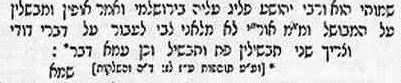
5- As one can see, in the said manuscript the words at Bein ha’Shemashos are omitted. See his footnote 50.

http://beta.hebrewbooks.org/pdfpager.aspx?req=38513&st=&pgnum=56

6- We finished with Gemara discussing a case where someone toivels keilim that are already tahor  in a mikva simply because… he wants the ‘extra’ tahara.
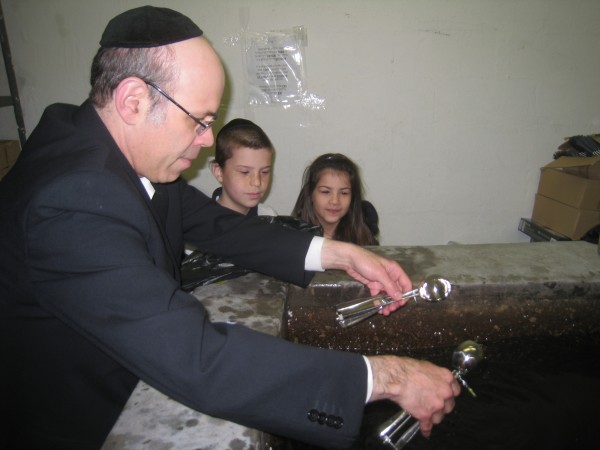
Image result for placing pots in mikva

Is that considered toiveling? or just….dipping? 😀


Shiur 02/21/2017 – Beitzah 18a-b.

Beitzah 18a-b.

1- This week we continued with the reasons as to why one may not immerse Kelim in a Mikvah on Shabbos and Yom Tov.


Image result for ‫מקוה כלים‬‎

2- The Gemara states four different reasons for the prohibition:

  • a) One might carrythe Kelim four Amos in Reshus ha’Rabim on Shabbos (Rabah – famous גזירה דרבה – below);

Image result for carrying heavy

  • b)-One might squeeze (Sechitah)the water out of clothing that required immersion (Rav Yosef);
  • c) one might delay (Shema Yeshaheh) immersing his Kelim until Yom Tov and then forget and use them for Terumah (Rav Bivi);
  • d) It appears that he is repairinga utensil (Nir’eh k’Metaken Kli  נראה כמתקן)  when he immerses it (Rava)

Image result for fixing a pot

3- The Gemara tackles reason ‘D’. If toivling keilim is Nir’eh k’Metaken Kli – נראה כמתקן  כלי  then a person should also not be allowed to use a mikva for the same reason?

The Gemara explains that when a person uses a mikvah it can viewed that he is not going for the purposes of tevila but to cool off.

It continues to explain this even if the water is cold, not clean and in the winter!

We discussed if the above can be understood even in a modern society.

4- We discussed the wide ranging opinions about using a hot mikvah on Shabbos and Yom Tov.

Image result for hot springs

5- We read the text of the Alter Rebbe regarding the toivling of keilim  where he brings down the machlokes if tevilas keilim is min haTorah or mide’Rabonon – טבילת כלים מן התורה, או מדרבנן.

The bottom line is that one should not toivel keilim on Shabbos. He suggests ways on how to get around this prohibition. One is use the kelim by gifting it first to a goy and then borrowing it back.

Image result for gift to a non jew

On Yom Tov it is permitted if he could not do it before Yom Tov.

6- We mentioned the פרי מגדים – Pri Megadim’s opinion that if one has only one becher for the arba koisos on Pesach but has not toilveled it (assuming he was able to do so before Yom Tov) he may not use it even it it means that he will not drink the wine.

Related image


Shiur 02/14/2017 Beitza 18a

Beitzah 18a.

1- The Mishnah (17b) states that both Beis Shammai and Beis Hillel agree that one may not immerse Kelim in a Mikvah on Yom Tov.

Image result for ‫טבילת כלים‬‎

The Gemara records four different reasons for the prohibition:

  • a) One might carry the Kelim four Amos in Reshus ha’Rabim on Shabbos (Rabah – famous גזירה דרבה – below);
  • b)-One might squeeze (Sechitah) the water out of clothing that required immersion (Rav Yosef);

Image result for squeezing water from clothes

  • c) one might delay (Shema Yeshaheh) immersing his Kelim until Yom Tov and then forget and use them for Terumah (Rav Bivi);
  • d) It appears that he is repairing a utensil (Nir’eh k’Metaken Kli  נראה כמתקן)  when he immerses it (Rava).

Image result for ‫תיקון כלי‬‎


We covered this week the Gemara’s questions to Rabah’s reason from a number of Beraisos

Rabah’s reason is a gezeira. This is the famed gezeira d’Rabbah that applies to Shofar, Lulav and Megillah. Namely, allowing these things on Shabbos may lead to one carrying the item four amos in a reshus  harabim on Shabbos –  שמא יעבירנו ד״א ברה״ר

So this gezeira applies also on tevilas keilim on Shabbos. We do not allow to toivel keilim on Shabbos least one carry them in a reshus horabim. 

Image result for ‫טבילת כלים‬‎

2- Rabah’s student Abaye repeatedly questioned Rabah’s reasoning.

Why can’t we toivel keilim on Yom Tov when carrying in a reshus horabim is permissible? Rabah’s response: it is because of a gezeira for Yom Tov because of Shabbos.

We discussed as to why this is not a gezeira lig’zeira.

2- The Gemara continues with more questions on Rabbah’s reasoning. One is from the Beraisa that states that a woman that has only one set of clothing and wants to purify herself and her garments; being that toivling garments is prohibited on Yom Tov , as above,  she can immerse herself while wearing the garments. The tevila will be effective for herself and her clothing.

Image result for why

The Gemara’s question is why is this allowed? The gezeira of not toivling keilim should be universal lest – אטו – one may toivel the garments independently.

3- We discussed the famous query as to when does one becomes tahor when toiveling in a Mikva. While under water or only once he  exits?

Image result for ‫מקוה‬‎

The Kesef Mishna’s opinion is that it occurs only upon exiting the water.

4- Let’s consider  the case of a person toivling in a Mikvah that has exactly 40 seah –  מ’ סאה – (the absolute minimum amount for a kosher Mikvah). When he exits the Mikvah he is considered tahor despite the fact that the few drops of water on him reduces the 40 seah and so the Mikvah is no longer Kosher.

But he is tahor nevertheless. Why?  Upon his exit, the Mikva was no longer Kosher. According to the Kesef Mishna, one becomes tohor only upon exiting – then this fellow exited a posul Mikva!

It is repeated that Reb Chaim of Brisk once explained that exiting a Mikva occurs not only when one actually exist the water but also when the Mikva exits him!

Image result for low tide

5- Last week we spoke whether guests need to make their own eiruv tavshilin. If they eat on their own then they surely need to in order to cook and light candles.

The question is if they will be eating at the table of their hosts.

Related image

See here an article by Rabbi Berel Levin on the opinion of the Alter Rebbe.

6- Another addition to last week. A grandson of Reb Akiva Eiger was a renowned mathematician and chess player by the name of Jakob Rosanes. See here and here.

Jacob Rosanes.jpeg


Shiur 02/07/17 – Beitza 17b-18a

Beitza 17b – 18a.

1- Our Gemara concludes the halachos of Eiruv Tavshilin.

Bottom line: Is a cooked item (Tavshil) sufficient, or does one need to have a baked item as well?

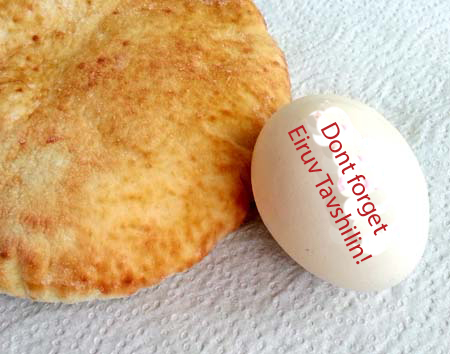
Custom Eruv Tavshilin reminder eggs Trademarked by AC  – כל הזכויות שמורות

We learned the Tosfos discussing the different opinions regarding this topic.

Rabbeinu Tam  writes that even Beis Hillel agrees that setting aside a cooked food permits one only to cook, fry, and boil (that is, to heat a food through the medium of a liquid – bishul) on Yom Tov for Shabbos. It does not permit one to bake (with dry heat) on Yom Tov for Shabbos. If one wants to bake on Yom Tov for Shabbos, he must set aside a baked item before Yom Tov.

His nephew Rabeinu Yitzchok (The “RI”) disagrees and maintains that a single cooked dish certainly suffices to permit both cooking and baking. He adds that the simple reading of the Mishna – “tavshilin” denotes that a cooked item (tavshil) is sufficient to do all work pertaining to food.

He nevertheless concludes that “my heart does not allow me to rule against my uncle and one needs to make an Eiruv Tavshilin with two items (cooked and baked) and that is the common Minhog”.

The Alter Rebbe rules like Rabeinu Yitzchok. See here #3 and further on #24.

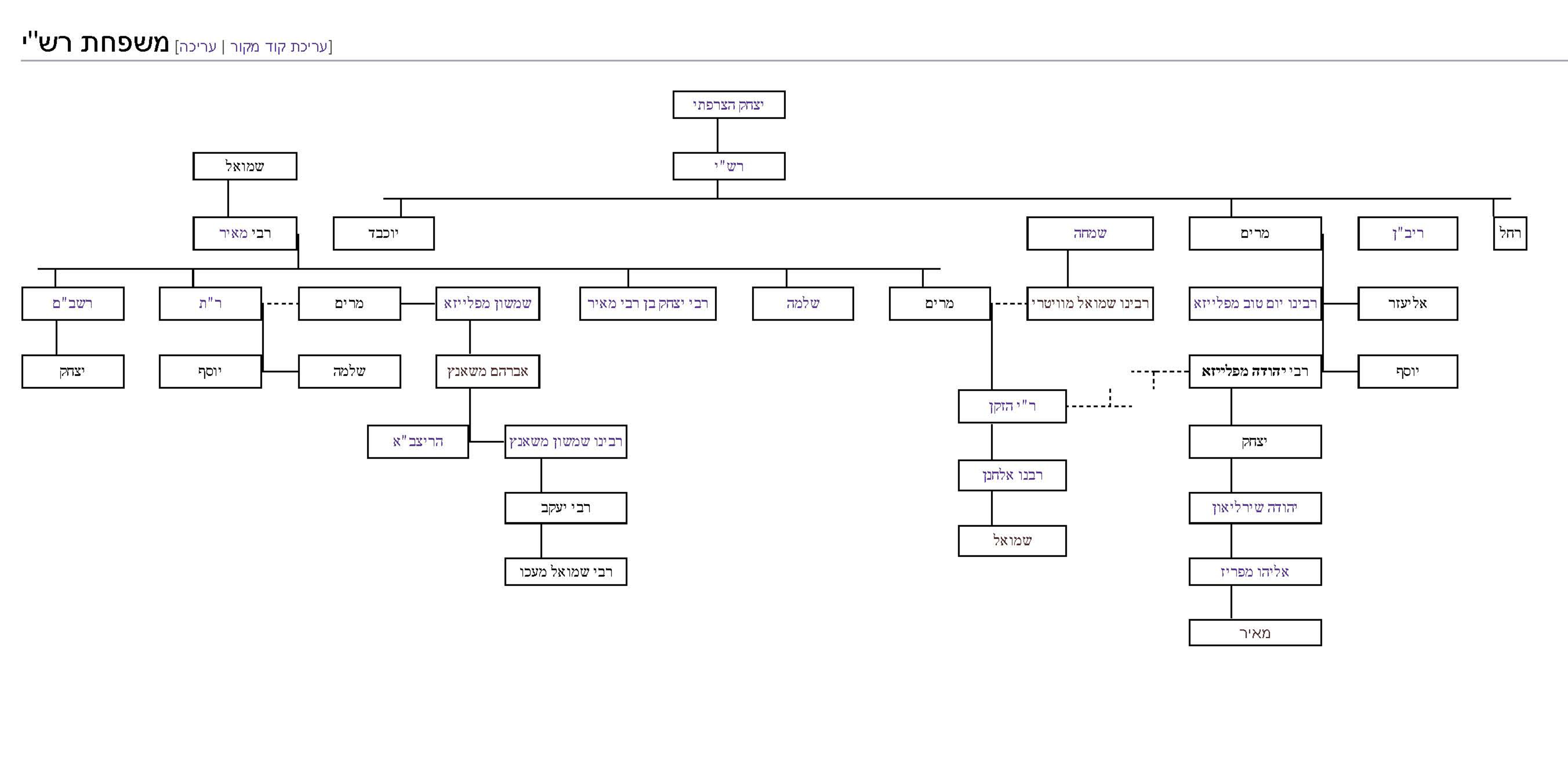
See here Rashi’s family.


2- The next Mishna discusses the topic of using a Mikva on Shabbos and Yom Tov. The opinion of both Beis Shamai and Beis Hillel is that on Shabbos one may not immerse keilim in the mikvah to purify them.


They do argue about a person using the mikvah on Shabbos and Yom Tov.

Image result for mikvah closed

We spoke about the lone opinion of Tosfos in Chulln that a person (not only a Kohen) has the obligation not to become tamei. Most opinions argue but all agree that before Yom Tov approaches, Min Hatorah one needs to make sure that he is tahor since he can enter the Beis Hamikdosh.

3- We mentioned the opinion of the Tzlach that it seems from the Rambam that even if one lives overseas (when there is a functional Beis Hamikdosh) he needs to become tahor!

רב יחזקאל לנדא

4- The first reason mentioned in the Gemara for the prohibition against tovling keilim is the famed ‘gezeira D’Rabbah’   גזירה דרבה שמא יעבירנו ד״א ברה״ר  – that one may carry the keli 4 amos in a reshus ha’rabim.

5- We related the story of Reb Leible Eiger – grandson of Rabbi Akiva Eiger-  as it relates to this Gemara.

See here and an interesting story here.

Found online one version of the story.

When Horav Shlomo Eigar’s son, Rav Leibele, left for the chassidic court of Kotzk and its Rebbe, his father was about to place an injunction of Kibbud av – binding him by the mitzvah of honoring one’s father – against his going. Rav Shlomo had strongly negative feelings against the Chassidus movement. When word of this parental injunction reached the Kotzker Rebbe, zl, the Rebbe remarked, “What a ‘partner’ does is done. Hashem is also a partner, and He facilitated R’Leibele’s arrival in Kotzk. The “other partner” cannot alter this.”

Rav Shlomo was despondent over his son’s decision, considering it a tragedy of epic proportion. He decided to travel to his father, Horav Akiva Eiger, who was the gadol ha’dor, pre-eminent leader of the generation, and solicit his advice. He described the terrible “tragedy” to his father, explaining that his son must have snapped. The Chassidic sect was not religious, and the chassidim were guilty of spreading a false culture, antithetical to traditional Judaism.

Image result
R’ Akiva Eiger

Rav Akiva Eiger was disturbed by his son’s blanket statements. Rav Shlomo was an outstanding Torah scholar and pious Jew. He was troubled by such statements emanating from him. He told his son that it is prohibited to accept lashon hora, slander, about an individual Jew, and certainly about a group of Jews. Since he saw how much the entire debacle bothered his son, however, he would travel to Poland to speak with his grandson. He would then determine whether there was a problem. Travel was not easy, and Rav Akiva Eiger was no longer a young man. Such a trip would take its toll on him, but he felt that he had to determine for himself the veracity of his son’s statements. He had to see for himself whether his grandson had gone off the derech, left the Torah way of life.

Rav Leibele was shocked to greet his distinguished guest. What could his revered grandfather want that he would put his health in danger by making such a trip? Rav Akiva Eiger embraced his grandson, kissed him and said, “When I meet one of my descendants, my custom is first to speak with him in learning. Only afterwards do we make time for pleasantries. He began, “The halachah is that one does not blow Shofar on Shabbos, because of Gezeirah d’Rabbah, the decree of Rabbah, who feared that one might forget and carry the Shofar four cubits in the reshus ha’rabim, public domain. A similar idea applies to Lulav. What troubles me is the following: In their commentary to the Talmud Shabbos 5b, Tosfos cite a question quoted in the Yerushalmi. According to Ben Azzai who opines that mehaleich k’omed dami, “One who is in the process of walking, who takes, say, two steps, is considered by Ben Azzai to have started and stopped a few times. Each time he places his foot down, he is considered to have placed his body down and come to a halt; and each time he has lifted his foot, he is considered to have lifted his body. According to this, how can Ben Azzai hold a person liable for transporting four cubits in a public domain on Shabbos? Each stride is considered a separate akirah and hanachah, lifting and placing, which is the primary criteria for liability for carrying on Shabbos. One must lift the object in one domain and place it in another. Ben Azzai separates each step, so there never occurs an akirah followed by a hanachah four cubits later. The Yerushalmi answers that, according to Ben Azzai, it must occur through the medium of jumping. One hops four amos in one stride.”

Rav Akiva Eiger looked at his grandson and asked, “We know that our sages do not issue a gezeirah, decree, in the event that the possibility of a prohibited occurrence is lo shechiach, unusual. Why would they prohibit blowing the Shofar on Shabbos or shaking the Lulav on Shabbos, because someone might carry it four cubits, when according to Ben Azzai this is only possible by jumping? Since the prohibition can only be realized in an atypical manner, Chazal will not prohibit it.”

Rav Leibele listened respectfully to the question, but was very passionate in his response. “Zaide, we are talking about Tekias Shofar, whose sound pierces the Heavens and creates a stir in the Heavenly spheres. It frustrates Satan, as it mixes him up. Lulav is not much different. How one toils to find a perfect Esrog, so that he can carry out the mitzvah of taking a beautiful fruit to serve Hashem! When a person seeks to understand the halachos concerning this mitzvah, he will do anything to locate a Torah scholar from whom he can learn. Is there a question regarding jumping? Who would not ‘jump’ to perform any of these mitzvos? I would not consider this an unusual act. After all, it is for a mitzvah!”

Rav Akiva Eiger stared deeply into the eyes of his grandson and replied, “I have another explanation, but – from your reply – I see that the approach taken by the chassidim to mitzvah performance is quite in sync with the Torah. They seek to add life, passion, feeling, emotion and joy to mitzvah performance. I will tell your father that he will have much nachas from you!”

Shiur 01/31/17 – Beitza 17a, b

Beitza 17 a-b

1- Our Gemara discusses the case of an individual that forgot to make an Eiruv Tavshilin and cannot rely on the Rov.

What is the consequence of not making an Eruv Tavshilin? There are two options:

  1. He is forbidden to cook for Shabbos, and his flour may also not be baked for Shabbos; or,
  2. He is forbidden but his flour is permitted.

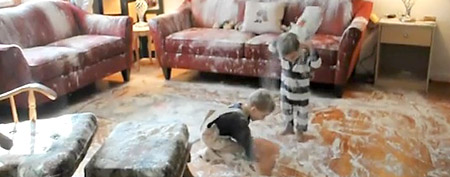
Image result for kids flour house

If we assume option 1 then his flour can be used by others.

If we assume option 2 then his flour is prohibited for him to use but it can be given as a gift to another person in order to be prepared.

We discussed the Tosfos that have another take on this. They quote this from the Be”hag, one of the few books written by the Geonim which we posses.

The Be”hag was the first one to itemize the exact 613 Mitzvos. The Rambam had many issues with the Ba”hag’s enumeration and listed them differently.

2- The next topic in our Gemara deals with someone that did not make an Eiruv Tavshilin but intentionally cooked or baked anyway. The question is, would he be allowed to eat the cooked food on Shabbos.


The Gemara quotes a Bereisa that allows a person who mistakenly ate his  Eiruv Tavshilin prior to cooking for Shabbos to add food for Shabbos into the pot of food being cooked for Yom Tov. But it concludes that one may not ‘cheat‘   בלבד שלא יערים – and cook a fresh pot (after the Yom Tov meal is cooked)  just for Shabbos.  The Gemara wants to compare the prohibition of ‘cheating’ and cooking intentionally without an Eiruv .

We discussed the difference between ‘cheating’ versus doing something intentionally.

3- The next topic were the seforim written by Reb Baruch Epstein. Son of the famous Reb Yechiel Michel Epstein  who authored the Aruch Hashulchan.

No…not this one.


Reb Baruch Epstein

We discussed Reb Baruch’s ‘history’ book ‘Mokur Baruch’ which contains many embellishments on the truth – primarily concerning his father’s visit to the Tzemach Tzedek. See here a critical review by the late Reb Yehoshua Mundshein.

Image result for and the darkness was thick

We read the text of his Chumash – Torah Temima- where he comes up with a unique take of the plague of darkness – Choshech. Trying to reconcile the saying of Chazal that the thickness of the ‘dark’ was the thickness of a Dinar coin, he suggests that a ‘skin’ (the thickness of a coin) was miraculously placed on the eyes of the Mitzriyim.

See here and next page.


Shiur 01/24/17 – Beitzah 17a

Beitzah 17a

1- Our Gemara talks about one who forgot to make an Eiruv Tavshilin.

Image result for calendar, one long day, yom tov

One of the ways that would allow him to cook on Yom Tov for Shabbos would  be to  make the Eruv on Thursday (Yom Tov) with a condition (Tenai) by saying, “If today is not really Yom Tov and tomorrow is, then I am making the Eruv today, and if today is Yom Tov and tomorrow is not, then I do not need an Eruv to cook tomorrow for Shabbos.”

We spoke as to why on he would need to make a condition? Why not just make an Eiruv Tavshilin on Thursday. If Thursday is a Yom Tov then no Eiruv needs to be made to begin with since Friday will be a weekday!

And if Thursday is a weekday then he is making a basic Eruv.

Image result for if then

2-  We discussed the famous ruling of the Rambam on this Halachah. He adds  that nowadays – when the two days of Yom Tov are observed not because of a doubt but because of the enactment of “Minhag Avoseinu” — “one may not make an Eruv with a Tenai… but rather it must be done only on Erev Yom Tov.”

The Rav’vad says that while the Rambam’s ruling has logical basis, there is no source for such a ruling in the Gemara or among the earlier Poskim. He therefore rules that one is indeed permitted to make an Eruv with a Tenai on the first day of Yom Tov nowadays as well, and that is the accepted Halacha.

Image result for logical

What is the logic of the Rambam’s ruling? Why should one not be allowed to make an Eruv with a Tenai today?

In the times when Beis Din established the new month based on the testimony of witnesses, the Jews in Chutz la’Aretz observed a second day of Yom Tov due to the doubt about when Beis Din declared the new month.

Related image

Today, the Jews in Chutz l ‘Aretz observe a second day of Yom Tov not out of doubt, but because of “Minhag Avoseinu.” If our forebears were permitted to make an Eruv Tavshilin with a Tenai on the first day of Yom Tov, then certainly we, who observe the second day of Yom Tov only because they did, should be permitted to make an Eruv Tavshilin with a Tenai on the first day of Yom Tov. After all, the “Minhag Avoseinu” includes the Minhag to permit making an Eruv with a Tenai on Yom Tov. So why do we observe the second day of Yom Tov in a more stringent manner than our forebears?

Second, the Rambam himself  rules that an egg laid on the first day of Yom Tov is permitted on the second day of Yom Tov, as the Gemara earlier (4b) teaches. From the fact that the Rambam does not differentiate between nowadays and earlier times it is evident that he maintains that the second day of Yom Tov is not more stringent nowadays than in days of yore. The fact that the egg is permitted on the second day of Yom Tov nowadays shows that the two days of Yom Tov are not one long Kedushah, but rather two separate Kedushos, just as they were when the second day of Yom Tov was observed due to a doubt. Since they are two separate Kedushos, one should be able to make an Eruv with a Tenai on the first day of Yom Tov?

We mentioned briefly the subtle idea of Reb Chaim of Brisk on this issue.

חידושי ר חיים הלוי

3- We spoke about the concept of ‘Marbe B’Shiurim’. This a rather complicated and interesting topic of which we just scratched the surface.

Here is a primer.

The Gemara in Menochos (64a) has a query-  if one needs to pick 2 figs for a very sick person and has two options:

  1. Cut two branches that each have one fig.
  2. Cut one branch that has three figs.

[Obviously, if the options would be to pick one branch with two figs or one branch with three figs…surely the rule would be to pick the one with two]

Image result for ripe figs on tree

Logic would say that picking  two individual branches with one each is worse than picking one with three. After all the act of a ‘melacha’ is double when picking two individual ones as to when picking one with a greater quantity of figs.

From the query it is obvious that the Gemara equates these two acts. Thus, ‘Marbe B’Shiurim’ – adding quantity to a ‘Melacha’ is equal to the prohibition of performing a ‘Melacha’ itself.

The Gemara concludes that one should cut the branch with he three figs.

4- We spoke about a scenario of ‘Marbe B’Shiurim’: An electrical main breaker that trips on Shabbos and darkens an entire hospital. The presence of the sick people allow and therefore obligates us to reset the breaker.

Image result for huge electric panel

However, by doing that one will automatically put on the lights in the entire hospital, including, for example the garage, where there is no Pikuach Nefesh.

Is one obligated (assuming the time it causes no harm to the patients in need) to go and shut of all the switches that are not important, leaving on only the switches for the rooms where the sick are located ?

Related to this questions is whether or not ‘Marbe B’Shiurim’ is in issur D’oraisa or not, and we mentioned the Ran who holds that it is in fact D’oraisa.

Shiur 1/10/17 – Beitzah 16 b.


Beitzah 16 b.


1- The Gemara mentions various Rabbonim that made an Eiruv Tavshilin for their entire city – Avuah D’Shmuel for Nardahea, Rav Ami and Rav Assi for Tverya.

avuah dshmuel seferid_36092_page_143

2- It then relates that a blind man was learning before Shmuel on Yom Tov. Shmuel saw that he was sad and asked him why.

The blind man answered that he forgot to make an Eiruv Tavshilin.

So Shmuel tells him that when he made his Eruv Tavshilin, he had in mind that it should serve for anyone in the city who forgot to make his own, and therefore the blind man may rely on Shmuel’s Eiruv.

Image result for dont forget eruv tavshilin

The following year, Shmuel again saw that the blind man was sad, and again the blind man told him that he did not make an Eiruv Tavshilin.

Shmuel responded that since the blind man forgot to make an Eiruv Tavshilin again, he was “Poshei’a” and may not rely on Shmuel’s Eiruv, while everyone else may rely on it.

3- Rashi explains that the second incident, when the blind said again that he make  to make an Eiruv Tavshilin, occurred on Rosh Hashanah.

For that reason, the blind man could not make an Eiruv Tavshilin with a condition (Tenai) by saying on the first day of Yom Tov, “If today is not really Yom Tov and tomorrow is, then I am making the Eiruv today, and if today is Yom Tov and tomorrow is not, then I do not need an Eiruv to cook tomorrow for Shabbos”.  His error was that such a condition cannot be made on Rosh Hashanah, because the two days of Rosh Hashanah are considered to have one long Kedushah, and not two separate Kedushos).

We discussed at length as to why Rashi needs to say that the second time the blind man did not make an Eiruv tavshilin was on Rosh Hashanah.

4- We had a heated argument about the popular saying that ‘one who forgets to make an Eiruv Tavshilin is allowed to rely on the Rov’s only once in his life time!’

That is indeed what the Mishne Brura writes. See here #22.

http://beta.hebrewbooks.org/pdfpager.aspx?req=14165&st=&pgnum=298

But is that the opinion of the Alter Rebbe?

It seems that he posits two types of ‘forgetting’:

A- Total forgetting: Meaning that one knows the Halocho of Eiruv Tavshilin but this particular Erev Yom Tov it simply slipped out of his mind.

In such a case one can rely on the Rov.

B- Forgetting due to procrastination: He was aware on Erev Yom Tov that he needs to make an Eiruv Tavshilin but pushed it off until ‘a bit later’… and later… until he ultimately forgot to do it.

Image result for procrastinate

In such a case one cannot rely on the Rov.

[In the words of the Shulchan Aruch: But someone who had to the time to make an Eiruv Tavshilin, but due to his laziness because he is not in awe about G-d’s instructions he forgot, since he was not an ‘oines’ in this forgetting but rather his laziness caused him to forget he is a ‘poshea’ and thus cannot be ‘yotze’ with the Eiruv of the Rav

Related image

So, if one totally forgot (not due to procrastination) to do it more that once, can he rely on the Rav?

Good question.

5- We concluded by learning the next paragraph concerning a Talmid Chacham that either forgot the entire Halachah of Eiruv Tavshilin or never learnt it to begin with is also called a ‘poshea‘.

Story with the Rav that wasn’t aware of a Pruzbal!

Shiur 01/03/2017 – Beitzah. 16a-b

Beitzah. 16a-b.

1- Our Gemara discusses the food items one can use for Eiruv Tavshilin. Since the Eiruv obviously needs to be edible, our Gemara discusses foods which were cooked by a goy.

The example used is a food that may or may not be permitted to eat because it was cooked by a goy. For Example: ‘Salty small fish’: They can be eaten raw and they are not served at a ‘king’s table’. Thus there is no  בישול עכו”ם.

Image result for salted herring

2 – The parameters of בישול עכו”ם are:

  1. The item cannot be eaten raw.
  2. The food needs to be of importance,  i.e. not a snack which is not served at official functions.

Such items, if cooked by a goy are considered בישול עכו”ם and prohibited.

So carrots that are consumed raw as well as cooked, are not a problem if cooked by a goy.  Also, a cup of tea is no problem since water is used even if not cooked.

Image result for guy cooking
Anyone for some Goyishe cooking?

We discussed the nature of foods that changed and evolved in history. Does the Halacha also change?

for example, twenty five years ago no one (sane) in the USA ate raw fish. Today, one who does not eat or at least express a liking to Sushi, iz nisht kein mentch

Image result for raw fish

Another example: Water in the Chernobyl area that was consumed only cooked after the nuclear disaster.

Does this mean that boiled water is prohibited if cooked by  a goy? At least in Chernobel?

Image result for chernobyl water

Potatoes were not considered to be fancy dish in the past. Has it changed today?

Image result for fancy potatoes

We discussed food items that are generally “cheap foods”- non-fancy but that can be prepared in a manner that would be fit for a “king’s table”. Would that be בישול עכו”ם?

Beer drinking in a bar is very problematic. See  שו”ע יו”ד ס קי”ד

Drinking goy-brewed beer at home is ok, either because it is not considered fancy food, or because the cooked hops are ‘botel’ to the water. Ditto for coffee (see note below). Some say the Ari”zal prohibited the drinking of goy-brewed coffee.

darchei-teshuva-yd-113-2

Please note: The Ariza”l was talking only about בישול נכרי. He is machmir however most do allow since the bean is botel to the water. Ditto with beer and booze.

Image result for coffee beans and water

But even if there is no בישול נכרי  there is still the separate prohibition of drinking all types of beer in a bar or pub.

Image result for booze spirits

The Mechaber seems to prohibit all types of alcohol. The Ramo is lenient on booze and says that so is the Minhag.

See here. http://beta.hebrewbooks.org/tursa.aspx?a=yd_x4362

3-   We learned the Tosfos that discusses various French cakes and pastries as to what their status is in regard to בישול עכו”ם . Is cake considered a ‘bread’?  Kosher Pas Aku”m is permitted. But cake has ingredients (eggs, spices etc.) that are also cooked!

Craftsy Cooking: Mille-Fueille Pastry

French pastries. https://www.craftsy.com/blog/2014/01/top-ten-best-french-pastries/

4- Our Gemara states that Eiruv Tavshilin needs to be at least a ‘kezayis’.

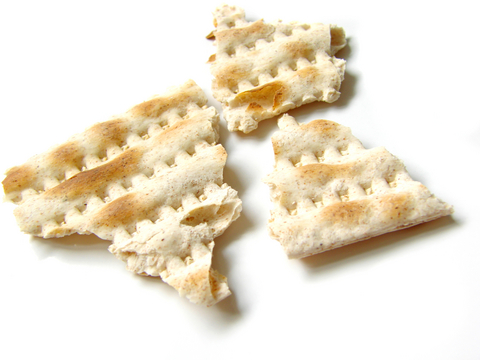
On the other hand we find a Beraisa that says that Eiruv Tavshilim has no ‘shiur’, implying that even a crumb of food is sufficient.

Image result for crumb of matzo

The Gemara answers that ‘no shiur’ means ‘shiur up’ (maximum ceiling)  meaning that you can make it as large as you wish. But not ‘shiur down’ meaning that it does have a minimum – which is a kezayis.

elu-devarim

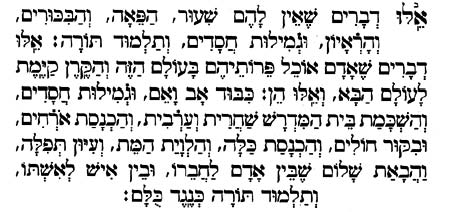
We mentioned the Mishna recited every day ‘The following have no shiur: Peah, Bikurim …..and Talmud Torah’.

What does ‘shiur’ mean here? Maximum, minimum or both. The obvious one of great interest is….Talmud Torah!

We know that there is no maximum one needs and can study. But is there a minimum? Perhaps not.

See here a lengthy explanation by the Tzemach Tzedek.

Shiur 12/13/16 Beitza 15 b

Beitza 15b.

1- Our Gemara states that G-D tells us that ‘“borrow money for Shabbos and Yom Tov food and I will repay you!”

Tosfos asks that we find else where where it seems that one should not go into debt for Shabbos needs. “[if one is poor] Make your Shabbos a weekday but do not come on to the favors of others”.


Image result for borrow

Tosfos answers that indeed, someone that has nothing should not borrow for Shabbos food.

But one who has assets that are not liquid, if he needs cash for Shabbos, he should borrow since his intention is to pay back when possible.

Image result for pawning

2- We mentioned the Sicha (LKS Vol 16 p180) of the Rebbe where he discusses this topic and how the Alter Rebbe phrases this Halacha in his Sulchan Oruch. 242,3.

The parallels of Shabbos and the Mon (manna from heaven).


manna-3

Three ideas of the Mon:

  • a- Reliance on the miraculous bread from heaven.
  • b-  Toiling to find the Mon.
  • c-  Bracha that accompanied the Mon user to recognize that all ‘bread’/Parnoso is miraculous.

Shabbos:

  • a- Miraculous guarantee of the Shabbos debts to be repaid.
  • b- Borrowing for Shabbos (see above, section 1).
  • c- recognition that even food for weekdays is G-D given.

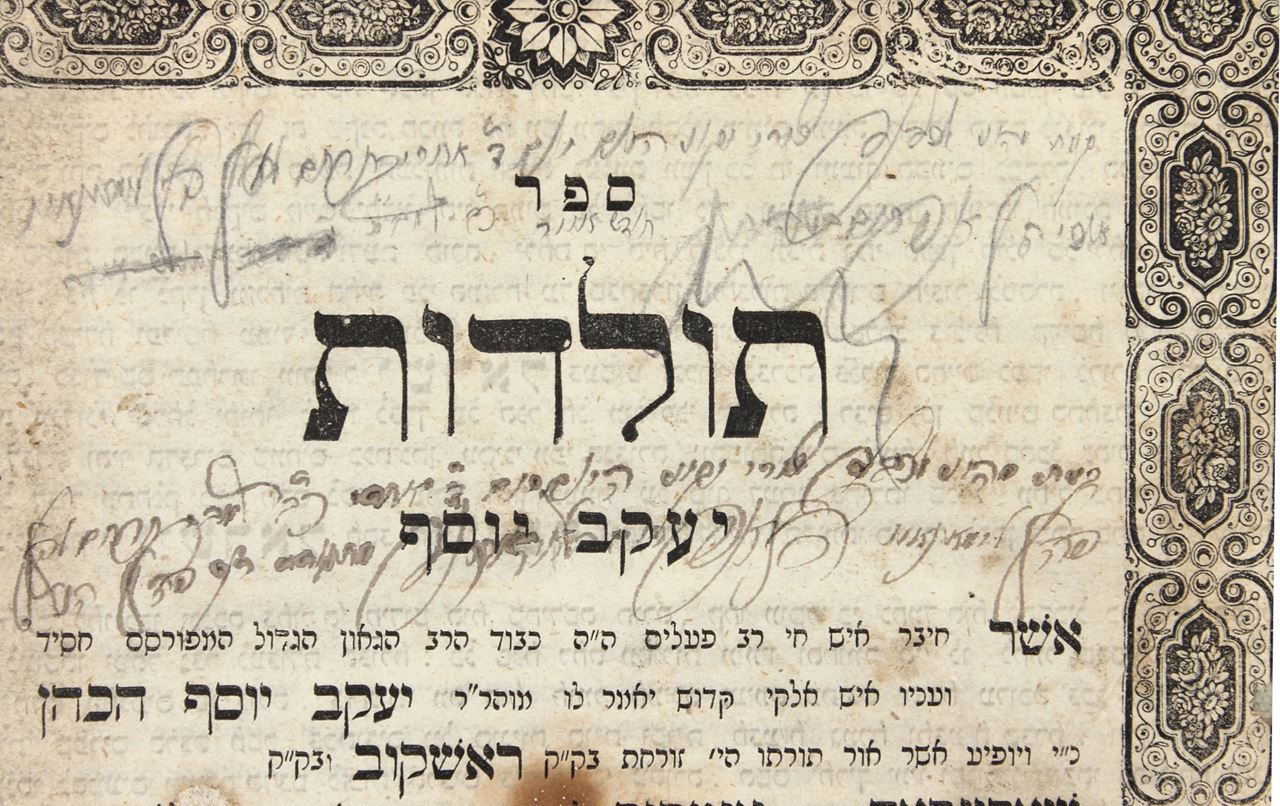
3- We spoke about the wonderful thought of the “Magid Reb Mendel’  that is quoted in the Toldos Yakov Yosef, the first book on Chasidus ever published (!) to reconcile the above.

Image result for toldos yaakov yosef

[in passing we mentioned that despite the author being a senior Talmid of the Baal Shem Tov, some recent misnagdisher pseudo ‘researcher’ published an article questioning this fact]

Here it goes:

If לוו עלי  – ‘lovu olai’ – connected with me- meaning  if one’s Shabbos is to be a connection with G-D, then אני פורע –  ‘ani porea’.  He will be paid back..

But if it’s שבתך –  ‘shabatcho’ your Shabbos, i.e. an un-G-dly one,  then if so, do  not borrow…

4- We spoke about the story of the ‘old’ Tzemach Tzedek,  Reb Menachem Mendel Krochmel,  (previously ) who forbade Jews of  his town to buy fish for Shabbos after the gentile fish merchants hiked up the price to an unreasonable amount. Despite the Minhag of eating fish on Shabbos the economic plight of his congregants was of a greater concern to him.

Image result for fish for shabbos

He based his Psak on the Gemora in Krisus. We find that Rabban Gamliel ruled, when the price of fowl reach an unsustainable level, that one pigeon may be used (temporarily) by multiple people for a Korban.

Image result for pigeon
…may be used for what?

The question we discussed is from our Gemara where it states that ‘the Parnasa of a person is decided on Rosh Hashana and Yom Kippur – except the outlays of Shabbos and Yom Tov. 

Image result for pomegranate brooklyn take out

So what was the Tzemach Tzedek worried about? What not pay the exorbitant price for Shabbos fish? One will get it back anyway!

We mentioned some possible solutions.

5- We spoke about the concept in Halacha of two opposing circumstances when one does not perform a Mitzvah.

  • 1-  פושע – ‘poshea’ (intentional- מזיד ‘maizid) R”L.
  • 2-  אונס – ‘oines’ (unintentional- שוגג’shogeg’)

Where does forgetting fit in?

Example-

  • #1- One intentionally did not Daven.
  • #2- one didn’t Daven because he had an emergency.

In case #2 one can make up the Davning. In case #1 one cannot.

What if one simply forgets? is that פושע – poshea or אונס – oines?

Related image

What about ערוב תבשילין – Eiruv Tavshilin?

~ To be continued.


Shiur 11/29/16 – Beitza 15a-b

Beitza 15 a-b

1- We continued discussing the laws of Shatnez. Mentioned the Rebbe’s letter to an elementary teacher in Israel.

Related image

The class worked on an art & crafts project  and embroidered pillow covers. Upon receiving one of these items as a gift from the class the Rebbe responded by writing a letter. He thanked them and added that they should ensure that the yarn used for these projects should not contain wool and linen.

Image result for shatnez

Discussed if the prohibition of Shatnez in wearing it or even producing Shatnes material.

Related image

2- We mentioned the Pri Megodim that states that although one may wear Shatnez in a  Tziztis garment  (linen cloth with wool – the Mitzvah of Tzitzis supercedes the prohibition of Shatnez) one may not do that on Shabbos. His reason being that since one cannot tie the Tzitzis strings on Shabbos then he is lacking part of the Mitzvah.

We tried to fully understand this logic.

3- The case of finding Tefilin on Shabbos on the street. Or, if one is wearing Tefilin on Friday and has not reached home yet and Shabbos approaches.

Image result for wearing tefillin in street


We will return to you Beitza Shenolda…

~~~

4- We began the new Perek that discusses the laws of Eiruv Tavshilin.

The basis of this Takana is the following:

What is the issue of cooking on Yom Tov for the following weekday or Shabbos?

One can say that it is prohibited Min Hatorah on a weekday.

But cooking for a Shabbos  that follows (not a weekday) is permitted min Hatorah since Shabbos is just an extension from the preceding Yom Tov.

The Rabonon prohibited it unless one makes an Eiruv Tavshilin. (for reason mentioned further in our Gemara)

Image result for ‫עירוב תבשילין‬‎

On the other hand, one can say that cooking on Yom Tov for the following weekday or Shabbos is not prohibited Min Hatorah.

Why?

Guests may always appear and thus it would be considered that he cooked for Yom Tov.

Image result for guests

The Rabanan prohibited it unless one makes an Eiruv Tavshilin. (for reason mentioned further in our Gemara)

5- We mentioned the Rebbe’s Sicha (16, Beshalach 4) as to when one should eat the Eiruv Tavshilin.

More to come next week.


Ari Chitrik Shiur Points