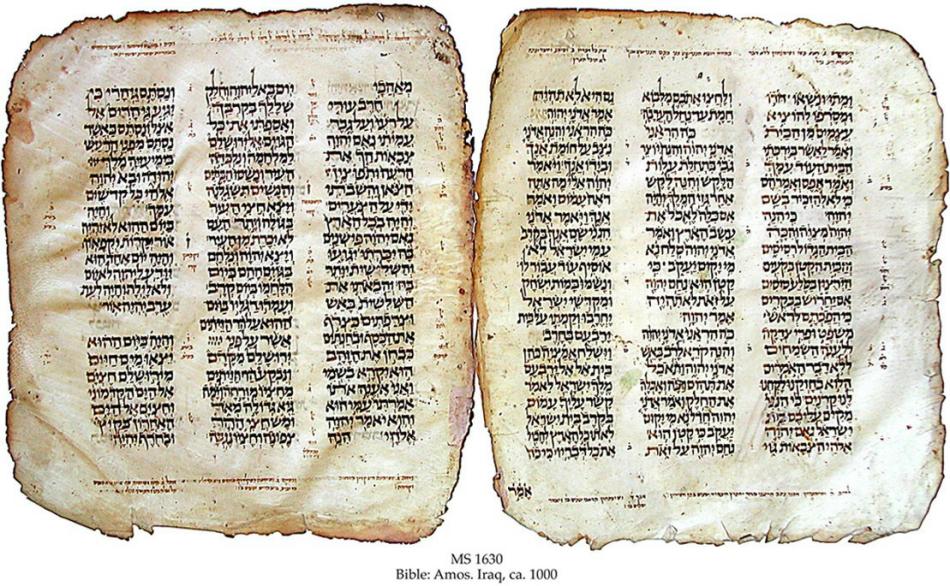
The Aleppo Codex Shiur 8/5/14 – Tisha’a B’Av

The Aleppo Codex

Thanks to Eli Chitrik.

The topic of the Shiur is truly intriguing. We just touched the surface, Bli neder we will continue discussing it at a future date.

As you can see from the recent (June 2014) Tablet article (link below) it is a ongoing saga, right here in Brooklyn, on Ocean Parkway!

21693500_600.jpg (600×600)See the Rambam discussing the Sefer edited by Ben Asher.

http://beta.hebrewbooks.org/rambam.aspx?sefer=2&hilchos=8&perek=8&halocha=4

 Here is some reading material.

1. A synopsis.

http://en.wikipedia.org/wiki/Aleppo_Codex

2. The Aleppo Codex introduction page from the Aleppo Codex org.:

http://www.aleppocodex.org/links/6.html

3. A great NY Times article, full of interesting facts, including Ben-Asher, Ben-Tzvi (who traveled to Aleppo first in 1935 attempting to being the Codex to Israel), Friedman’s book and more:

http://www.nytimes.com/2012/07/29/magazine/the-aleppo-codex-mystery.html?pagewanted=all&_r=0

Even Edmund Safra a”h got dragged into it…

The New York Times
July 29, 2012
The Route the Codex took.
Copyright 2012 The New York Times Company

Go to the NY Times article to see the above map in interactive format.

http://www.nytimes.com/imagepages/2012/07/29/magazine/29aleppo_map.html?ref=magazine

4. Matti Friedman’s book:

http://www.amazon.com/The-Aleppo-Codex-Obsession-Friedman/dp/B00CAYNZYC/ref=sr_1_2?ie=UTF8&qid=1407334966&sr=8-2&keywords=aleppo+codex

President of Israel, Yitzchak Ben-Zvi  (Yitzchak Shimshelevitch from Poltava) 

A fragment…

5. Latest article from Friedman in Tablet:http://www.tabletmag.com/jewish-arts-and-culture/books/176903/aleppo-codex

Where in the world is the rest of it?

6. Here is a very concise and interesting history of the Tosfos era / and Crusades 1-3, by Rabbi Wein, covering the exact period in Jewish History presented at the Shiur, and the story how they almost crucified Rabbeinu Tam:

http://www.jewishhistory.org/the-age-of-rabbeinu-tam/

Makos 5b (2). 7/29/14

Makos 5b

1. “Kasher Zamam vlo Kasher Asah”

We mentioned the question of the Ohr Hachaim Hakadosh (See here in English Hebrew) that maybe the fact that the Torah mentions “Kasher Zamam” is coming to teach you that even if they did not carry out the verdict then you punish the eidim zomemin, how much more so had they carried it out.
The Ohr Hachaim Hakodosh answers the fact that the Torah mentions a new word “Zamam” we learn from there that it is only if they did not carry out the verdict (Some mentioned that the question is definitely better then the answer) Attached please find the PDF.


2. In continuation to the question of the Rambam’s opinion that Gemara only uses this rule of “Kasher Zamam”  regarding death and it does not pertain to Malkus or money. We brought the famous answer of R’ Chaim Soloveitchik of Brisk (English  Hebrew) that Malkus (as opposed to death) can only be done in front of Beis Din, if it is not done in front of Beis Din it is considered a lynching. Hence, once it was revealed  that these witnesses were liars, retroactively the alleged accused never received “Malkus” what he got was an unwarranted beating, therefore there was never a “Kasher Asah”. Attached please find the PDF from Reb Chaim’s  famous book on the Ramabam.


3. An interesting explanation of the Rebbe.


The Alter Rebbe writes in Tanya (Igh”k 25) that Chazal say that being angry when someone harms you is tantamount to idol worship.

Why? asks the A”R

He explains that the individual that is being harmed, physically or monetarily,  is getting what he deserves as ordained by G-D. He has no way out. His anger shows his lack of faith in the idea that all is preordained.

Now surely the one that causes the harm will be punished accordingly. His action is NOT preordained because humans were granted free choice. He willingly chose to harm his victim. If he would have contained himself and not harm the  (deserving) victim  G-D would send someone else.


In 1965 the Rebbe posed a similar  question. Based on the above, why then does a thief need to pay back to his victim? The question is not that he should be allowed to keep what he stole of course.


The question is that since it was ordained that the victim should lose the amount stolen, it would make sense that the robber should be forced to give back the loot to charity!!! Returning it to the victim runs contrary, it seems, to the master plan of a thief robbing him of his money as it was preordained.


The Rebbe’s answer is quite simple – the fact that the thief was caught  and is in possession of the stolen property is proof that the victim was not destined to lose his money permanently! It was only to be taken away from him (and him to suffer the anguish) for a predestined period of time. Thus, when the thief is caught the money needs to be returned to the victim as was preordained.

See this explanation at length here.


4. Regarding the Story of R’ Yehuda Ben Tabai. Two witnesses testified about a murder they witnessed. The Beis Din reached a verdict but did not yet carry it out.

Another set came along and were mazim only one of the first set. R’ Yehudah ruled that the single witness should be put to death despite the fact that he was only one of the two Eidim Zomemin.


We mentioned that R’ Yehuda’s statement seems to indicate that he too was aware that the witness was not liable for execution under the rules of the law, but that he executed him anyway in order to counter the heretical views of the Tzdukim that say he only gets punished if the sentence is actually carried out on the victim. This seemingly weird Halocho is based upon the Gemore in Sanhedrin concerning the power of a Beis Din.

We asked, if he was aware of all this why was he so upset when Shimon Ben Shatach told him he made a mistake, since he was fully aware of what he was doing?

A Rosh Yeshiva of the previous generation, Reb Yechzkel Abramsky author of ‘Chazon Yechezkael’ answers this question.

[Parenthetically, Reb Yechezkel granddaughter Jenny directed the audio and music division at the …. (anti-Semitic) BBC in London]

In addition to their opinion on “Kasher Zamam and also Kasher Asah” the Tzdukim are also of the opinion that even if only one of the Eidim Zomomin are Muzam he still gets punished (since need the Hazomo of both witnesses is a Torah Shel Bal Peh ruling).

Therefore, by putting this single witness to death he refuted their opinion (about punishing the witness even before the verdict was carried out) but on the other hand he confirmed their opinion on the other issue! (of designating a single witness as an eid ziomem). That is the issue Shimon Be Shotach had with Reb Yehuda’s ruling and subsequent regret by the latter.

5. The Rishonim ask how such a terrible error could have befallen on R’ Yehudah Ben Tabbai when the Gemara says that G-D does not allow an error to occur even to the animals of the righteous!

(We mentioned the story of Reb Sender Menkin the Parisian who did not want to take the small donation, and bringing proof from the donkey of Reb Pinchas Ben Yair).

Ramban and Ritva answer that though the witness had not deserved to die for giving false testimony, he had been guilty of other capital crimes (for which he had not been prosecuted). Thus, his execution was not in fact a miscarriage of justice.

Tosfos answers that the special Divine Providence bestowed upon the righteous to protect them from inadvertent violations of the law is granted only in regard to food consumption, as in the cases cited by the Gemara.

Ohr Hachaim Kasher Zamam

Reb Chaim Eidim Zomemin

Makos 5b Shiur 7/22/14‏

Makos 5b

1. We mentioned the shitah of Rabbi Yehudah, that if a pair  [A] witnesses testify and new witnesses  [B]  come along and are mazim the [A} and then another set [C] comes along and testifies exactly as the first set [A], and they too are contradicted by [B], neither [A] or [C] are considered Eidim Zomimin. This is because we assume that this [B] is a set of plotters who have conspired to discredit anyone who testifies against the accused. 

 The questions was asked, at the end of the day the Torah says that if a set [B] of witnesses  comes and says “you were with us at the same time as you say the eidus about the other person” they [A] are considered Eidim Zomemin, so who cares how many more sets [C-Z] of witnesses contradict them? They should all be considered Eidim Zomemin? 

 We answered that what Rabbi Yehdah means to say is that once there are many sets [C, D ..] coming and saying the same thing, and the same two people [B] are refuting all of them, then this is not going to be a din in Eidus, but rather a separate din that when Beis Din sees something fishy they cancel the entire case.

 2. The Gemara mentions the famous rule regarding Eidim Zomemin “Ka’asher Zomom, Vlo Kasher Asah” if the verdict was already carried out on the defendant the Edim Zomemin do not get punished. 

 Surprisingly the Rambam seems to learn that the Gemara only uses this rule regarding death and does not pertain to Malkus or money. The obvious question is, nowhere in the Gemara does it mention this distinction, thus where did the Rambam get  this differentiation. The question is so strong the the Raavad on this Halacha proclaims that the Rambam made a big mistake. 

The Kesef Mishnah (By Reb Yosef Karo EnglishHebrew author of Shulchan Aruch) first tries to say that regarding money you can always return the money therefore there is no “Kasher Asah”, but this would only answer regarding money and not regarding Malkus?

He therefore gives two answers:

1.  Since judgment is ultimately in God’s hands, had the executed party not been guilty, God would not have allowed him to be executed by a proper Beis Din. Hence the lying witnesses need not be punished by humans. They will be dealt with by God himself.  

2. That the punishments inflicted by the courts are not goals in their own right, but means to bring a person to atonement. The sin of causing a human being to die is exceptionally severe. It is not fitting to give these lying witnesses, who caused a person to be executed, the opportunity to achieve such atonement.

Attached please find the Rambam with the Kesef Mishnah.

Makos 5a. Shiur 7/15/14

Makos 5a.

1. We continued discussing the point which we spoke about last week. The Gemara says that if two Eidim claim that they witnessed a person, in Los Angles for example, doing something and another two Eidim come and say that these witnesses were with them in Tokyo, we calculate if it was possible to travel the distance and be in both places on the same day. If it is not possible, the first pair is guilty of being Eidim Zomemin.

We mentioned that the Rishonim ask: There is a phenomenal story about Shmuel’s father who was out of town and he traveled back to his wife (Shmuel’s mother) using the power of a “Shem“.

Thus we clearly see that one can claim that he traveled a long distance in a short span of time- even in Halocho!!!

Read the details of this story here:

http://beta.hebrewbooks.org/pdfpager.aspx?req=46819&st=&pgnum=5

Note that the fortuneteller who tempted Samuel’s father was a gilgul of Potifar’s wife- the woman who tempted Yosef in Mitzrayim!

Attached please see attachment PDF of the Shulchan Oruch.

2. The Mishnah states the following “Witnesses do not become Zomeminuntil they discredit themselves“.

When we learned the Gemore we translated it the way Rash”i explains it, that in order for them to become Eidim Zomemin the second pair of Eidim have contradict something about the first pair of Eidim’s credibility, for example they were out of town. If they only contradict the facts of the story’s  they do not become Eidim Zomimn

At the Shiur we mentioned the fascinating point which is mentioned in the Rabeinu Chananel in the name of Reb Hai Gaon (His bio in English or Hebrew) that what the Mishnah means to say by “Witnesses do not become Zomemin, until they discredit themselves” is that they can only become Zomemin if they admit they they were lying or remain silent and don’t contradict the second pair.


That is a huge Chiddush and something which is not mentioned in most Rishonim! We mentioned in the Shiur that the Chasam Sofer uses this Peshat to answer many questions of Tosfos. Attached please find the PDF.  Attached also find the original source from R’ Hai Gaon’s classic book.

3. We mentioned the Chasam Sofer regarding the reasoning of the Ramaban why you believe the second pair of Eidim.  Basically- when testifying against a pair of witnesses by saying that they were elsewhere at the time of the alleged act of the defendant is like saying that the first pair are mecha’lelei Shabbos. Thus in turn they become defendents themselves and therefore cannot refute the second pair!

4. The story with the murder, snake, golus and the shomer.

Story with Shmuel’s Father

Chasam Sofer Eidim Zomemin

Rav Hai Gaon

Makos 4b. (7/1/14)

Makos 4b.

  1. We spoke about Reb Elchonon’s answer to a famous question. The definition in Sha”s of a ‘kenas’ (as opposed to – ‘momon’ regular payment of a guilty party) is when one is obligated to pay more than the actual damage incurred. Such as “kay’fel’ – a punishment to pay double the amount of the theft.

So the question is how can one say that Eidim Zomemin is not a kenas? They pay more than the intended damage (the Halocho is that they pay only when the falsely accused defendant didn’t pay)“Ka’sher zomam ve’lo ka’sher oso”.

Reb Elchonon explains that what creates the Eidim Zomemin’s obligation to pay is the Beis Din’s verdict that they are obligated to pay. Therefore, since it is only as a result of a Beis Din ruling/verdict, the required payment by the Eidim Zomemin has the category of money and not kenas.

Furthermore, even if the Eidim wanted to cause the defendant to pay a kenas, for example “Motize Shem Ra” nevertheless the money that the Eidim Zomemin are obligated to pay, becuase it is going through Beis Din,  has the category of money and not Kenas.

We heard some valid arguments to the contrary. Nu, that’s the idea of the shiur.

2-    לאו שאין בו מעשה.

We spoke about what the definition of ‘doing nothing’ is. Gornisht, Gor gornisht (a groiser Gornisht….HV)

3- We mentioned the Aruch – the first Hebrew encyclopedia/dictionary written by Reb Noson of Rome, Italy, a contemporary of Rashi. Actually this sefer is much more than just definitions of Aramaic words in Chaza”l. The author incorporates many Halachik opinions in various topics. Many Rishonim, including Rashi and Tosfos quote him and discuss his rulings.

Interestingly the Aruch was one of the first Jewish books to be printed. See here and below for the Venice edition of 1531.

Reb Noson had an interesting life. Read more:  English, or Hebrew.

4-    The prohibition of Kilaim is the planting of a grape seed with a wheat seed. Rabbi Akiva adds that also when one is ‘Makayem’ Kilaim one is chayev Malkus.

What is the definition of  the word ‘Makayem’ ?

The Aruch’s definition of being “Mikyem” Kilaim is that he did nothing at all, he didn’t plant the seeds, the wind blew them in and he just let remain there.

Tosfos does not like this interpretation because according to Rabbi Akiva’s opinion that one needs to perform an action to receive Malkus, if one really did nothing (such letting it remain in the ground) how can one receive Malkus for doing nothing

Therefore Tosfos has his own definition of the word ‘Makayem’  KilaimIt means that he built a fence around the Kilaim. Tosfos considers that an action in the prohibition of Kilaim.

We mentioned that Tosfos’s answer is hard to understand because one still did not do an action with the actual Kilaim which would warrant him to receive Maulks!

5-             For Gimmel Tamuz we semi-joked about the definition of a “meshichist”…..that it is an easily moveable and adjustable definition…….

6-             We mentioned the Ohr Hatorha about the definitions of death according to Kabala and Chassidus. The Rebbe Rashab also expounds on this topic. See attached.

At issue is an age old question of the Zohar and others. How can the Torah state that the cause of death in the human race is a result of Adam’s eating from the Tree of Life when the Torah (which preceded the creation of the world) states many laws of impurity which comes as a result of touching a dead body. It seems that death was programmed in the human race even prior to Adam’s failure in Gan Eiden.

The Zohar (as explained by the Rebbe the Tzemach Tzedek) responds that true, death was part of the original plan. But that ‘death’ would be a mere ‘transfer’ from one world to another. (Story of Reb Leivik).

In these ‘lighter forms of death’ the body either:

a-     ascends with the soul (Eliyohu and Chanoch) or,

b-     the body ceases to function and is actually buried. But the soul “transfers to another world just like one changes from weekday clothes to Shabbos clothes”.

In either case, had not Adam sinned,  one would not feel what is called ‘the pain of death’. This was the original idea of death! Painless.

The sin of Adam caused humans to go thru ‘ta’am miso’. A more ‘gross’ form of death.

Has any human experienced this (b- body ceases to function but soul is transferred) ‘lighter form of death’?

The Tzemach Tzedek says that that is the meaning of ‘Ya’akov ovinu lo mes’.


Ohr Hatorah

Atres Chukas

Makos 4a (2) Shiur (6/24/14)

Makos 4a (2) 6/24/2014

  1. We spoke about the Gemore that seems to say that if a few gallons of water are dumped into an ocean, as opposed to water of a river, the water does not mix in immediately. Last week we posted the Chasam Soifer where he writes that he is perplexed about this as the water in an ocean is constantly moving etc.  He suggests that perhaps the salty ocean water does not quickly mix with fresh water.
  2. In connection to the above we mentioned a rare gem in the writings on the Rogatchover highlighting his regard of the Alter Rebbe and his Torah.

Some background first.

The common custom is that when writing a get, in addition to writing the name of the city where the get is being written the city is identified with its nearest body of water. Such as an ocean, spring, river or a well.

In Yerushalayim they write “Yerusholayim that is adjacent to the water of the (river) שילוח (that is the Silwan stream) and waters of wells”.

In Brooklyn the custom is to write “City of Brooklyn that sits on the East River”.

[if it turns out that the river stated is not near the city and/or spelled incorrectly the Get may be invalid and a hoard of problems arise……

In 2011 some Rabbis raised the issue about all the Gitten written in Lakewood that perhaps are ALL invalid…… See here: http://www.bhol.co.il/article.aspx?id=34689

Oy Vey….]

See here a list of cities and the spelling of their rivers from the ‘Tiv Gittin’- an authoritative manual on Get writing.


http://books.google.com/books?id=7PklAQAAIAAJ&pg=PA64&lpg=PA64&dq=%D7%91%D7%92%D7%98+%D7%93%D7%99%D7%AA%D7%91%D7%90+%D7%A2%D7%9C+%D7%99%D7%93+?&source=bl&ots=UljZBCNhvp&sig=cDozwRBZhLdZAK9e0-if0-QX8TQ&hl=en&sa=X&ei=6zOsU7GLGJOjqAb854DYBg&ved=0CDIQ6AEwAw#v=onepage&q=%D7%91%D7%92%D7%98%20%D7%93%D7%99%D7%AA%D7%91%D7%90%20%D7%A2%D7%9C%20%D7%99%D7%93%20%3F&f=false

What about a city that is located on a  lake? The common custom is to write “river” or “the wells near the city”.

The question is whether a lake is like an ocean (size, shape and water not flowing) or  a river. A lake that has waves is also a factor in the discussion.


In 1925, the famed Chossid and Rav, Reb Avrohom Eliyohu Plotkin wrote to the Ragatchover about an interesting ‘Pinkus’ or Community Historical Book of the City of Asvia  that was situated on lake Seliger. (?)


[I’m not sure about the exact city and/or name of the lake. Need help locating this city and lake on a map. See below comment from Alex Hepfenheimer]

The book contained an entry stating that the Alter Rebbe instructed, that when writing a get there, one should write “City of Asvia, situated on a ‘small ocean’ “Yama Zuta” called Lake Seliger (or Suzia?) and some wells…”


Reb Avrohom Eliyohu Plotkin realized that using the term ‘small ocean’ for a lake is a novel idea not mentioned in earlier sources. He thus wrote to the Ragatchover if one can rely on the Pinkus.


The response on the Rogatchover is typical with loads of cryptic footnotes etc.

What is rare about the response is that as it is well known in the Yeshiva world, the Ragatchover never quotes any source other than a select few from the Rishonim. He ignored even the Shulchan Aruch! His ‘respect’ to anyone, save Rambam and Rashi, was very limited indeed.


Yet in this letter he refers to the Alter Rebbe as “the true genius”. “ha’Goan ho’Amitee”. הגאון האמיתי.


The Ragatchever cites numerous places in Sha”s that discuss the waves in the ocean as well as lakes.


He also refers to our Gemore about the water in an ocean not moving etc. therefore, in a sense, a lake is more similar to an ocean than to a river.


His solution to the question (how can you say that ocean water doesn’t move when there are waves?) is that in comparison to rivers, ocean water is stationary.


He then brings proof to the Alter Rebbe’s idea that the term “ocean” is used even when not referring to a large ocean such as the Atlantic.


Even a man-made large pool is called an ocean! He writes that in the Beis Hamikdosh there was a large copper basin placed on 12 copper oxen (for the Kohanim to wash their hands and feet) and that is indeed called in Tanach the “Sea of Solomon ”!

http://en.wikipedia.org/wiki/Molten_Sea

Despite all this and much much more, the Ragatchover instructs (in the second letter) not to use the term ‘small ocean’ for a lake since it is a term not mentioned in Gemore. He suggest writing ‘lake’ so and so.

  1. We mentioned the notes the Rebbe wrote on the letters he received from his father, Reb Levi’k, if one can be ‘makdish’ a korban in his heart without verbalizing. In Likutei Torah the A”R writes that one can etc.


The general response from Reb Levik to the Rebbe is that the Likutei Torah is a book of ‘Ma’amorin’ not a book of ‘halocho’…..


Please see the attached links.

http://beta.hebrewbooks.org/pdfpager.aspx?req=31679&st=&pgnum=295


http://beta.hebrewbooks.org/pdfpager.aspx?req=31679&st=&pgnum=298


http://beta.hebrewbooks.org/pdfpager.aspx?req=31679&st=&pgnum=299


Ragtshover regarding The AR Pesak to write a small river (2)


From Alex:

ONE THOUGHT ON “MAKOS 4A (2) SHIUR (6/24/14)”

  1. “Asvia” is probably Osveya, located on the lake of the same name. (The expression quoted from the pinkas is באסוויע מתא דיתבא על ימא זוטא המכונה אזירא דמתקריא סוויע.) It has another claim to fame – it was the birthplace of R. Aharon Strasheler.

    Here’s Lake Seliger. A look at it in Google Maps shows that R. Plotkin’s town of Ostashkov is located on it.


Makos 4a – Shiur (6/17/14)

Makos 4a. 

1. We spoke about the big chiddush of the A”R in Hilchos Shabbos. In short, the A”R states that there are two ‘melochos’  pertaining to cutting/tearing/ripping on Shabbos:

A-  Chotech- which only applies when cutting an object something to measure and/or in an exact line. Such as a perforated sheet or tissue.

B-  Ko’rea-  which only applies in a case where cutting, ungluing or taking apart any composite material. Meaning  that was put together from a bunch of parts. Such as a piece of cloth that is woven from many strands.

Therefore, cutting a paper, which is not a composite,  there is no issue to do so on Shabbos unless one forms something new by cutting it.

​ The Mishna Brurah mentions this chiddush of the A”R but does not mention the A”R’s name! See the attached PDF.

We mentioned that an Israeli Yemenite Rov, a  true talmid chochom, Reb Pinchos Zevichi,  writes that due to the change in the method of producing paper nowadays (it is a composite of many materials)   the A”R would agree that even today you would not be allowed to tear a paper on Shabbos.

It is in his book  עטרת פז. ח”א.

http://www.bsd-paz.org/Texts/AteretPaz_v1_Orech_Haim/html/E7ECF75FE05FEBF8EA5FE05FE0E5F8E75FE7E9E9ED5FF1E9EEEF5FE9E15FE0E5FA5FE62DE7.htm

Others who mention it:

http://www.hebrewbooks.org/pagefeed/hebrewbooks_org_51762_62.pdf

http://atranet.co.il/aviadstollman/responsan_new.asp?m=6

——————–

2- We spoke about ‘tevilas nida’ in a ‘Mayon’ – meaning a well or spring and NOT a conventional Mikvah.  Machlokes.

Interesting that in Likutei Torah  the A”R says that one needs Mayim Chaim!

http://beta.hebrewbooks.org/pdfpager.aspx?req=16093&st=&pgnum=222

Rebbe’s note on this:

http://beta.hebrewbooks.org/pdfpager.aspx?req=16093&st=&pgnum=670

—————

3- Discussed the common universal practice of warming a Mikva- something we  (correctly) take for granted that it is OK!

See here that the Shulchan Oruch/Mechaber has a big problem with it.

http://beta.hebrewbooks.org/tursa.aspx?a=yd_x5583
——————————-

4- Issue with pouring water into an ocean or river and the water not mixing.

Chasam Sofer ​ notes that this Gemore is beyond him.  See here​.

http://beta.hebrewbooks.org/pdfpager.aspx?req=1839&st=&pgnum=176

We will continue this topic IY”H next week.


MIshna Berurah, referring to the שיטה  of the AR

Makos 3a-b Shiur (5/27/14)

Makus 3a-b

1. We spoke about R’ Eliezer from the city of Tul, regarding a teacher who did not get paid on time if he is allowed to charge what he could have invested and earned had he been paid on time. See here for more of this discussion.

2. We spoke about the Machlokes Rash”i  & Tosfos if a Pruzbull is the same thing as someone who gives his Shtar / debts to beis din.

3. We mentioned the Kovno Rov’s (In English and Hebrew) very logical explanation regarding why a person does not count Sefiras Haomer if he is unsure which day it is. The definition of counting, he says, is being definite about the number. When when counts ‘two or three’, it negates the concept of counting.
We then spoke about the Rebbe’s and Rav JB Solovetchik’s  identical response to the ‘logical and cute’ idea. (Attached please find the pdf).


 4- Attached please find the chart showing the two ways one can calculate the amount (net present value) of what a Kesubah is worth prior to death or divorce.

The Rebbe and JB

NPV

Makos 3a Shiur (5/21/14)

Makos 3a

1. We spoke about Reb Elchonon’s explanation that Eidim Zomemin don’t necessarily get what would have happened to the defendant, rather they get what Beis Din would have Pasekned. For example, if the witnesses claim that the defendant stole something, even though -had the verdict been carried out- the Bais Din would have sold the defendant as a slave (because of lack of money), the false witnesses would only have to pay money.

This is because the verdict of Beis Din would have been “pay money”. The selling the defendant as a slave is only a result of his lack of funds.

2- Attached is the famous letter of Reb Elchonon about Yeshiva University and other “Torah u’Mada” institutions.

3-  We mentioned, that we all assume, that the money paid by Eidim Zomemin goes to the defendant.

In reality there is no clear indication of this anywhere in Shas!

The first to question this assumption was Reb Eliezer of Metz, France who was a Tosafist, a student of Rabbeinu Tam and author of the Sefer Yerayim.

See here: http://en.wikipedia.org/wiki/Eliezer_ben_Samuel


In Hebrew: http://www.daat.ac.il/encyclopedia/value.asp?id1=1592


His Sefer in various editions: http://beta.hebrewbooks.org/home.aspx?title=%u05E1%u05E4%u05E8%20%u05D9%u05E8%u05D0%u05D9%u05DD&auth=&ocr=&sort=0#gsc.tab=0


See the attached PDF of the Yireim who brings up this question and proclaims that until someone shows him differently he thinks the Eidim can give the money to Bais Din and they can distribute it to whoever they or he would like. See the commentary on the side.


In the footnotes, Reb Yerucham Perla* also tries to answer the Yerayim’s question.

* Rav Yerucham Fishel Perla (1846-1934). Born in Warsaw in 1846 and studied under Rav Yehoshua Leib Diskin in Lomza and under Rav Yosef Dov Halevi Soloveitchik. While he was still young, he was offered prestigious rabbinates, including in Lublin and Krakow, but he turned them down so he could continue his studies. He is known for his encyclopedic commentary to the Sefer Hamitzvos by Rav Saadiah Gaon. Editor


Yiraim about who the money goes to


Reb Elchonon YU PDF

Makos 2b  Shiur (5/13/14)

Makos 2b

  1. We spoke about Zomemim that it is a Lav that is not connected with an action. Lav She’in Bo Ma’ase where the general rule is that Malkus is never given.

Why is Zomemim a Lav that is not connected with an action?

Either because when “testifying” one just  utters words or (even if talking is considered an “action”) or because the concept of a witness is “testifying what he “saw”,  “and that, seeing, is not considered an “action”.


We mentioned the Magid Mishna’s opinion of the Ramba”m, that even if you are ovier lav without an action, if it was possible to do the lav with an action you are still going to get Malkus. (Lengthy Minchas Chinuch on this topic. # 8)

The opinion of the Rambam (as opposed to many others) is that witnesses can indeed submit their testimony in writing! Thus Zomemim should be considered a Lav that does indeed have “action”. A gute kashe


2. Ramban’s view that the real punishment for someone’s ox killing a person is misa bidei shmoyim. The “koifer” (atonement payment) is a means to avoid the misa bidei shmoyim. It is a substitute. Therefore the first set of eidim never really could have caused misa bidei shmoyim to happen to the victim, because heaven always knew he was innocent. Thus the eidim zomemeim can’t be required to pay the “koifer” which is only a substitute.


3-We started speaking about Reb Elchonon Wasserman’s vort on an Eved Ivry. See here  in English or Hebrew.

Attached is the preface his children wrote for his famous book “Kovetz Shiurim”. On the last page is the fascinating story of his heroic and holy stance before he was killed by the Germans YM”S.


Elchonon Wasserman

Ari Chitrik Shiur Points