Shiur 11/15/16 Beitza 14b

Beitzah 14b.

1- We continued talking about the melacha of ‘borer‘ on Yom Tov.

2- We reviewed the ruling of the Alter Rebbe is his Siddur which is the basis of the custom in Chabad not to eat sunflower seeds on Shabbos.

Image result for ‫גרעינים‬‎

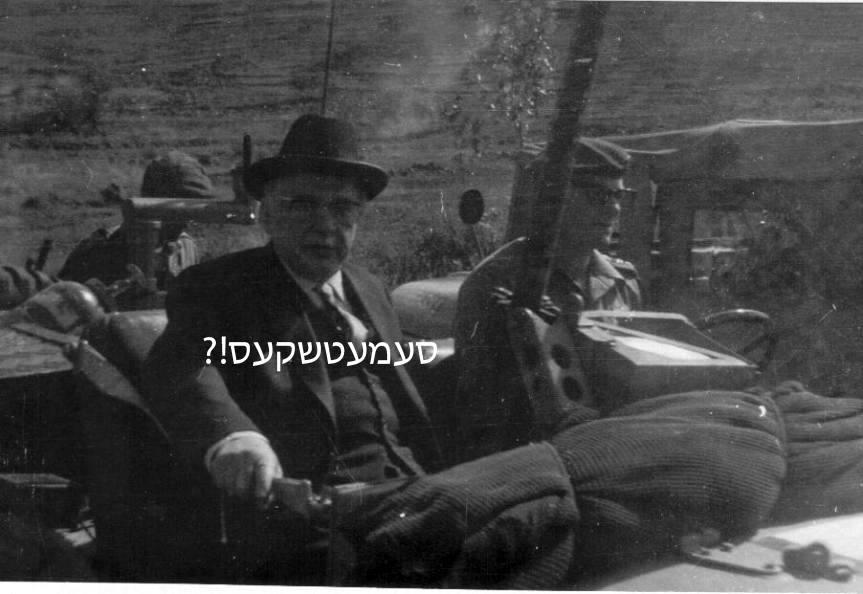
Story of the President of Israel, Mr. Zalman Shazar who called out from his car on Shabbos to a few Lubavitcher-looking people that were chewing sunflower seeds

“hey Chabadniks! don’t you know the Alter Rebbe is machmir and we don’t eat sunflowers seeds on Shabbos…..”

shazar-in-jeep-2

3- The next Mishna moved into the sending of items through a Reshus Horabim to friends on Yom Tov.

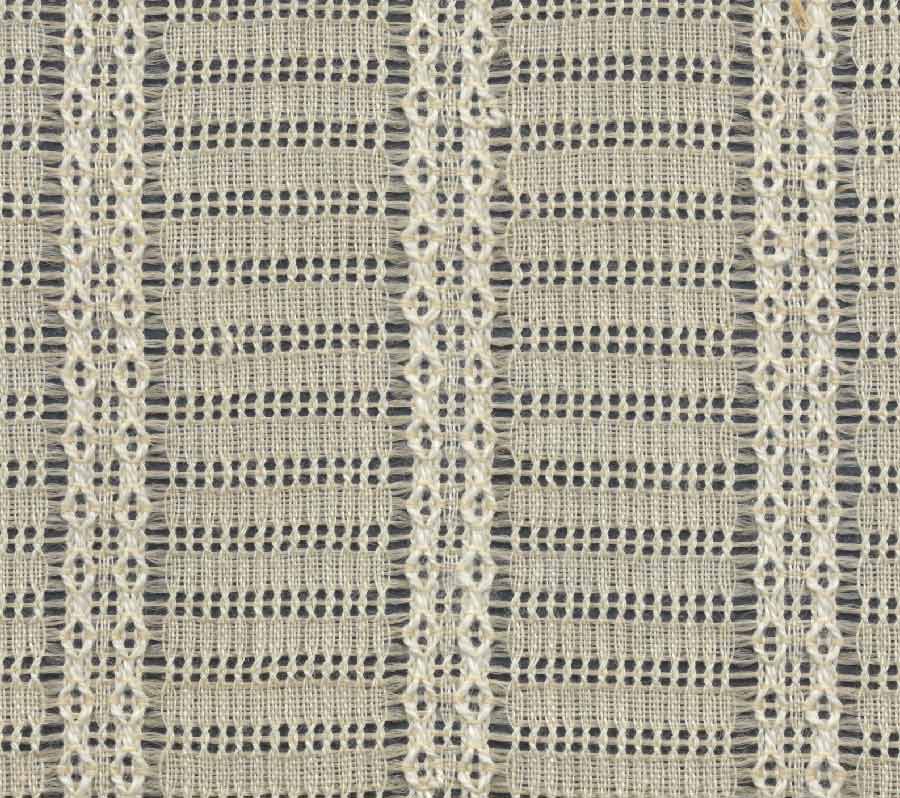
One of the items the Mishna enumerates is sending a garment or cloth that has Kilayim which is prohibited to wear.

Image result for bolt of fabric

The Gemara takes issue with this item since the receiver can’t do anything with it so why is it permitted to send on Yom Tov?

The Gemara concludes that this Kilayim is referring to a curtain that is used as furniture and not as clothing, and thus has some practical use.

The Gemara then continues to say that one may not weave a curtain from kilayim since one may wrap himself in it! Just as we see the Halachah that a curtain is considered a keili (not part of the building structure) and can become tamei  because one may wrap himself with it.

4- Tosfos  mentions the Gemarah that the Paroches when it became tamei needed 300 Kohanin to immerse it in the Mikvah! It then states that this 300 number is an exaggeration!

Image result for many kohanim

We mentioned the explanation of the Gro that the number is actually accurate. The Poroches was (in Amos) 20 x 40 for a total perimeter of 120 Amos. Each Amo is 5 tefochim for a total of 600 tefochim. So, 300 Kohanim, each using his two hands (which is a tefach each) equals 600 tefochim!

5- We analyzed the Tosfos about the issue of the Paroches. The question is if the curtain in the Mishkan/Mikdosh is considered a ‘keili’ and it can become tamei or it is considered part of the structure and cannot.

6- We mentioned one of the great pre WWII European Geonim Reb Yaakov Zeev Yoskowitz who was a Ruzin/Chortkover Chosid. His magnum opus was a commentary on the SifriAmovuhi DeSifri.

We discussed some of the questions he writes at length about our Tosfos,  (page 197) and the letter he received from the Ragatchover on his topic. (page 2).

7-  Here is the name of the French city mentioned in the Tosfos –

Évreux

Image result for évreux

One of the baalei tosfos in that city, R Shmuel of Evreux.


Shiur 11/08/16 – Beitza 14a, b

Beitza 14a-b.

1- Our Gemara enlightens us as to the financial condition of Jews in Israel who were well to do in comparison to the Jews living in Bavel who lived in poverty. Consider: Meshulochim traveled to Israel……

Image result for babylonian jews

This disparity manifests itself in a practical Halachah:

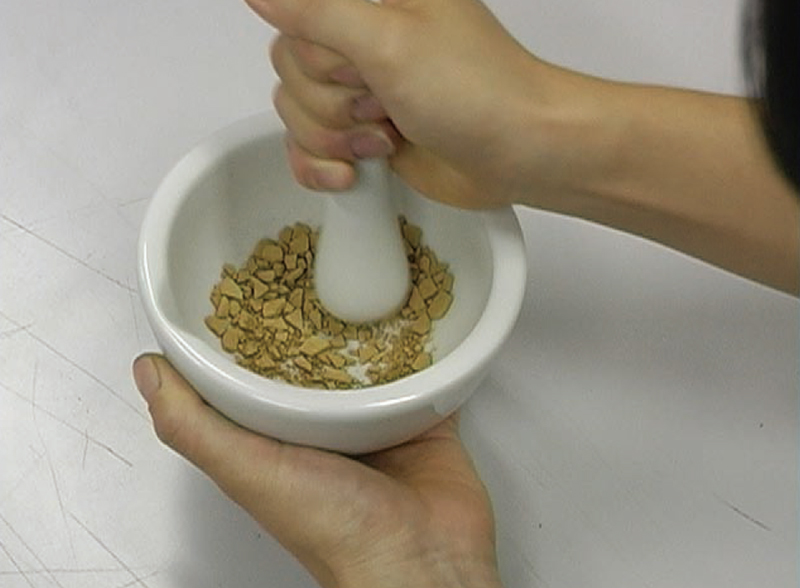
The rule is that crushing or chopping spices on Yom Tov is in principle permitted as long as one does the work on a limited basis; namely on a small scale for use at the next Yom Tov meal.

Image result for tiny mortar and pestle

[Additionally, food items that lose some of their taste or aroma if they were to be ground before Yom Tov would also be permitted.]

This limits one to use a small crusher. Using a large one (although it may require less effort) is prohibited, for it is generally used for grinding large quantities for future use.
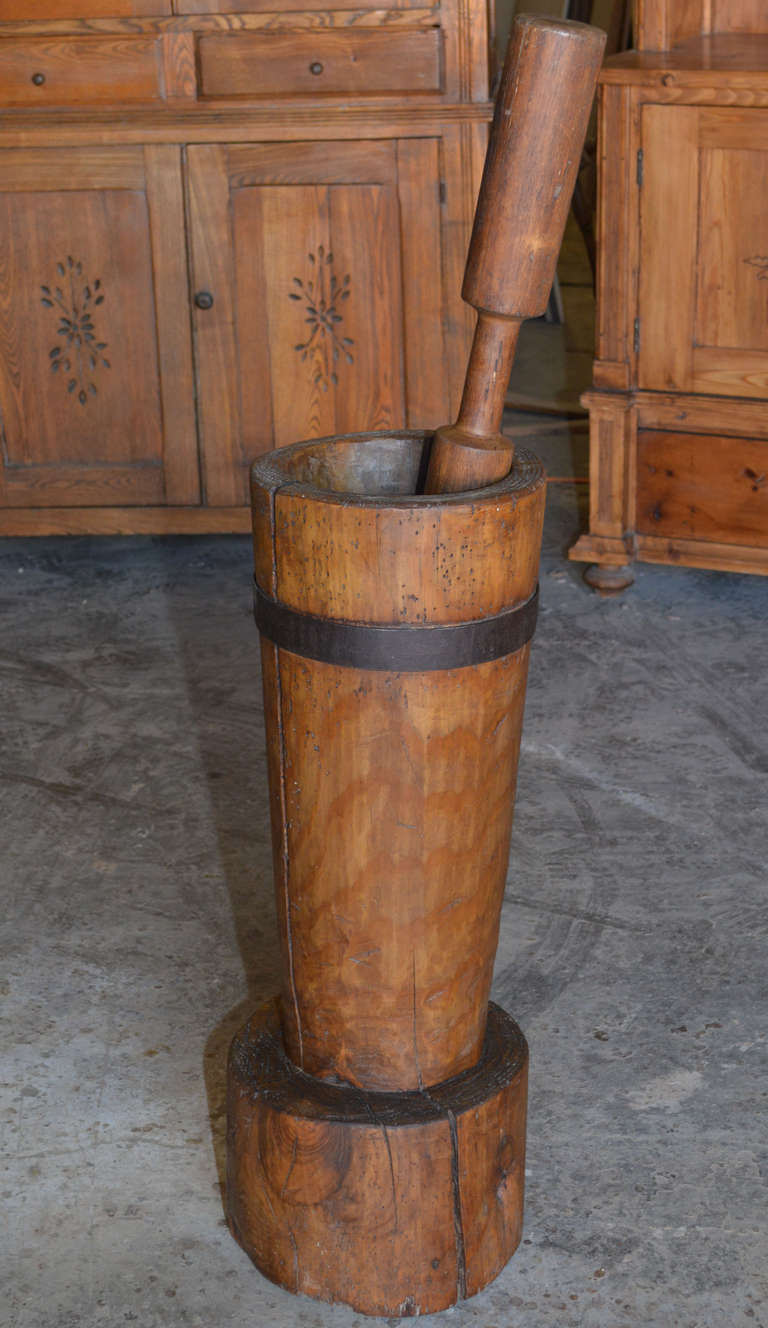
Image result for massive mortar and pestle

The Chachamim in Israel became aware that this leniency of using a small crusher/grinder in homes of the affluent Jews of Israel, where the kitchen staff was comprised of ‘servants’ (Jewish?), who would take the easy route by using a large grinder. The owners were obviously not aware of this.

Thus a law was passed is Israel: No crushing/grinding would be allowed, period. Neither small nor big utensils.

Image result for no herbs

2- We moved on into the sugya of ‘borer‘, sifting, or choosing on Yom Tov where Beis Hillel allows the most basic ‘borer‘ – removing the bad from the good.  Beis Shamai allows only choosing the good from the bad.
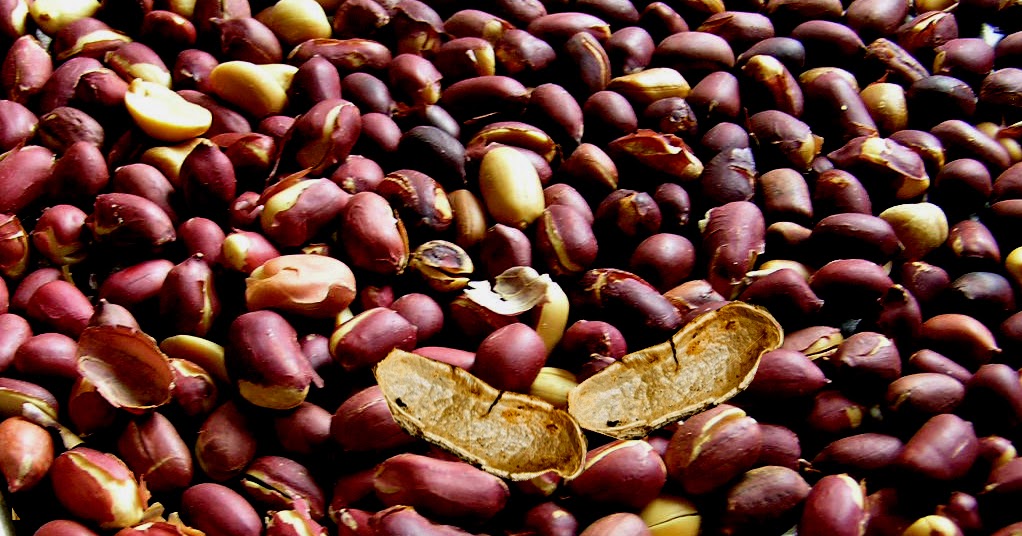
Image result for nut mixed in with shells

3- We discussed a case of a mound of peanut shells with a peanut in this stack. According to Beish Shamai one would be allowed to pick this peanut from the mound.

Now according to Beis Hillel can one opt to remove all the shells and end up with the peanut?

To be continued next week…

4- We ended with 2 interesting explanations on a perplexing verse in Parshas Lech Lecha.

וּמַלְכִּי-צֶדֶק מֶלֶךְ שָׁלֵם הוֹצִיא לֶחֶם וָיָיִן וְהוּא כֹהֵן לְאֵל עֶלְיוֹן.

– And Malki Tzedek King of Jerusalem presented (to Avrom) [after his victory in the war against the 4 kings] bread and wine, and he [Malki Tzedek] was a Kohen of G-D.

Image result for malki tzedek bread and wine

Rashi explains that the bread and wine offered by this King  to Avrom was prophesying the future when the descendants of Avrom would bring offers of bread (Mincha) and wine in the Beis Hamikdosh.

We asked as to why the description of Malki Tzedek – King of Jerusalem and him being a Kohen –  is interrupted by the act of bringing bread and wine?

A-The wine offering, which was poured into a crevice at the foot of the Mizbeach, was poured in its entirety.

On the other hand, a Mincha was only partly placed on the Mizbeach [the Kmitza] and the balance eaten by the Kohanim. So in a sense the wine offering is superior to the Mincha.

So why why is the bread (Mincha) mentioned first?

The answer is that a Mincha that is brought by a Kohen is completely  placed and burned on the Mizbeach. No portion of it is eaten. Such a Mincha is equal to a wine offering.

So the end of the verse ‘and he [Malki Tzedek] was a Kohen of G-D’ is an explanation as to why the order is bread and then wine!

Here is how to read it now:

And Malki Tzedek King of Jerusalem presented to Avrom bread and wine, [why do we not mention the wine before the bread, because] and he [Malki Tzedek] was a Kohen of G-D.

Image result for challah  and wine

2- This symbol of the bread and wine alluding to the descendants of Avrom that would bring offers of bread (Mincha) and wine in the Beis Hamikdosh is a bit problematic. If Avrom himself would be the Kohen he would be prohibited from working there since all warriors  are perhaps prohibited from from doing any Avodah! This applies even killers BeShogeg.

Just as we find in regards to ‘du’chening’. A Kohen that caused a death, even unintentionally, is prohibited form blessing others. See here  s50.  See there if Teshuva helps to clear this issue.

We also mentioned the famous Takono by Rabeinu Gershon, Meor Hagola allowing Kohanim who had recanted their conversion to  ‘Duchen’.  See there s51.

So what is Malki Tzedek trying to tell Avrom? Your children can do the Avoda and not you????

Tosfos states that there is perhaps a way to allow a Kohen who took a life away to do the Avoda if he is the only Kohen around. If we were to not allow him, then the Avoda would not be performed. So Avrom could in theory be allowed to do the Avoda since at that time he was the only Jew and…..Kohen.

But that would be a cynical compliment- ‘Avrom, you can be a Kohen only when there is no one else’…….

So the Torah states, after the compliment given to Avrom (alluded to by the bread and wine), that Malki Tzedek himself was a Kohen! So now we have two Kohanim and nevertheless Avrom would be allowed to do the Avoda. (as an exception?)

Here is how to read it now:

And Malki Tzedek King of Jerusalem presented to Avrom bread and wine, [alluding that Avrom, despite being a warrior, can indeed be a Kohen, and not only as a last resort because there was no other Kohen. There was another Kohen, since] he [Malki Tzedek] was a Kohen of G-D.
 

Shiur 11/01/2016 – Beitza 13a

Beitzah 13,a

1- We gave a general overview of the basic premise of which melachos are permitted on Yom Tov.

See here where we spoke briefly about this.

The parameters:

A- On Yom Tov no melacha can be performed. The definition of a melacha is one of the 39 melachos that are prohibited on Shabbos.

Image result for melachos associated with food

B- The exception are melachos that are associated with the preparation of food.

The issue: Are all of the 39 melachos permitted when associated with the preparation of food?

There are a few opinions of this topic.

A- Rashi (23b) & Rambam (YT 1,5) . (23b) Any melacha which can be done before Yom Tov is not permitted to be done on Yom Tov. Such as harvesting, fishing, picking fruit.

Image result for chassid fishing

B- Tosfos. (3a) Quotes a Yerushalmi which says that since the exception to food preparation (b above) is juxtaposed to the Mitzvah of ‘watching the Matzos’ (preventing them from becoming Chametz which commences at the time of kneading the dough), the Torah means to say that only melachos that begin at a stage of ‘kneading’ are permitted. Thus, harvesting, fishing, fruit picking, grinding are  prohibited Min Hatorah.

Image result for melachos associated with food

c- Other Rishonim. A melacha that is performed in bulk: Meaning that the work is not only in preparation for the food to be eaten on Yom Tov but also for the days following.

Image result for food preparation in bulk

See Alter Rebbe where he combines a & c.

2- Our Mishna discusses the grinding of spices and salt. We discussed the opinions of Beis Shamai and Beis Hillel.

Image result for grinding in mortar and pestle

3- We reviewed the Tosfos that quotes the two opinions about grinding on Yom Tov and the poetic and rhyming conclusion.

4- We mentioned the wonderful idea of the Maggid from Amsterdam regarding the saying of Rava that ‘wine and spices makes one smart’.

Whereas while grinding spices is it advantageous to talk (as we say say daily ‘keshe hu shochek omer hodek heitev’) while handling wine the opposite is true. Remaining silent is beneficial to the quality of the wine.

Image result for pouring wine silently

A person needs to know that being smart is to know when to speak and when to keep quiet…..


Shiur 9/13/16 Beitza 13a-b

Beitza 13a-b.

1- Much ground covered concerning the laws of Truma and Ma’aser.

2- We discussed the question posed by Reb Yosef Engel regarding Mitzvos that need to be performed in a particular order. A before B.

Image result for babushka dolls

For example:  The requirement of giving Truma before Ma’aser. One who gives Ma’aser to the Levi prior to the giving of Truma to the Kohen trangresses a ‘Lav’  in addition to not being observing the ‘Ese’ of doing these thing in proper order.

So Reb Yosef Engel queries, if one does both at the same time did he do it right. In our example: He figures out a way to give Truma and Ma’aser simultaneously.

Image result for simultaneous

On one hand, he didn’t transgress by giving  Ma’aser before Truma. But on the other hand, he didn’t give the Truma before giving Ma’aser.

In other words – If A needs to precede B. What is crucial?

1- That A should precede B or

2-  B should not come before A.

Difference?

If #1 is true, then, in our case:  Since A- Truma was not given before B- Ma’aser, and therefore it was not done in the proscribed order, thus creating a prohibition.

If #2 is true, then, in our case: B- Ma’aser was not given before A- Truma.  So all is well.

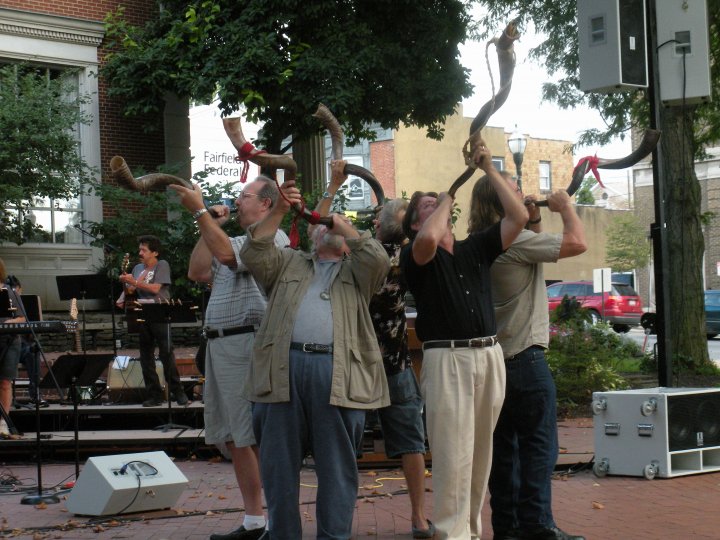
3- Another example- Shofar blowing. We have to hear the four sounds in this particular order: Tekai, Shevorim, Trua and Tekia.

If one hears all four sounds from four Shofar blowers at once!

Image result for four shofars at once

Let’s analyze what occurred.

He didn’t hear the numbers 2,3 and 4 before the first Tekia. So it’s not out of proper sequence. But on the other hand he didn’t hear numbers 2,3 and 4 after the first Tekia either.

And more.

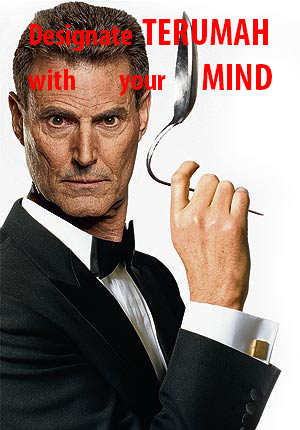
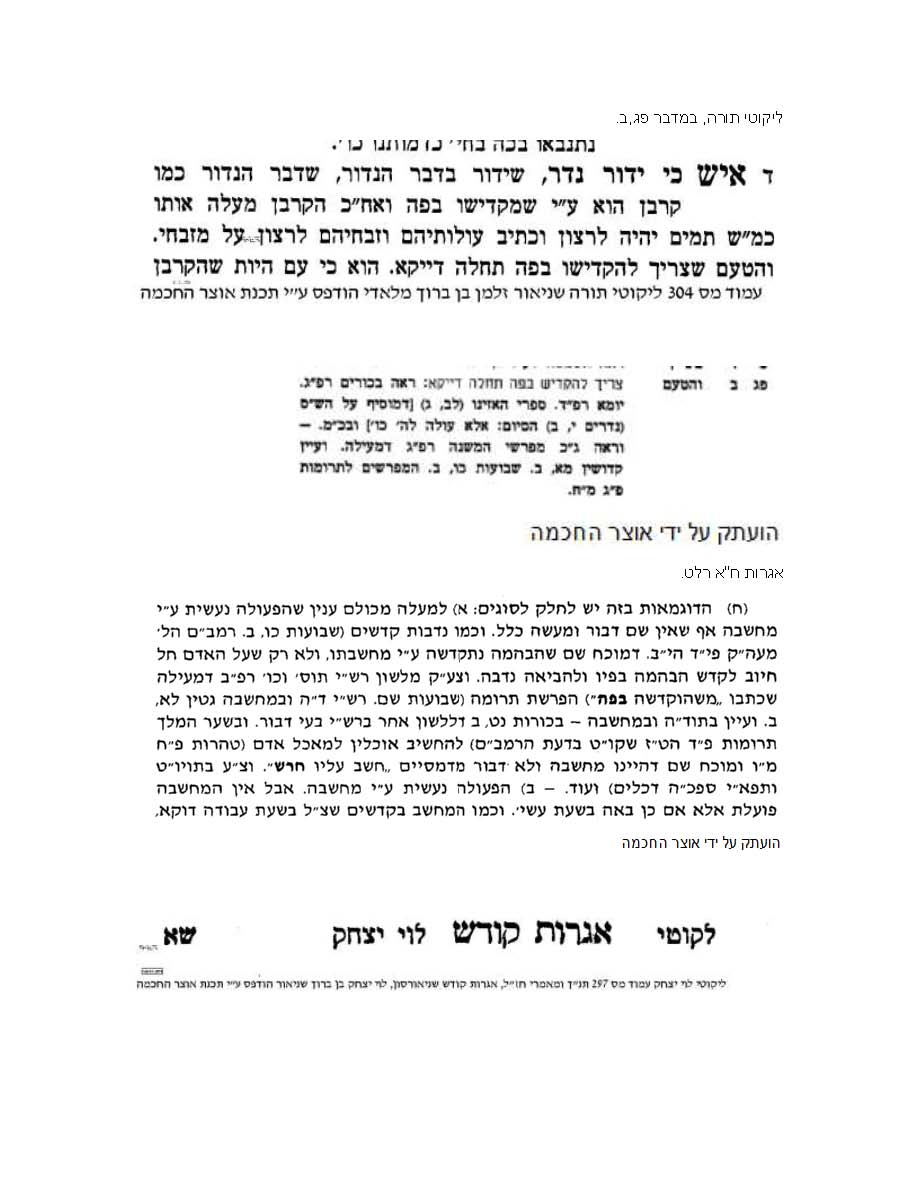
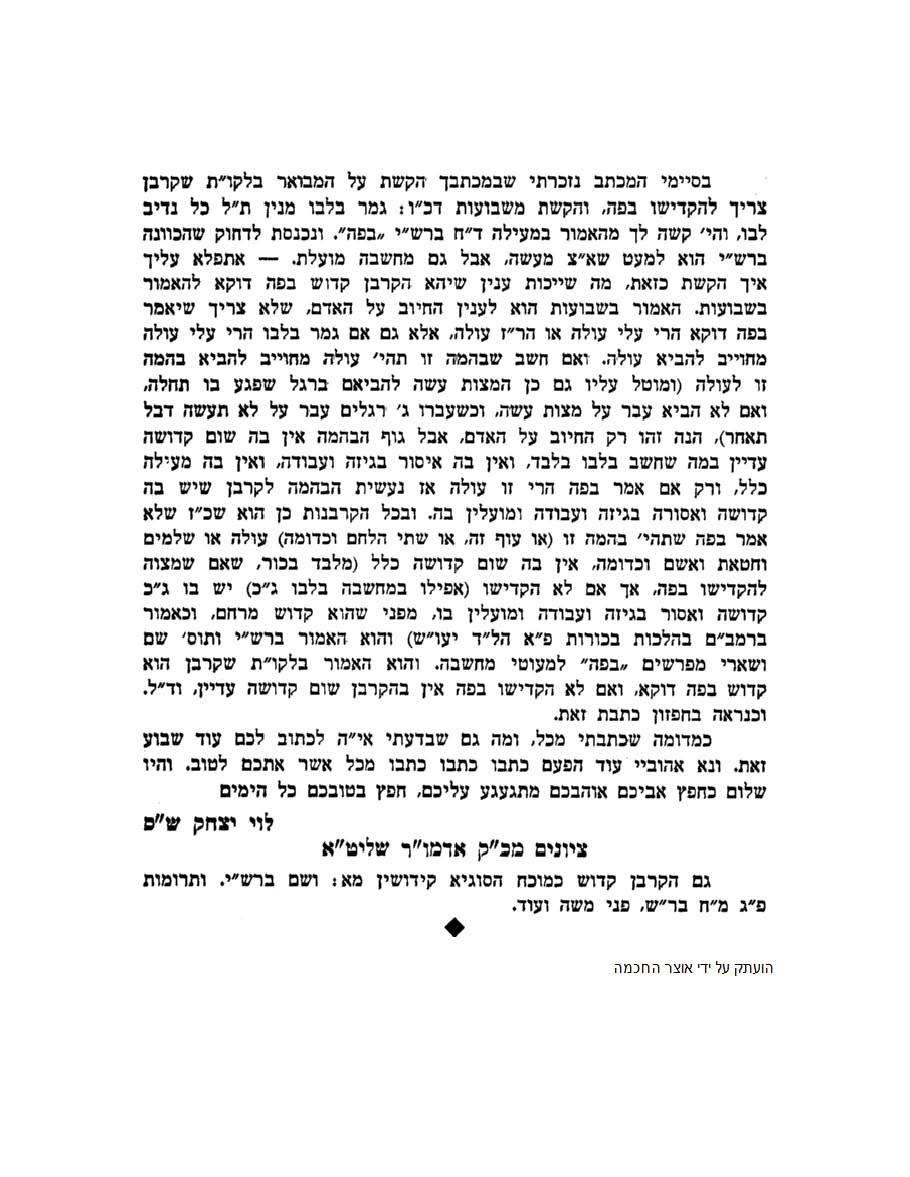
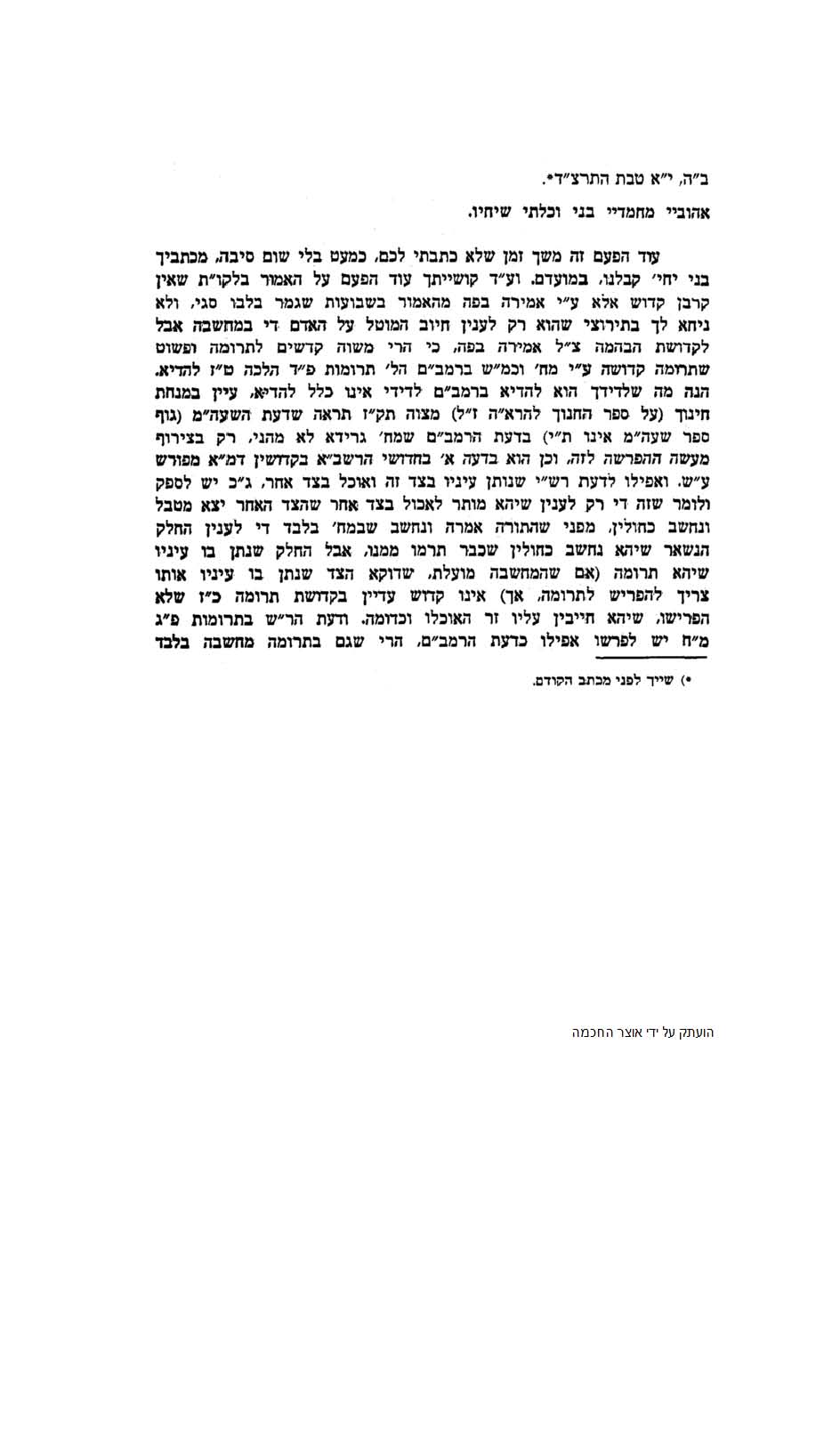
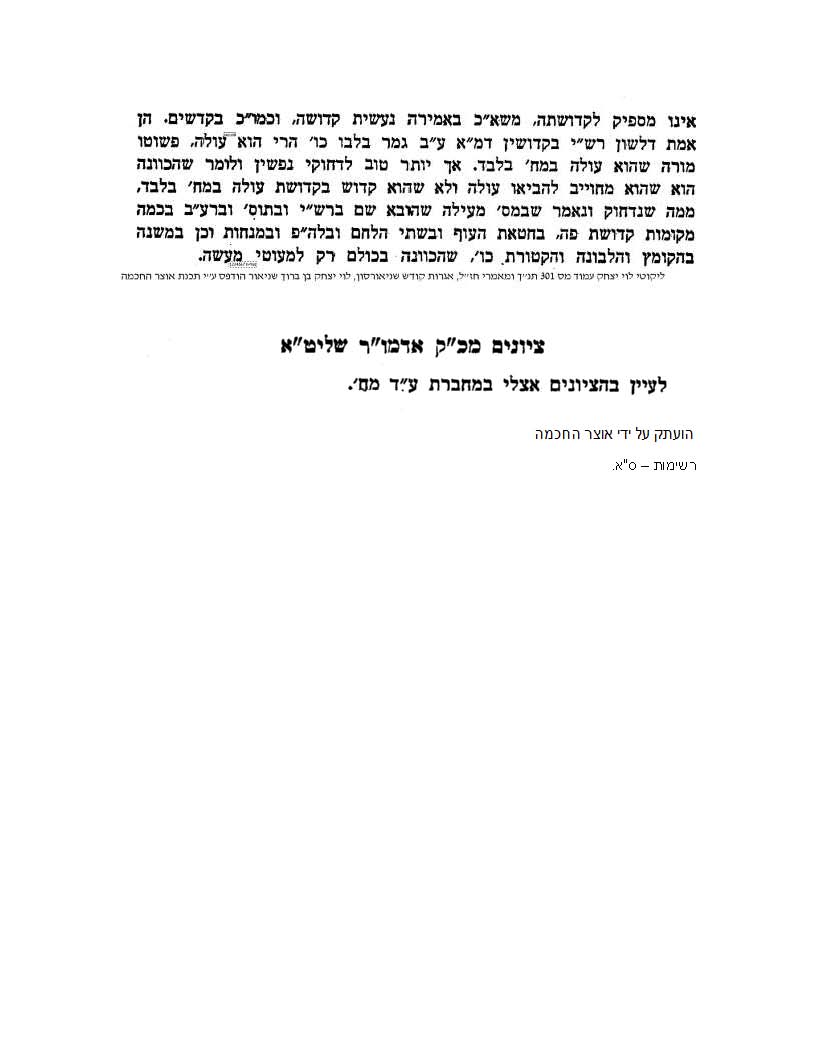
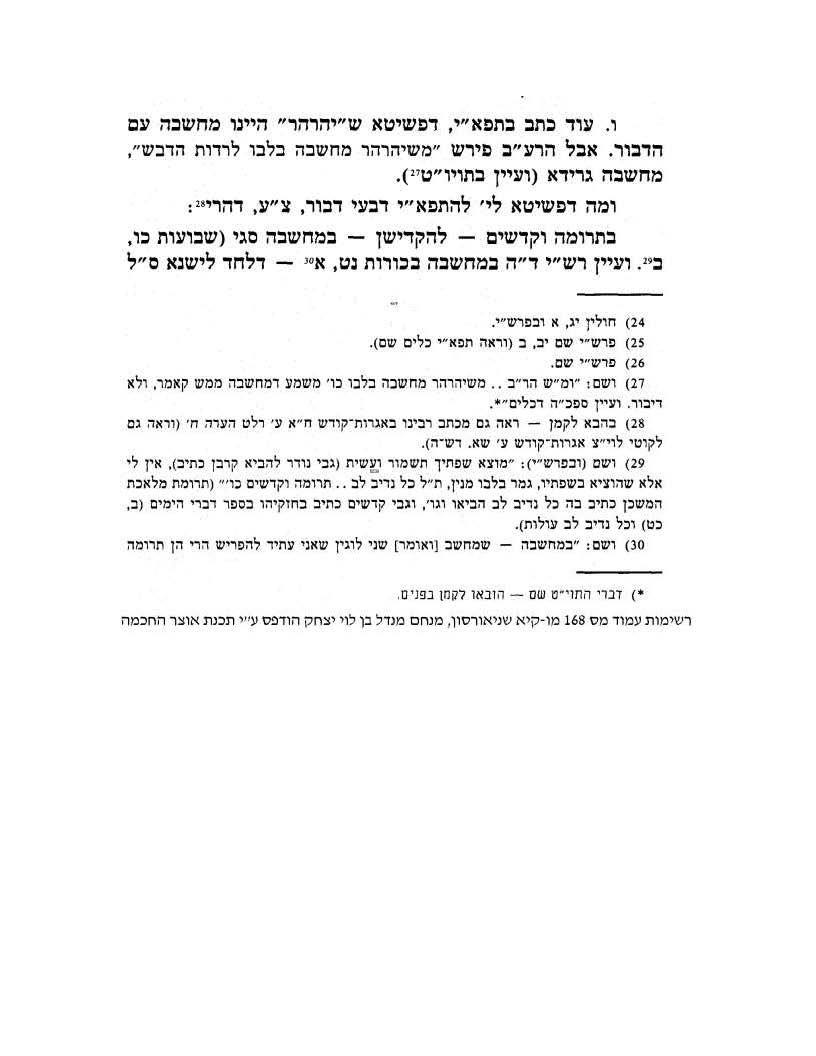
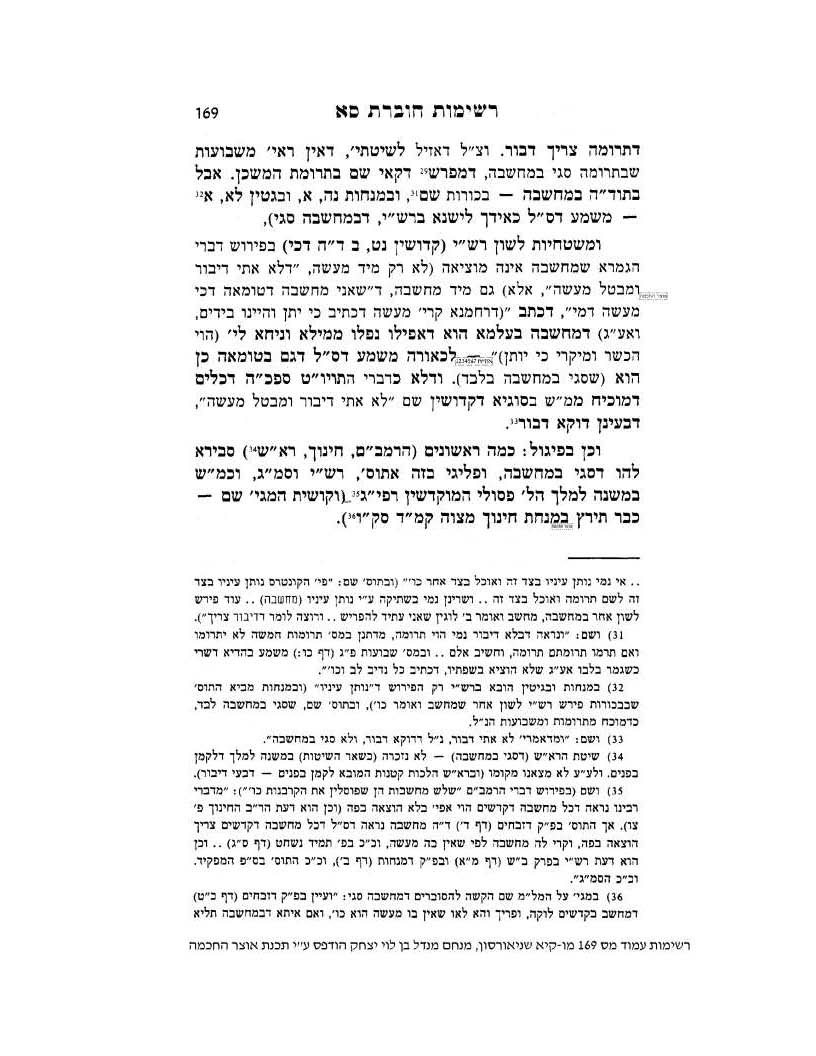
4- Our Gemara mentions that Terumah can be effected ‘be’mach’shava’. Just by thinking about the amount one wants to designate as Terumah is sufficient to crate Terumah. No verbalization is needed.

mind-bending-geller-spoon-1746602


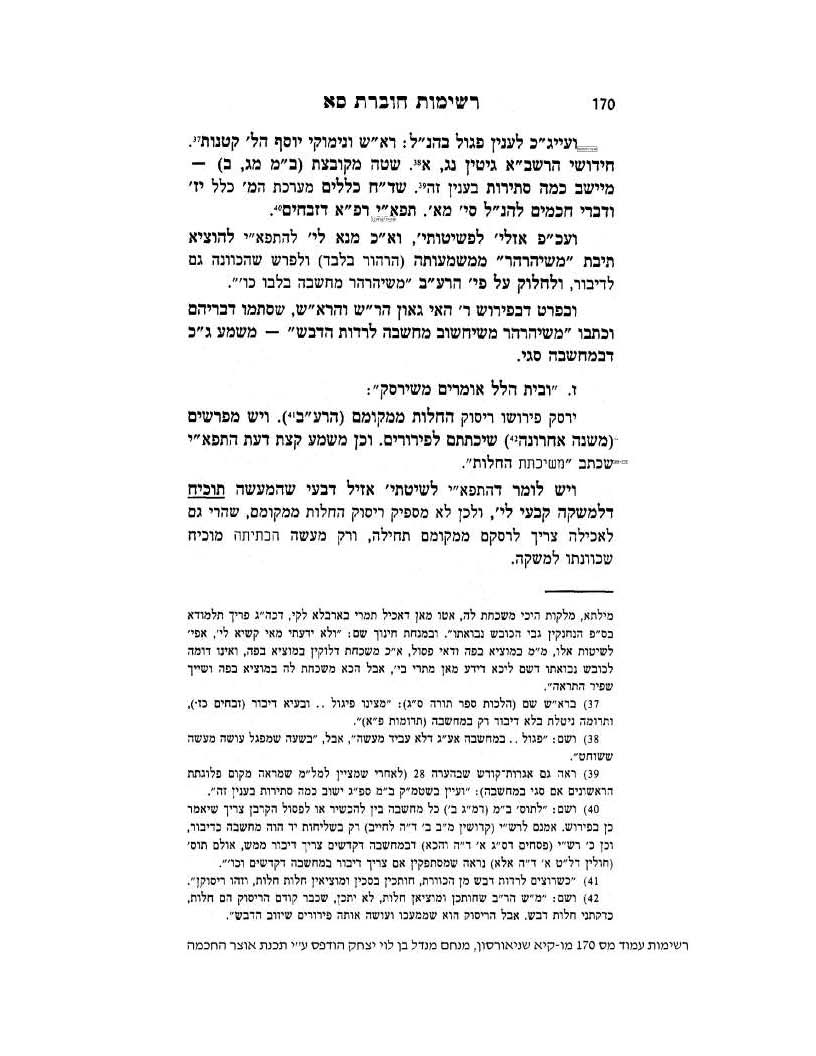
We spent a while going over the long history of the Rebbe’s writing on this issue. His letters to his father Reb Levik. The responses of Reb Levik. The footnotes. The Rebbe’s foot note to Likutei Torah. His reference to “my notebook regarding Mach’shovo”.


See attached.

%d7%a7%d7%99%d7%93%d7%95%d7%a9-%d7%91%d7%9e%d7%97%d7%a9%d7%91%d7%94-%d7%90%d7%95-%d7%91%d7%a4%d7%94-002_page_1 %d7%a7%d7%99%d7%93%d7%95%d7%a9-%d7%91%d7%9e%d7%97%d7%a9%d7%91%d7%94-%d7%90%d7%95-%d7%91%d7%a4%d7%94-002_page_2 %d7%a7%d7%99%d7%93%d7%95%d7%a9-%d7%91%d7%9e%d7%97%d7%a9%d7%91%d7%94-%d7%90%d7%95-%d7%91%d7%a4%d7%94-002_page_3 %d7%a7%d7%99%d7%93%d7%95%d7%a9-%d7%91%d7%9e%d7%97%d7%a9%d7%91%d7%94-%d7%90%d7%95-%d7%91%d7%a4%d7%94-002_page_4 %d7%a7%d7%99%d7%93%d7%95%d7%a9-%d7%91%d7%9e%d7%97%d7%a9%d7%91%d7%94-%d7%90%d7%95-%d7%91%d7%a4%d7%94-002_page_5 %d7%a7%d7%99%d7%93%d7%95%d7%a9-%d7%91%d7%9e%d7%97%d7%a9%d7%91%d7%94-%d7%90%d7%95-%d7%91%d7%a4%d7%94-002_page_6 %d7%a7%d7%99%d7%93%d7%95%d7%a9-%d7%91%d7%9e%d7%97%d7%a9%d7%91%d7%94-%d7%90%d7%95-%d7%91%d7%a4%d7%94-002_page_7


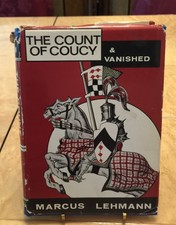
 5- We mentioned the Reb Shimshon of Coucy mentioned in Tosfos 13,a. We all grew up with the Lehman novel about the Count of Coucy and in Hebrew ‘Hasar Mi Kitzy” 

Image result for the count of coucy

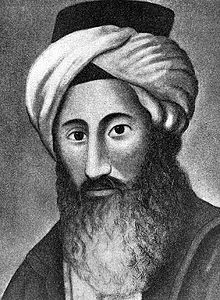
The Chida”h writes that he once saw it written that in truth this Reb Shimshon was not a count. It is just that his abbreviated name is HA”RA”SH. This word can also also mean “the pauper”. To avoid this negative connotation they switched the letters around and it became “HASAR“! Meaning the count or minister. The rest is history. 

(Note: in the Shiur of 02/09/16 we mentioned the answer of the Chida”h on why we have 2 days Rosh Chodesh).

Chaim Yosef David Azulai.jpg
Chaim Yosef David Azulai – Chida”h

Similarly he writes that originally Rashi whose name was Reb Shlomo was known as the R”ASH. As above, it was switched by adding a YUD, to RASHI. Perhaps the YUD was to mention his father, Reb Yitzchok. 

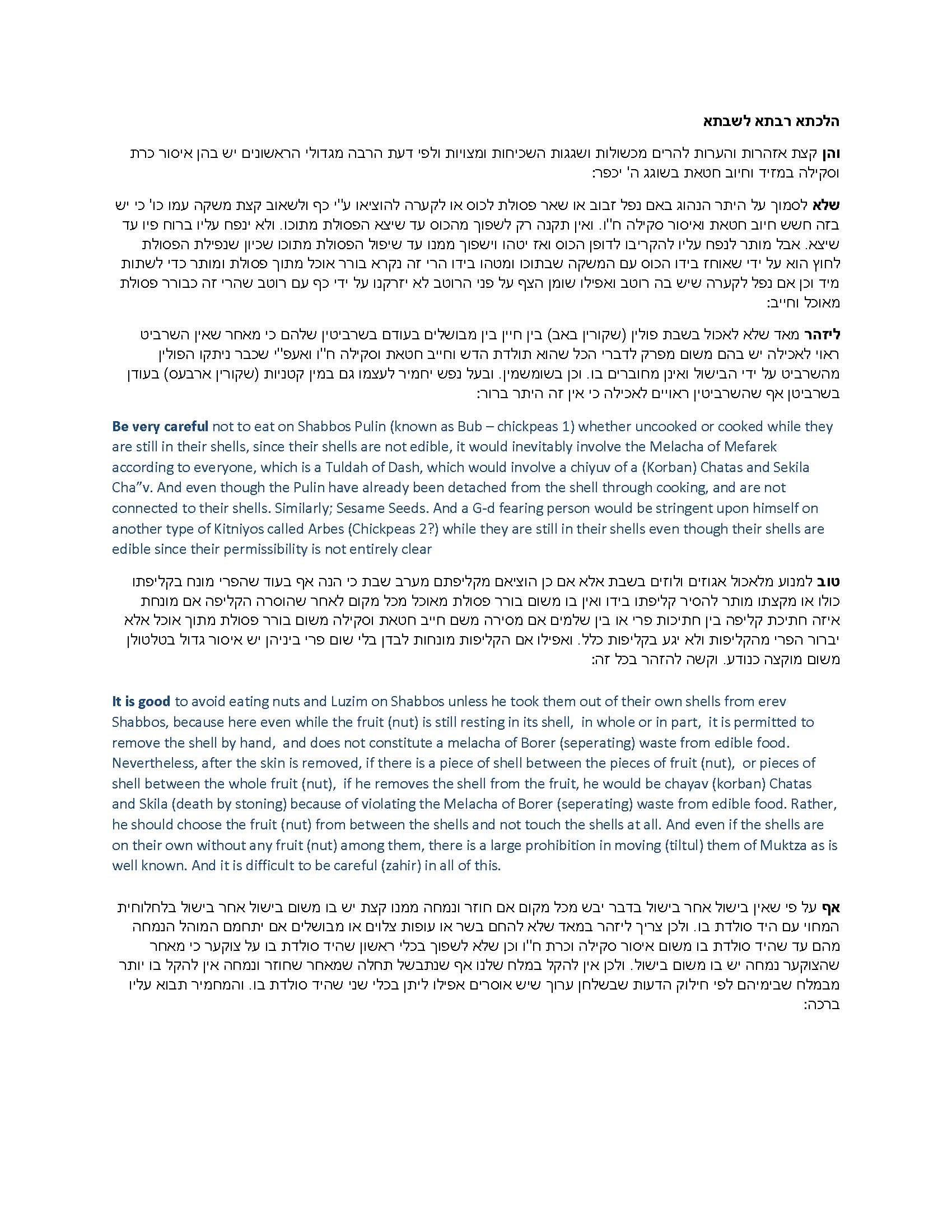
6- We began to study one of the Halochos of Shabbos which the Alter Rebbe placed in his Siddur. 

See attached.

%d7%94%d7%9c%d7%9b%d7%aa%d7%90-%d7%a8%d7%91%d7%aa%d7%90-%d7%9c%d7%a9%d7%91%d7%aa%d7%90

Shiur 8/24/16 Beitza 12b

Beitza 12,b.

1- We spoke about the two categories of ‘gifts to the Kohen’.

a- Terumah and Maaser.

b- Chala and Matnos Kehuna.

Image result for bringing gifts

2- We spoke about the Trumas Hadeshen that derives from the Rashi in our Gemara that any ‘gift to the Kohen’ that remains “chulin” (category b) are not limited to be given on that particular date.

For example: Pidyon Haben: Ideally, this mitzva should be performed on the 31st day. But if the 31st day falls on a Shabbos, since the Chachomim prohibited a Pidyon Haben on Shabbos because it is similar to a business transaction, then it’s OK to push it off to Sunday.

Image result for 31st day

3- We discussed the Trumas Hadeshen’s suggestion of giving the money to the Kohen on Friday with the condition that the transaction occur only on Shabbos. He strikes that idea because the Brochos are problematic:  Saying it on Shabbos defeats the purpose. One can’t say it on Friday since nothing has happened yet. To say it on Sunday is after the fact.

4- Now, this idea, is of relevance to commerce on Shabbos where the seller does nothing.

Image result for internet sales

As mentioned, the Trumas Hadeshen,  the Brochos issue aside, seemed to say that there would be  nothing wrong in setting up a scenario before Shabbos that will register a business transaction on Shabbos!

Reb Akiva Eiger writes on this topic.

Image result for chiclets vending machine

5- We mentioned the frum vendor, Mr. Davidson, that had the Chiclets franchise in the NYC Subways in the 50’s. He loaded the machines and people would drop pennies to buy the gum on Shabbos .

Image result for chiclets vending machine

Was this “selling on Shabbos” that is strictly forbidden? Or perhaps permitted since the seller does nothing…

Image result for chiclets vending machine

From Chiclets to selling on the the internet…….

Shiur 8/16/16 -Beitza 12a-b

Beitza 12a-b

1- We continued the sugya of Mitoch.

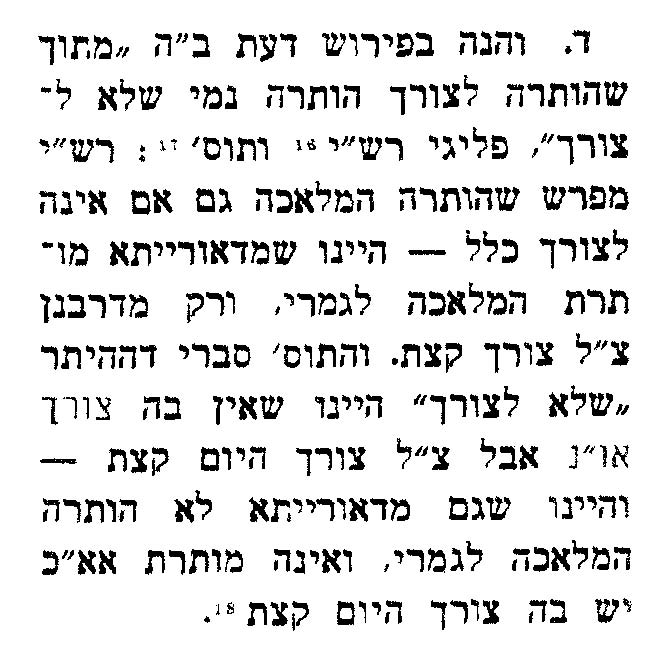
Spoke about the halacha follows Tosfos’ opinion that although one can perform ‘work’ not directly associated with the preparation of food (such as carrying a Lulav) nevertheless there needs to be a ‘bit of a need’ associated with Yom Tov.


Playing ball in a Reshus Horabim is thus permitted only because it is obviously enjoyed by the players.
seferid_15936_page_44
in the words of the Rebbe…Liku”S,11 p36 

Work that serves no purpose at all is Biblically prohibited.

2- We spoke about the prohibition of carrying keys. The Ramo in Shulchan Aruch states that carrying keys to alleviate the fear of loss is permitted. We discussed the Mogen Avrohom and the Taz who prohibit it, and the Alter Rebbe’s ruling that this applies only to items not used on Yom Tov. Such as keys to a safe.

House keys are not a problem.


3- Finishing the sugya of Mitoch we mentioned a story fascinating we once heard. Just found it on the web!

On today’s daf we find that Beis Hillel holds that since carrying is permitted for the purpose of אוכל נפש on Yom Tov, it is also permitted to carry for purposes that have nothing to do with  אוכל נפש . This principle is abbreviated as מתוך as is quoted in full above, “Since = מתוך carrying has already been permitted for the purpose of  אוכל נפש , it has been permitted for the purpose of non אוכל נפש  “.

During the last year of the life of the Chasam Sofer, zt”l, his students asked that he learn Masseches Beitzah with them. The gadol said to his students, “You must know that it is to your disadvantage that you’ve chosen that particular masechta. But seeing as it is what you all prefer and you are determined that I learn it with you, I will do so.” 

They began their study, and when they reached Beitzah 12, the daf that discusses the concept of מתוך ,the Chasam Sofer passed away and his holy soul ascended to the yeshivah shel ma’alah. His students all agreed that what had happened was alluded to in the words of Chazal in Berachos 31a: “A person should only depart from his friend while involved in “מתוך“of אל יפטור אדם מחבירו אלא :halachah הלכה דבר מתוך .Somehow, the Chasam Sofer had known that when he reached the principle of מתוך in Masseches Beitzah, he would take his leave of his students!

4- The next Mishna we began discusses the carrying on Yom Tov of the items we give to a Kohen such as Challa separated from a batter of dough and the ‘Matnot Kehuna‘ of a slaughtered animal. Namely the cheek & tongue, right front leg and the stomach.

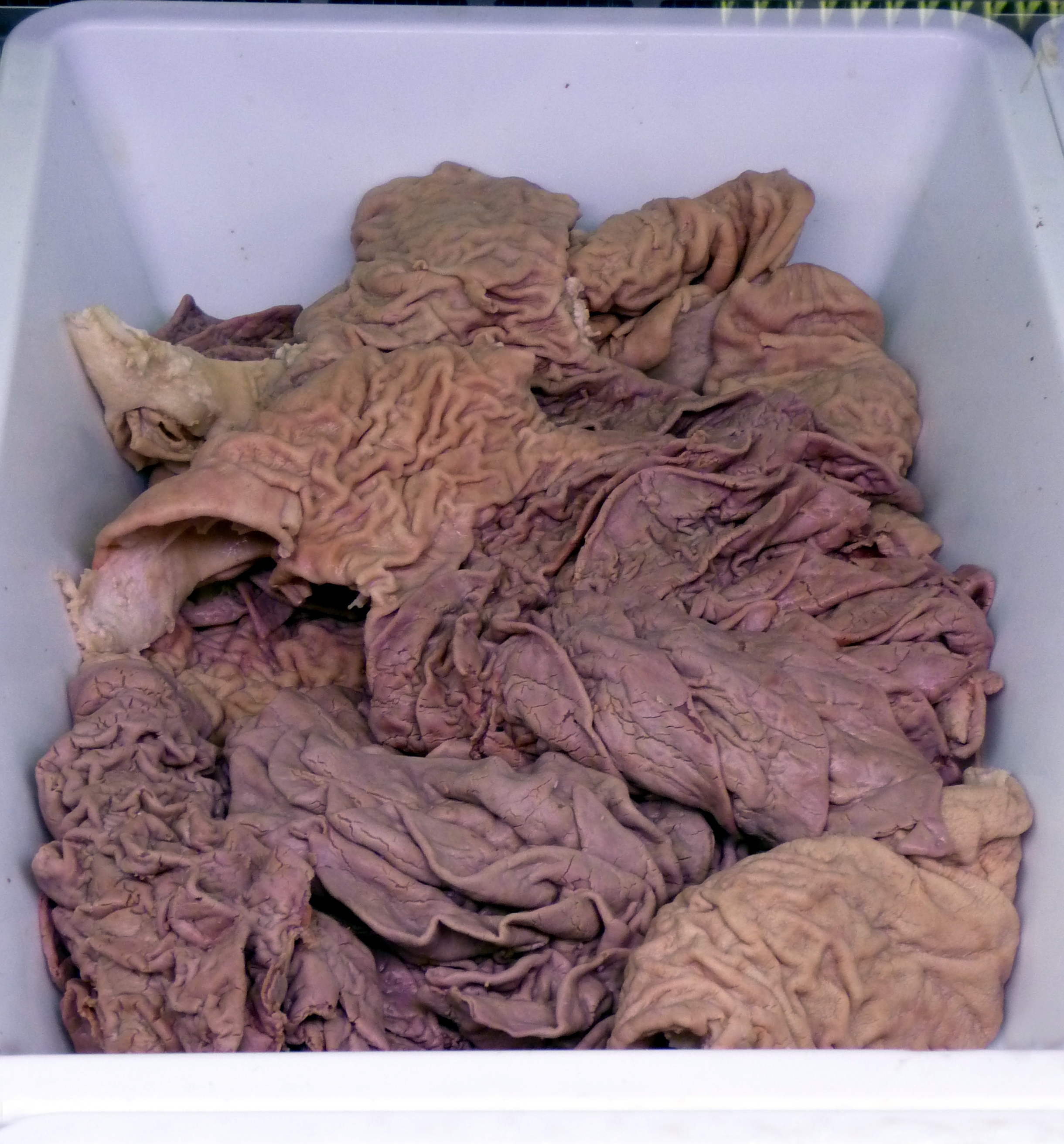
Zeroa

5- Lengthy discussion as to a perplexing phenomenon as to why we rarely see the mitzvah of Matnot Kehuna‘ performed nowadays despite it being plainly stated in the Shulchan Aruch that this Mitzva is mandatory Min Hatorah today!  The problem is even greater in Israel since meat slaughtered there all are in agreement that it is mandatory to gift ‘Matnot Kehuna‘to a Kohen.

“Keivos”

Additionally, unlike Challah that only a Kohen Tahor may eat, (which is the reason we burn it nowadays), the ‘Matnot Kehuna‘ – if these parts of the animal would indeed be gifted to the Kohen, he would actually have meat on his dinner table.

…and Lechaim

We mentioned the minhag in a few rare places where they would ‘gift it to the Koshen and then buy it back for a symbolic amount‘.

See here in Hebrew.


Shiu 8/9/16 Beitza 12a

Beitza 12a,

1- We continued the sugya of “mitoch’.

In the Mishnah, Beis Hillel permits carrying a child, Lulav, or Sefer Torah into Reshus ha’Rabim on Yom Tov because of the principle of “Mitoch.”

4


Mitoch” states that since a Melachah is permitted by the Torah on Yom Tov for the sake of food preparation, that Melachah is permitted even for matters unrelated to food preparation. Beis Shamai disagrees and prohibits any Melachah unrelated to food preparation.

2- The Gemara states that shechting a korban Olah on Yom Tov (even a korban that is a chiyuv such as ‘olas re’iya’) one is chayev malkus.

We diverted to discuss the Halacha that even a non-Kohen is permitted shecht in the Beis Hamikdosh. Mentioned the Tosfos (Zevochim 31b) that takes issue with this possibility since all non-Kohanim were limited on how deep they were allowed into the ‘azoro‘-  courtyard. So those animals that needed to be shechted close to the Heichal would preclude a non-Kohen from its shechita!

Tosfos discusses the possibility of this ‘zor’ using a very long knife. We spoke about the availability of metal at that time that would not sag and the prohibition of the chalaf to go in a downward motion. Also wondered if any Rov would allow such a shechita today.

3- We spoke about the leniency of ‘mitoch‘ that allows a melacha on Yom Tov as long as there is some necessity or enjoyment that is universally accepted. That would exclude, as the Mishna states (22b), burning incense or spices on coal since it is something that is limited to the people that enjoy such scents.

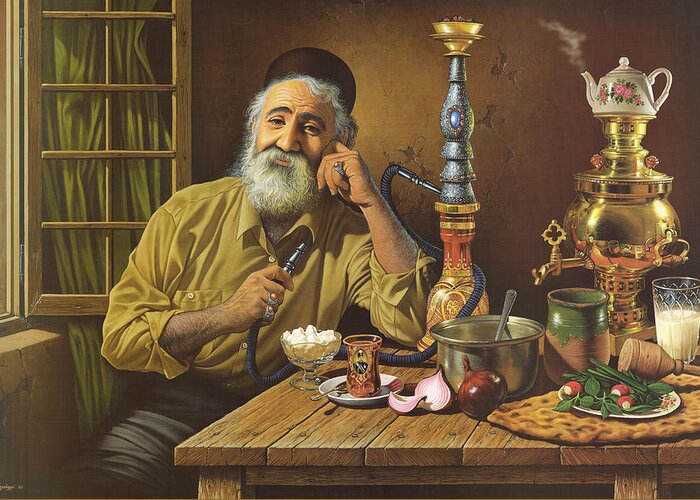
Persian Photography Greeting Card featuring the painting Old Man Smoking Water Pipe by Salma

4- From there we went to the “drinking tobacco” which we know as a nargila. We mentioned the Kesav Sofer who permits it although it is only enjoyed by few people nevertheless since its ultimate benefit is for health purposes using the nargila is considered universal because everyone wants to be healthy!

5- We mentioned the connection or Reb Akiva Eiger, the Chasam Sofer and their descendants to Chabad. Reb Menachem Mendel, the son of the Rebbe Maharash married a daughter or niece of the Chasam Sofer.

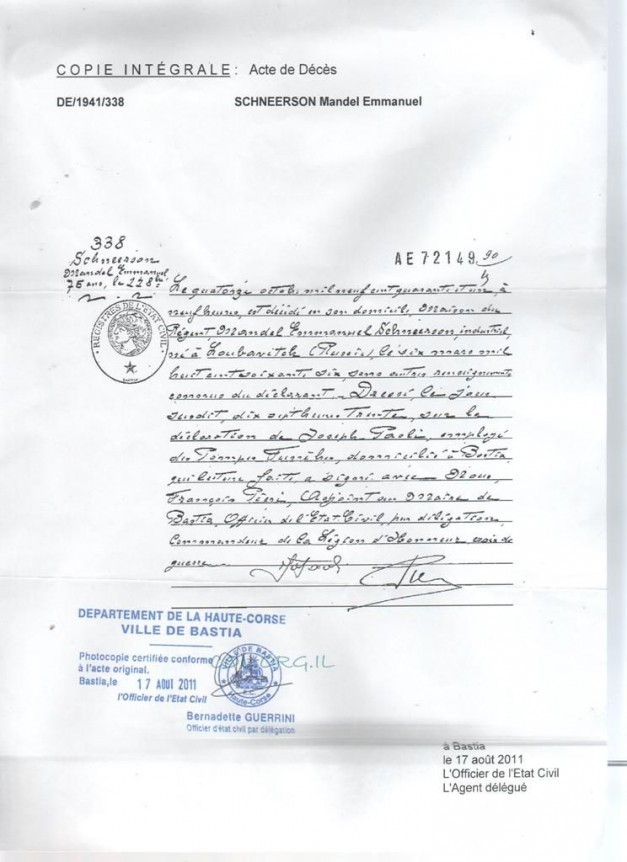
6- We related the mysterious and tough life of Reb Menachem Mendel, son of the Rebba Maharash, and his passing away on the island of Corsica and the Rebbe’s efforts to secretly transfer his body to Tzefas.

See here in Hebrew.

His death certificate

Menachem son of Maharash Death Cert2


5- We began to speak about smoking on Yom Tov originally permitted as the thinking was that it had health benefits. What about today?  Many great Rabbonim prohibit it.

6- We concluded with the fascinating explanation of the Rebbe as to why the Rambam neither lists the building of the ‘Aron‘ as a mitzvah nor does he explain how to build it.

The nekudah is that since the original

Aron‘ was hidden under the Beis Hamikdash we therefore have 2 ‘Kodesh haKodoshims’.  One above ground as the place for ‘Aron‘ during the time of peace and one underground for the ‘Aron‘ to be hidden during the period of strife.


Thus, after the first ‘Aron‘ was constructed there would never be the possibility of the need to build a new ‘Aron‘ as the original one still exists!


Shiur 8/2/16 – Beitza 11b – 12a

Beitzah 11b-12a.

1- We concluded the section concerning the 3 or 4 halachos where the ‘means justifies the end’.

The Gemara explains the two types of stall/box closures/doors.  One type is permitted to be removed and returned to cover the box. The other is prohibited.

Basically these doors are a flat rectangular board. It can be made with one peg protruding out of the center of one side of the board, or it can be made with two pegs protruding from two opposite sides, one at the top corner of the board and one at the bottom corner of the board.

figure a
Figure A


Figure B
Figure B

Rashi  explains that the reason why one is prohibited to replace a door with two pegs at the sides is because it is “Domeh l’Binyan,” similar to an act of ‘building’. Even though the closet is not attached to the ground (and thus returning the door does not constitute a real act of building), it looks as though it is.

Tosfos says that it is prohibited because of a Gezeirah “Shema Yiska” — perhaps one will secure the door in its place by nailing it in, in which case one will have transgressed the Melachah of Binyan b’Kelim.

A door with two pegs is more prone for one to wedge the pegs permanently thus making this look like ‘construction’.

Shema Yiska

A door with two pegs is more prone for one to wedge the pegs permanently thus making this look like ‘construction’.

Shim

2- We began a new Mishna famous as the entry into the ‘sugya of Mitoch’.

In the Mishnah, Beis Hillel permits carrying a child, Lulav, or Sefer Torah into Reshus ha’Rabim on Yom Tov because of the principle of “Mitoch.”

Mitoch” states that since a Melachah is permitted by the Torah on Yom Tov for the sake of food preparation, that Melachah is permitted even for matters unrelated to food preparation. Beis Shamai disagree and prohibit it.

3- We prefaced the subject by first defining the meaning of work in general.

Hard at work.

On Shabbos it states: “Lo sa’se kol melocho”- so doing a melocha/work is prohibited. But we know that carrying a feather in a Reshus ha’Rabim is considered work but moving a heavy couch in a Reshus Hayochid is not.

So what defines prohibited work?

The simple answer is that  the parameters of ‘work’ that is prohibited on Shabbos is defined no less than by the Torah itself. And that is only the 39 melochos. Anything else, despite the toil and sweat it produces is not considered ‘work’.

4- What about Yom Tov? What is considered ‘prohibited work’? The prohibition to work on Yom Tov is expressed in the same language as on Shabbos. “Lo sa’se kol melocho”.

But the flip side is that the Torah explicitly permits to perform (some of) the 39 melochos  ‘for the sake of food preparation’.

So here is the question:

Does that mean that when performing a melacha for food on Yom Tov one is indeed doing a melacha but one that that is permitted?

Or any melacha  associated with the preparation of food it is not considered work to begin with?

In other words – is work associated with food a reason for the permissibility or is it a sign that such actions, in regards to Yom Tov at least, not considered a melacha to begin with?

If someone is fasting on Yom Tov: If the performing of a melacha for food on Yom Tov is considered work but one has a ‘pass’ because the purpose of performing this work with the food is in order to eat it, then one who is fasting would not be permitted to do this work or melacha.

On the other hand if such a melacha is not considered a melacha to begin with, then this non-eater would still be allowed to do this work since he is not performing any malacha or ‘work’.

5- We mentioned that this query was first brought up by Reb Meir Orbach (and here) to explain the argument of Beis Shamai and Beis Hillel of our Mishnah if, for example, one can carry a child on Yom Tov. Beis Hillel permits it because since carrying can be used to move food in and out of a house this is a sign that carrying is not defined as work to begin with.

6- We mentioned the Sicha of the Rebbe where he discusses this idea and the Alter Rebbe’s opinion about this.

See here. http://www.hebrewbooks.org/pdfpager.aspx?req=15936&st=&pgnum=42

(Also, in the Likras Shabbos, page 16.)

http://likras.org/files/18528_32056.pdf


Shiur 07/26/16 – Beitzah 11b

Beitzah 11,b.


1- Mishna concerning the removal/return of the doors of the shopkeepers box-stalls on Yom Tov.


2- Ula’s general statement that 3 prohibitions were permitted because have they not been allowed, it would have caused the lack of an observance to begin with.

A reverse of ‘the end justifies the means’.


For example – after an animal was shechted on Yom Tov we allow the handling of its hide (and placing it at the door to be trampled on which is part of the tanning process) despite it being muktze.

For had we prohibited the handling of the hide one would not shecht to begin with, least he loses value of the untouched hide. Not shechting on Yom Tov diminishes simchas Yom Tov.

The means (shechita) thus justifies the end (tanning).

3- We mentioned that Reb Akiva Eiger notes an additional situation where such a reasoning is applied.

As we learned in Rosh Hashana people that see the appearance of the new moon are permitted to be mechalel Shabbos to make their way to the Beis Din.

Once they testify they cannot be mechalel Shabbos to return home. Only on the prohibition of the laws of techum (2000 amos) can one be lenient.


Ancient Techum Marker

Why this leniency? Because were we not to allow them to return home they would not have come to the Beis Din to begin with.

Again, the means (kiddush hachodesh) thus justifies the end (techum).


4- From here we went to discuss the issue of Hatzolah; if they are permitted to drive back once they drop of the patient at a hospital. The rational to allow the return by ambulance is that if prohibited the members would be reluctant to drive to the hospital on Shabbos.

5- The Amora ‘Rachva’ adds a fourth case where the means justifies the end.  The case concerns a wine vat opened on Yom Tov when the laws of the schism between the ‘chover’ and the ‘am ha’aretz’ were relaxed in Yerushalayim.

We discussed the concept of a ‘chover’ and tried to understand how these people lived. Did their shying away from the ‘am ha’aretz’ cause strife and animosity?Their membership, the initiation rites, the ability for someone that lost his membership (due to non-compliance) to rejoin, the status of a woman ‘chover’ etc.


Shiur 07/19/16 – Beitzah 11a

Beitzah 11a.

1- Our topics were on two issues concerning the hide and fats of an animal that was shechted on Yom Tov.


2- Preparing the hide (tanning) for use involves some melochos which are prohibited on Yom Tov, resulting in the hide being muktzeh. On the other hand, not to do anything with the hide would cause it to spoil.

Thus the difference of opinions concerning the movement of the hide. Beis Hillel allows the placing of the hide at the door for people to step on. The reason being that if this minimum of handling is prohibited one would simply not shecht on Yom Tov which would in turn cause a lack of simchas Yom Tov.


Salting

3- Part of the tanning process is the salting of the skins. Our Gemara discusses if one would be allowed to salt meat on top of the hides so that any salt which falls off would indirectly land on the hide…..

4- We discussed the famed question of Reb Akiva Eiger concerning the requiring of salting of meat. Salting must be done on both sides. When salting, say, a 10 inch wide piece of meat, we assume that the salt on one side penetrates 5″ into that side. Ditto for the salt on the other side and thereby both together desalting the entire 10″.

So if salt has the power to desalt to a depth of 5″ why does one need to salt  both sides of a piece of meat that is only 5″ thick?!

And the answer to that is that the salt on both sides work in unison. Only by salting both sides at the same time does the salt reach the middle of the chunk of meat.

So his question is: if one, for whatever reason, salted only one side, in order to rectify this error,  the halacha is that he now needs to salt the other side. It seems that he can do it hours after he originally salted the first side. But what will salting the other side accomplish now? The salt on the original side has already dissipated and lost its extraction capabilities. So the halocho should have been stated that he needs to redo and salt both sides!

5- We spoke about the chemical that completely removes the blood of meat rendering the meat totally white and it’s halachik implications. Also mentioned the Rinse and Chill process and the controversy in 2009 about using it for kashering. See attached. Rinse and Chill-Rabbi Weissmandl

6- We went on to discuss a truly interesting and rare phenomenon in the Alter Rebbe’s Shulchan Aruch where he takes to task (rather harshly) a great scholar who attempted to argue with the Magen Avraham regarding the halacha of nolad on Yom Tov.

1 and 2

Ari Chitrik Shiur Points